Shopify support AI for UK retailers: a decision guide
The most effective route to adding AI-powered support to a Shopify store in the UK is a hybrid approach: use Shopify's built-in AI and app ecosystem for standard, table-stakes tasks, and commission custom AI agents where your customer experience or workflow automation is a genuine competitive differentiator.
Verdict at a glance:
- Pilot (6–8 weeks): Deploy a focused proof of concept on one high-volume use case, such as order tracking or returns, using existing Shopify data.
- MVP (3–4 months): Extend to chat, email, and RAG across your product catalogue and knowledge base; integrate one or two third-party systems.
- Production rollout (6–12 months): Full multi-channel deployment with voice, CRM integration, GEO optimisation, and SLA-backed support.
- Immediate action: Draft a one-page pilot brief, appoint a commercial lead and a technical lead, and open procurement within the next two weeks.
Table of Contents
- What can Shopify support AI actually do for your store?
- Build vs buy: which approach fits your Shopify store?
- How do you connect AI agents to Shopify's technical stack?
- What does UK data protection require before you go live?
- What do pilots, MVPs and full rollouts cost in the UK?
- How do you pick the right UK partner for Shopify AI support?
- Which KPIs should you track after launch?
- What do end-to-end AI agent workflows look like in practice?
- What are the concrete next steps to start a pilot?
- Key takeaways
- The part most procurement briefs get wrong
- Real-studios: from pilot brief to production agent
- Further reading and authority sources
What can Shopify support AI actually do for your store?
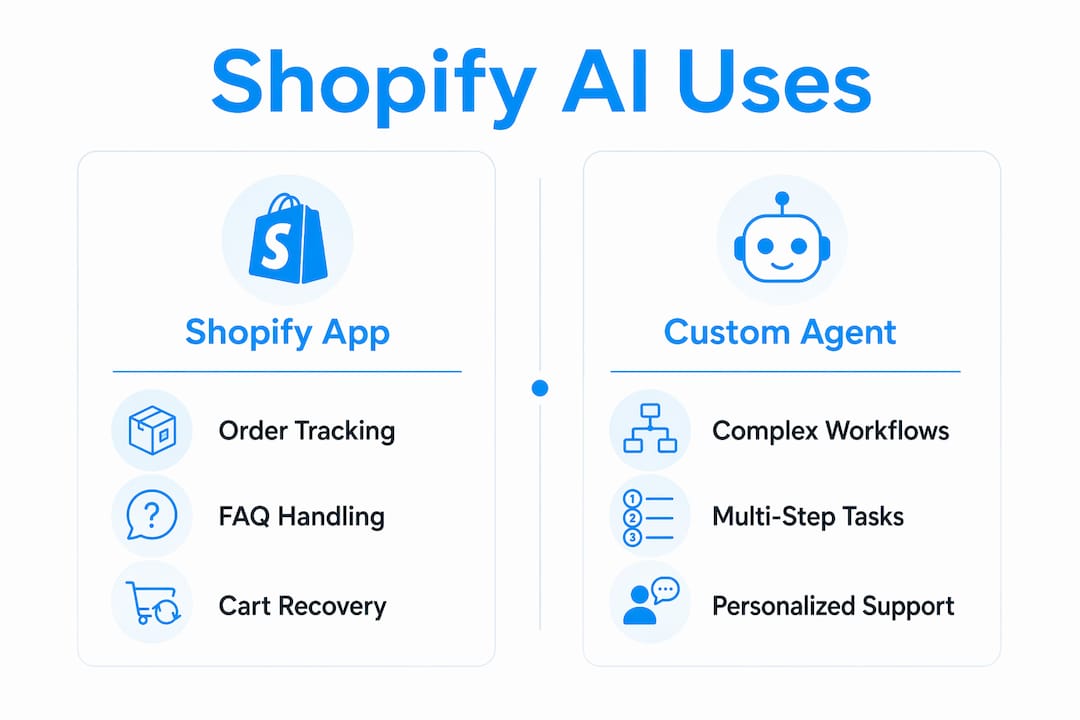
Shopify support AI covers five practical capability areas: conversational chat, email automation, voice, retrieval-augmented generation (RAG) for product and order data, and cross-system workflow automation.
Chat handles product discovery, cart recovery, and FAQ resolution in real time. Email automation triages inbound queries, routes them, and drafts or sends responses without human intervention. Voice agents manage inbound calls for order status and simple returns. RAG connects the agent to your live product catalogue, order history, returns policy, and knowledge base so answers are grounded in your actual data rather than generic responses. Cross-system automation is where the real operational value sits: an agent that connects Shopify to your 3PL, CRM, and payment processor can execute a refund, update a fulfilment record, and send a confirmation email in a single workflow.
The commercial case is well-evidenced. A correctly built AI chatbot integrated with Shopify can recover 10–20% of abandoned carts, lift conversion by 15–35%, and automate 60–80% of routine customer service tasks.
| Use case | Shopify app sufficient? | Custom agent justified? |
|---|---|---|
| Order status / tracking | Yes | No |
| FAQ and returns policy | Yes | No |
| Cart recovery with personalisation | Partial | Yes, above £1M revenue |
| Multi-step refund and 3PL update | No | Yes |
| Voice support | No | Yes |
| RAG over proprietary product data | No | Yes |
Build vs buy: which approach fits your Shopify store?
Choose a hybrid when AI is partly a differentiator. Use platform features for non-differentiating tasks and build proprietary agents for the workflows that set your brand apart.
The cost gap is significant. Custom development typically costs 3–5x more than Shopify Plus with AI apps over a five-year period. That premium is justified when the agent executes unique business logic that no off-the-shelf app replicates.
Quick decision checklist:
- Stores with lower revenue: start with marketplace AI apps; custom builds rarely amortise at this scale.
- Mid-range revenue stores: evaluate on a case-by-case basis; focus on one high-value workflow.
- Higher revenue stores: custom agents can become cost-effective when amortised across a longer period.
- Data control is a board-level concern: custom build gives you full data residency and IP ownership.
- Speed to market is the priority: Shopify-native tools deploy in days; custom agents take weeks to months.
Pro Tip: Treat "tools" and "agents" as distinct categories before you write an RFP. AI agents execute multi-step workflows across Shopify, your CRM, and your 3PL; tools generate content or single-step outputs. Buying a tool when you need an agent is the most common and costly procurement error in this space.
How do you connect AI agents to Shopify's technical stack?
The minimum integration surface is catalogue, orders, customers, and webhooks. Add 3PL, CRM, email platform, and payment connectors as your use cases require.

Shopify exposes four primary connection points for AI work. The Admin API gives authenticated access to orders, customers, products, and fulfilment data. The Storefront API powers customer-facing product discovery and cart operations. Webhooks push real-time events (order created, payment captured, refund issued) to your agent without polling. Shopify Flow handles rule-based automation within the platform itself.
For agentic commerce, Shopify Catalog and Agentic Storefronts syndicate your product data to AI channels including ChatGPT, Perplexity, and Microsoft Copilot. The Universal Commerce Protocol (UCP) standardises cart and checkout flows across AI platforms, so agents can build carts, apply localisation, and hand off to checkout without bespoke integrations per channel.
A typical support interaction that escalates to an automated refund flows like this: the customer message hits the agent via chat webhook → the agent queries the Admin API for order status → RAG retrieves the returns policy → the agent determines eligibility → it calls the refund endpoint → triggers a 3PL return label via API → sends a confirmation email via your email platform. No human touches the transaction.
On security: rotate API credentials on a defined schedule, apply least-privilege service accounts, enforce rate-limit handling with exponential back-off, and store secrets in a vault rather than environment variables. Replacing multiple point-to-point app integrations with a small number of well-architected AI agents also reduces latency and operational complexity.
What does UK data protection require before you go live?
Establish lawful basis, minimise your data surface, and document all data flows for RAG pipelines and conversation logs before launch. The UK GDPR and the Data Protection Act 2018 both apply.
Compliance checklist:
- Identify and document lawful basis for each processing activity (legitimate interests or contract performance are most common for support AI).
- Apply data minimisation: RAG pipelines should retrieve only the fields the agent needs to answer the query.
- Set retention schedules for conversation logs; do not retain indefinitely.
- Capture and record consent where you use conversational channels for marketing or profiling.
- Build data subject rights workflows: access, erasure, and rectification requests must be answerable within statutory timeframes.
- Maintain a Record of Processing Activities (ROPA) entry for each AI agent.
- Review the ICO's guidance on AI and automated decision-making before deployment.
Pro Tip: Design RAG pipelines with query-level redaction and retrieval filters. This prevents PII from customer records appearing in generated responses, which is both a GDPR risk and a brand risk if a customer sees another customer's data in a chat reply.
What do pilots, MVPs and full rollouts cost in the UK?
Pilots and MVPs are the low-risk path. Full production rollouts commonly take 6–12 months depending on scope and integration complexity.
| Stage | Typical duration | Indicative cost range | What's delivered |
|---|---|---|---|
| Pilot | typical duration | indicative cost range | Single use case, one integration, test data, KPI baseline |
| MVP | typical duration | indicative cost range | Multi-channel agent, 2–3 integrations, RAG, basic GEO |
| Full rollout | typical duration | indicative cost range | Voice, full CRM/3PL stack, GEO, SLA retainer |
Indicative ranges for UK market; actual costs vary by scope, data complexity, and vendor.
Subscription-based AI apps carry lower upfront cost but accumulate monthly fees and offer no IP ownership. Custom builds require capital expenditure but deliver proprietary logic and data control. For stores with higher revenue, the amortisation case for a custom build across multiple months is clear.
How do you pick the right UK partner for Shopify AI support?
Prioritise vendors with demonstrable Shopify API experience, RAG delivery capability, GEO experience, and UK GDPR readiness. Everything else is secondary.
Questions to ask in discovery:
- Can you show a working Shopify Admin API and webhook integration from a previous project?
- Do you have case studies showing containment rate and escalation rate improvements?
- Who owns the IP and code on completion? Is there a formal transfer?
- What does your post-launch SLA cover, and what is the incident response time?
- How do you handle GEO and model retraining after launch?
Red flags: opaque cost models with no fixed scope, reluctance to confirm IP transfer in writing, no demonstrable Shopify agent experience (not just chatbot experience), and no post-launch optimisation plan.
| Evaluation dimension | Entry-level app | Bespoke agent build |
|---|---|---|
| Cost (pilot vs production) | Low upfront, recurring fees | Higher upfront, lower ongoing |
| Time to launch | Days to weeks | 6–12 weeks for pilot |
| Customisation level | Template-based | Fully bespoke logic |
| Scope of support | Chat only, limited APIs | Chat, email, voice, RAG, automation |
| SLA and maintenance | Vendor-managed | Contractual SLA, dedicated support |
For multi-channel deployments that include AI SMS and receptionist capabilities alongside Shopify chat, confirm the vendor can coordinate across channels without duplicating customer records.
Which KPIs should you track after launch?
Track containment rate, escalation rate, response time, task completion accuracy, and commercial KPIs including average order value uplift, conversion rate, and recovered cart abandonment.
Monitoring routine:
- Daily (first four weeks): health checks on API error rates, agent response latency, and escalation volume.
- Weekly: optimisation cycles reviewing low-confidence responses, missed intents, and RAG retrieval quality.
- Monthly: GEO and relevance reviews to update knowledge base content, retrain on new product lines, and assess AI channel attribution in Shopify admin.
SLA essentials for a production contract: 99.5% uptime minimum, mean time to respond to incidents under two hours, a documented model-behaviour rollback procedure, and a defined support retainer scope covering both technical incidents and content updates.
What do end-to-end AI agent workflows look like in practice?
A well-built Shopify AI agent handles the full customer journey from discovery to post-purchase resolution without human intervention on routine cases.
Cart recovery workflow (numbered steps):
- Webhook fires when a cart is abandoned after 30 minutes.
- Agent retrieves cart contents and customer purchase history via Admin API.
- RAG queries the knowledge base for relevant product information and current promotions.
- Agent sends a personalised recovery message via email or SMS.
- Customer clicks through; agent answers follow-up questions in chat.
- Order completes; agent logs outcome and updates CRM.
Returns and refund automation:
- Customer initiates return via chat or email.
- Agent authenticates customer and retrieves order via Admin API.
- RAG checks returns policy eligibility against order date and product category.
- Agent issues return authorisation, triggers 3PL label generation, and initiates refund via Shopify Payments API.
- Confirmation sent; order record updated; case closed without human review.
The commercial impact of correctly deployed AI agents is measurable: automated support can recover 10–20% of abandoned carts, lift conversion by 15–35%, and automate 60–80% of routine service tasks, freeing your team for higher-value work.
What are the concrete next steps to start a pilot?
Draft a one-page pilot brief and convene a steering group of two to three people: a commercial lead, a technical lead, and a legal or data protection adviser.
Pilot brief template:
- Objective: one measurable outcome (e.g. automate 60% of order-status queries within eight weeks).
- Success metrics: containment rate, escalation rate, response time, and one commercial KPI.
- Systems to connect: Shopify Admin API, plus any third-party system required for the use case.
- Data access: confirm who owns data access permissions and how test data will be anonymised.
- Budget envelope: agree a ceiling before approaching vendors.
Suggested timeline: week one to two, internal brief and stakeholder alignment; week three to four, vendor shortlist and RFP; week five to six, discovery calls and proposal review; week seven, contract and kick-off. Legal and data protection sign-off should run in parallel from week one.
Key takeaways
A hybrid approach, combining Shopify-native AI for standard tasks with custom agents for differentiating workflows, delivers the best balance of speed, cost, and competitive advantage for UK retailers.
| Point | Details |
|---|---|
| Hybrid is the default | Use Shopify-native tools for hygiene tasks; commission custom agents where automation is a differentiator. |
| GDPR before go-live | Document lawful basis, data flows, and retention schedules before any agent touches customer data. |
| Revenue threshold for custom builds | Stores above £1–2M revenue typically justify custom agent builds amortised over multiple months. |
| Pilot first | A 6–8 week pilot scoped to one use case is the lowest-risk path to proving commercial value. |
| Real-studios as UK partner | Real-studios delivers pilot-to-production AI agent builds, RAG, GEO, and ongoing support for UK retailers. |
The part most procurement briefs get wrong
Most Shopify AI projects stall not because the technology fails, but because the brief was written for a tool when the business needed an agent. A content-generation tool that drafts product descriptions is not the same as an agent that authenticates a customer, checks their order, applies your returns policy, and triggers a refund in your 3PL. They are categorically different in architecture, cost, and delivery risk.
The second consistent failure is treating GDPR as a post-launch checklist item. In practice, the data flows for a RAG pipeline, the retention of conversation logs, and the consent model for proactive messaging all require legal sign-off before the first line of code is written. Projects that skip this step face costly rearchitecting at the worst possible moment.
Finally, GEO is underused. Shopify's Agentic Storefronts mean your products are now discoverable inside ChatGPT and Copilot conversations. If your knowledge base, product schema, and brand voice are not structured for AI retrieval, a competitor whose data is cleaner will appear instead of you. That is an optimisation problem, not a development problem, and it should be on the roadmap from day one.
Real-studios: from pilot brief to production agent
UK retailers who want to move from a scoped brief to a working AI agent without the overhead of managing multiple vendors will find Real-studios's pilot-to-production model a direct fit. Based in Manchester, Real-studios builds custom AI agents covering RAG, chat, email, voice, and workflow automation for UK businesses, with GEO built into every engagement so your brand surfaces correctly in AI-driven search and commerce channels.
A typical pilot engagement runs six to eight weeks: Real-studios handles discovery, engineering, and deployment; you provide data access, a named internal sponsor, and sign-off on the success metrics. IP and code transfer on completion. Post-launch, a structured service integration retainer covers model tuning, knowledge base updates, and GEO reviews on a defined SLA.
To request a scoped proposal for your Shopify AI pilot, contact Real-studios directly at real-studios.com.
Further reading and authority sources
- ICO — AI and data protection: ico.org.uk — the primary UK authority on lawful basis, automated decision-making, and data subject rights. Essential reading for legal sign-off.
- Shopify Agentic Commerce (developer docs): shopify.dev/docs/agents — technical reference for UCP, MCP servers, and the Shopify AI Toolkit.
- Shopify Agentic Storefronts announcement: shopify.com/news/winter-26-edition-agentic-storefronts — explains how Shopify Catalog syndicates product data to AI channels and how merchants control channel opt-ins.
- Agentic shopping for UK store owners: shopify.com/uk/blog/agentic-shopping — practical guidance on AI discoverability and product schema for UK merchants.
- Real-studios service overview: real-studios.com/Services — covers RAG, GEO, agent development, and automation retainers for UK businesses.