What is an MVP AI agent, and how do you build one fast?
An MVP AI agent is the smallest autonomous workflow that completes a real, multi-step task with a defined success condition, nothing more. Build one by scoping a single task, limiting tool access, adding a fallback, and validating with real inputs before you touch a second feature.
To start now, you need:
- One task with a measurable success condition
- 10 to 20 real examples of that task
- A single LLM, one tool integration, and a human fallback
- A way to log what the agent does
Key Takeaways
Shipping a working AI agent MVP depends on scoping one measurable task, building the smallest viable stack, and validating with real inputs before adding complexity.
| Point | Details |
|---|---|
| Scope one task | Choose a repeatable task with a clear success condition before writing any code. |
| Build six components max | LLM, orchestrator, one tool integration, optional vector database, input source, and logging. |
| Run three sprints | Discovery, then a working POC with guardrails, then a monitored limited pilot. |
| Budget by UK cost tier | Simple agents run £8,000 to £25,000; advanced ones exceed £75,000. |
| Bring in specialists when needed | Real-studios delivers discovery, guardrails, deployment, and GEO for complex or high-risk builds. |
Table of Contents
- What is an MVP AI agent, and when should you build one?
- What is the minimal architecture for an AI agent MVP?
- What does a sprint plan for an AI agent MVP look like?
- What do you need before starting an AI agent MVP build?
- Which frameworks and tools should you use to build the agent?
- How do you validate an AI agent MVP?
- What does an AI agent MVP cost, and how long does it take?
- When should you bring in a specialist consultancy?
- What UK data privacy rules apply to AI agents?
- How Real-studios turns your AI agent MVP into a working pilot
- Where to go next for code, demos, and cost detail
- Frequently asked questions
- Sources
What is an MVP AI agent, and when should you build one?
An AI feature answers a question. An AI agent MVP takes action: it calls tools, chains steps, and moves a task from start to finish without a person driving each click. That distinction is what separates a chatbot from a functioning agent, and it's the one most teams get wrong early. The MVA (Minimum Viable Agent) approach treats this as a distinct discipline from standard MVP building: ship one outcome, for one user, on one path, per the Minimum Viable Agent framework.
Build an agent MVP when the task is repeatable, high-frequency, and has a clear pass/fail condition. Good early candidates include:
- Email triage and routing by intent
- Lead qualification against fixed criteria
- First-line ticket resolution with escalation
If the task can't be scored objectively, you're not ready to automate it yet.
What is the minimal architecture for an AI agent MVP?
Six components, no more, prove or kill an agent MVP:
- LLM: the reasoning engine driving decisions and language generation.
- Planner/orchestrator: sequences tool calls and manages the task loop.
- Tool integration layer: connects the agent to APIs, databases, or actions it needs to take.
- Vector database: optional, only needed if the agent must retrieve knowledge (RAG).
- Simple UI or input source: a form, Slack channel, or email inbox is enough.
- Monitoring and logging: tracks every decision so you can see where it fails.
Everything else, memory systems, multi-agent handoffs, fine-tuning, gets deferred until the core loop proves reliable. A minimal stack might pair OpenAI for reasoning, a lightweight orchestration script for the planner, one API integration, and a spreadsheet or simple dashboard for logging. That's a working POC, not a placeholder.
What does a sprint plan for an AI agent MVP look like?
A scoped agent typically takes 10 to 16 weeks end-to-end, according to guidance on validating an agentic product, though a ruthlessly narrow scope can compress that into a single week using a day-by-day plan for an agentic MVP in one week. Three sprints get you from idea to pilot:
- Sprint 0 (discovery): write the outcome spec, gather 10–20 real examples, and run feasibility checks against your chosen LLM.
- Sprint 1 (POC): build the core loop against real inputs, add basic guardrails, and shadow-test with human review on every output.
- Sprint 2 (limited production): add monitoring, escalation paths, cost caps, and run a small pilot against fixed acceptance criteria.
| Sprint | Primary deliverable | Go/no-go check |
|---|---|---|
| Sprint 0 | Outcome spec + sample set | Feasible with chosen LLM and data? |
| Sprint 1 | Working end-to-end POC | Completes task on real inputs with guardrails? |
| Sprint 2 | Piloted, monitored agent | Meets completion and intervention thresholds? |
Each sprint ends with a decision, not a demo. If Sprint 1 can't complete the task reliably on messy real inputs, don't move to Sprint 2, fix the loop first.
What do you need before starting an AI agent MVP build?
Before Sprint 0 begins, gather the essentials:
- 10 to 20 real, messy examples of the task, not synthetic ones
- API access and authentication for the one system the agent must touch
- A defined limit on tool access (one integration at MVP stage, not five)
- Audit logging from day one
- A human-in-the-loop fallback for anything the agent can't resolve confidently
Skipping guardrails to save time is the single most expensive shortcut in agent development, because a mistake at scale costs more than the week you saved.
Pro Tip: Collect your 10 to 20 validation examples from actual historical data, old support tickets, real emails, logged transactions, never from examples you write yourself. Agents trained or tested against tidy hypothetical inputs fail the moment they meet real ones.
Which frameworks and tools should you use to build the agent?
Framework choice matters less than scope discipline, but a few tools consistently speed up MVP builds:
- LangChain: the standard for chaining LLM calls and tool use in an orchestration layer.
- LlamaIndex: purpose-built for retrieval-augmented generation when your agent needs a knowledge base.
- OpenAI: the fastest route to a working reasoning engine for a first POC; skip fine-tuning at this stage.
- Hugging Face: worth exploring for open models when token costs matter more than raw capability, and Hugging Face Spaces let you fork a working demo instead of building from zero.
- Pinecone and Weaviate: solid vector database choices, but only add one if your agent genuinely needs retrieval, most single-task MVPs don't.
Pick tools you or your team already know. The framework is not where MVPs fail, the scope is.
How do you validate an AI agent MVP?
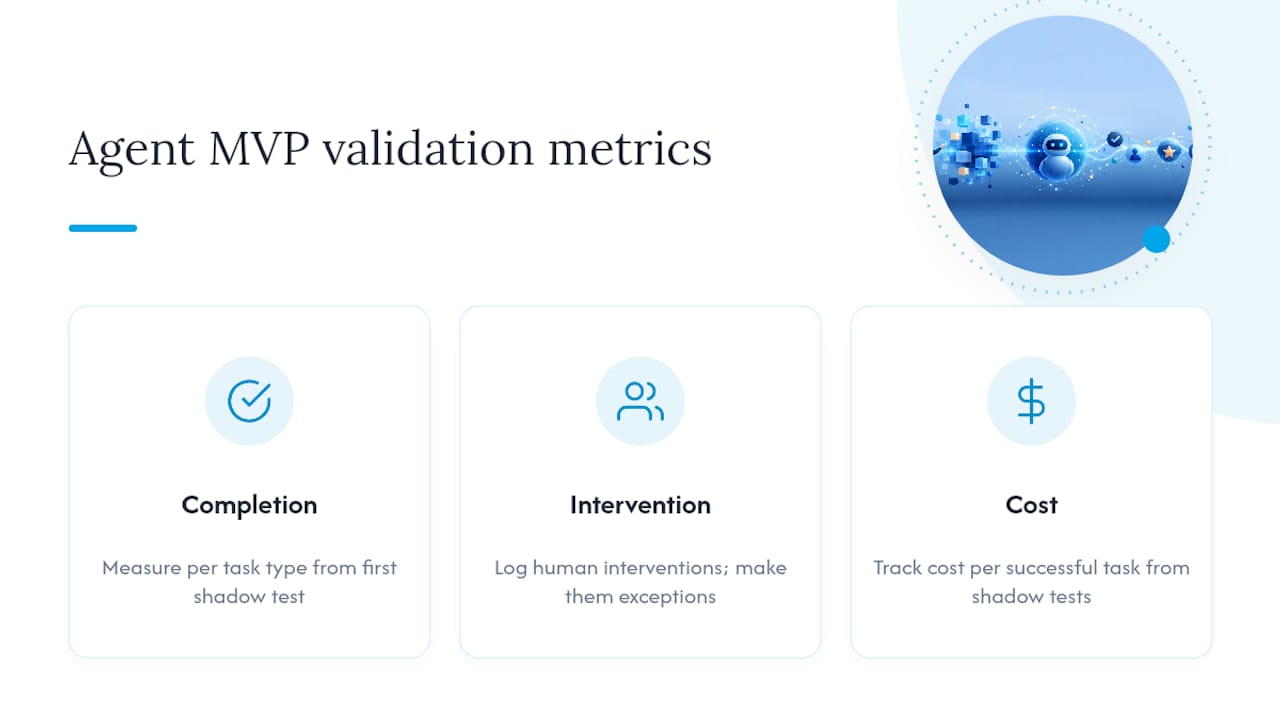
Three metrics tell you whether the agent works: task-completion rate per task type, human-intervention rate (how often a person had to step in), and cost per successful task. Track these from the first shadow test, not after launch.

Run the pilot against 3 to 5 real users and log every failure, not just the successes. Test deliberately for edge cases: ambiguous inputs, missing data, and requests outside the agent's scope. A workable threshold for moving out of shadow mode is a completion rate high enough that intervention becomes the exception, not the routine, with every failure logged for the next iteration.
What does an AI agent MVP cost, and how long does it take?
Costs scale with integrations and autonomy, not with the model you pick. Indicative UK ranges show simple single-task agents at £8,000 to £25,000, mid-range agents with multiple integrations at £25,000 to £75,000, and advanced multi-agent systems at £75,000 to £200,000 or more.
The main cost drivers:
- Number of system integrations
- Required autonomy level (fully automated vs. human-reviewed)
- Model choice (hosted API vs. self-hosted open model)
- Testing rigour, especially edge-case coverage
Budget for ongoing costs too: LLM token spend, hosting, a vector database subscription if you use one, and typically several percent of build cost annually in maintenance.
When should you bring in a specialist consultancy?
Bring in outside help when integrations get complex, when the agent takes high-risk or regulated actions, or when your team lacks in-house AI expertise to design guardrails properly. A capable consultancy should deliver a discovery phase with a clear outcome spec, guardrail design before any happy-path logic, a working deployment, and post-launch tuning, plus increasingly, Generative Engine Optimization so your business shows up in AI-driven search results.
Before signing a proposal, check it against a short list:
- Does it include a discovery and outcome-spec phase?
- Are guardrails and fallback paths explicitly scoped?
- Is there a defined pilot period with acceptance criteria?
- Does support continue after launch?
What UK data privacy rules apply to AI agents?
Any agent MVP handling personal data, customer emails, support tickets, lead records, falls under UK GDPR and the Data Protection Act 2018, regardless of how small the pilot is. This isn't optional at MVP stage; it shapes architecture decisions from Sprint 0 onward.
Three practical implications matter most. First, decide where data lives: sending customer data to a hosted LLM API means it may leave your infrastructure, so check the provider's data retention and training policies before you wire up the integration. Second, log what the agent accesses and does, audit trails aren't just good practice, they're often required if the agent touches customer records or makes decisions affecting people. Third, build in a human review step for anything with real-world consequences, an agent that auto-responds to a support ticket is lower risk than one that auto-approves a refund or shares account details.
Data minimisation matters more at MVP stage than teams expect. Feed the agent only what it needs for the task, not your entire customer database, both because it reduces risk and because a narrower dataset is easier to test and reason about. If your validation samples include real customer data, anonymise or pseudonymise them wherever the test doesn't specifically require identifiable information.
None of this needs to slow down a sprint plan. It needs to be designed in from Sprint 0, not retrofitted after a pilot reveals a gap.
A practitioner's take on where AI agent MVPs go wrong
Most failed agent MVPs weren't killed by the model, they were killed by scope creep and happy-path thinking. Test on your messiest real data first, build guardrails before features, and prove one agent works before you dream up a fleet of them.
How Real-studios turns your AI agent MVP into a working pilot
Building the architecture is one thing; getting from Sprint 0 to a piloted, guarded, monitored agent without burning weeks on the wrong integration is another. Real-studios runs discovery and outcome-spec work, rapid POC builds, and guardrail design as a single engagement, so the gap between "we have an idea" and "we have a working pilot" closes in weeks, not months. Beyond the build, Real-studios also handles the layer most agencies skip: Generative Engine Optimization, so your business gets recognised inside AI-driven search results as that shift accelerates.
If you're scoping your first agent MVP, get in touch through the MVP delivery service to book a discovery call and put a sprint plan on the calendar.
Where to go next for code, demos, and cost detail
For hands-on building, start with the MVP-Agent repository for working code patterns, Hugging Face Spaces for a live hosted demo you can fork, and Algolia's developer docs for retrieval and search patterns if your agent needs RAG. For orchestration and multi-agent design thinking beyond the MVP stage, Steel's exploration of agent behaviours and this guide to AI agents in prediction markets offer useful conceptual grounding.
Frequently asked questions
What's the difference between an AI chatbot MVP and an AI agent MVP? A chatbot MVP answers questions; an agent MVP takes multi-step action, calling tools, chaining decisions, and completing a task without a person driving each step.
How long does it take to build an MVP AI agent? A scoped agent typically takes 10 to 16 weeks, though a tightly scoped build can ship in as little as one week if the task is narrow enough.
Do I need a vector database for my first AI agent MVP? Only if the agent needs to retrieve knowledge from documents or a knowledge base. Most single-task MVPs, like email triage or lead qualification, don't need one at all.
What's the biggest reason AI agent MVPs fail validation? Scope creep and skipped guardrails. Teams that test only on clean, hypothetical inputs miss the messy edge cases that break the agent in production.
How much does it cost to build an MVP AI agent in the UK? Indicative ranges run from £8,000 to £25,000 for a simple single-task agent up to £75,000 to £200,000 or more for advanced multi-agent systems.
Sources
- AI Agent MVP: How to Build and Validate an Agentic Product
- Agentic MVP in One Week: Ship a Real Product in 7 Days