Multi-agent systems: a practitioner's guide for UK teams
A multi-agent system (MAS) is a set of autonomous agents that collaborate or compete under a coordination layer to solve problems no single agent can handle alone. For UK developers, product managers, and CTOs, the practical takeaway is this: if your workflow involves parallel tasks, multiple data sources, or decisions that require specialist reasoning at each step, a MAS is worth serious consideration.

The Alan Turing Institute defines MAS research as spanning coordination, communication, incentive design, and emergent behaviours across applications from autonomous driving to automated tutoring. That breadth is the point. A MAS is not a single clever model; it is an architecture.
Before you read further, here are the core elements to orient yourself:
- Agents: autonomous software units that perceive inputs, reason, and act
- Orchestrator: the coordination layer that routes tasks and manages agent sequencing
- Specialist agents: purpose-built agents for specific subtasks (retrieval, summarisation, validation, API calls)
- Memory/store: shared or per-agent context that persists across steps
- Validation/QA layer: automated and human checkpoints that catch errors before they propagate
Build a MAS when a single agent produces brittle results, when tasks genuinely benefit from parallelism, or when you need to integrate across systems that have no common interface.
Table of Contents
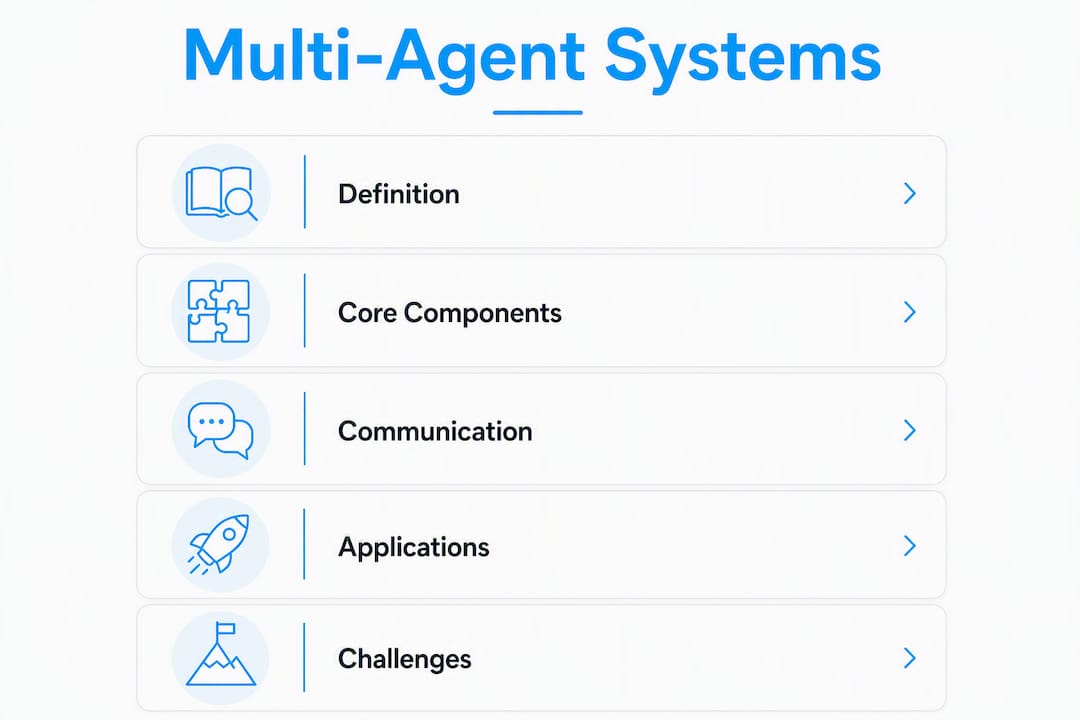
- What are multi-agent systems and how do they differ from single-agent AI?
- What are the core components and architectures of a MAS?
- How do agents communicate and coordinate?
- Which algorithms and techniques power multi-agent systems?
- Which tools and frameworks should you use to build a MAS?
- Where are multi-agent systems being used today?
- How do you design and implement a MAS? A practical checklist
- How do you evaluate and benchmark a MAS?
- What are the safety, ethics, and governance requirements for MAS in the UK?
- What UK practitioners have learned from real MAS projects
- How do you start a MAS prototype? A step-by-step playbook
- Key takeaways
- Real-studios builds MAS for UK teams, from pilot to production
- Useful sources and further reading
What are multi-agent systems and how do they differ from single-agent AI?
The term "agent" in AI has a precise meaning: a software entity that perceives its environment through sensors or data inputs, maintains some form of internal state or goal representation, and takes actions to move toward an objective. Autonomy is the key property. An agent does not wait for a human to tell it each step; it decides.
A single-agent system handles the full task pipeline within one model or process. That works well for bounded, well-defined problems: classifying a support ticket, generating a product description, or answering a factual query. The moment a task requires parallel reasoning, specialised knowledge in distinct domains, or coordination across multiple APIs and data stores, a single agent becomes a bottleneck.
Multi-agent systems distribute that work. Each agent has a narrower objective function, and the system's global behaviour emerges from their interactions. Google Cloud's documentation frames this as orchestrator and specialist roles composed into workflows, which maps directly to how most enterprise MAS are built today.
Agent-based modelling (ABM) is a related but distinct concept. ABM is primarily a simulation technique used in research to study how individual agent rules produce macro-level phenomena, such as traffic flow or market dynamics. A production MAS is built to execute real tasks; an ABM is built to understand system behaviour. The distinction matters when you are choosing tooling: ABM frameworks like NetLogo or Mesa are not production deployment tools.
Three short examples illustrate where MAS becomes necessary rather than optional:
- CRM automation: a retrieval agent pulls customer history, a reasoning agent drafts a response, a compliance agent checks it against policy, and an output agent sends the message. No single model does all four reliably.
- Multi-robot factory line: each robot is an agent with local perception and actuation; a coordinator agent manages sequencing and collision avoidance across the line.
- Multi-agent RAG pipeline: a query-routing agent directs questions to specialist retrieval agents (product catalogue, policy documents, live inventory), then a synthesis agent assembles the final answer with citations.
Emergence is the phenomenon to watch. When agents follow local rules, global behaviours appear that no individual agent was explicitly programmed to produce. In a warehouse MAS, agents avoiding collisions locally can produce efficient global routing without a central planner. That is useful. It can also produce unexpected failure modes, which is why testing and observability matter as much as the agent logic itself.
What are the core components and architectures of a MAS?
Every production MAS, regardless of domain, is built from the same set of components. Getting the architecture right before writing a line of agent code saves significant rework.
Core components
- Orchestrator: receives the top-level task, decomposes it, routes subtasks to specialist agents, and aggregates results
- Specialist agents: each handles one well-defined function (retrieval, reasoning, code execution, API call, summarisation)
- Communication layer: the messaging infrastructure agents use to exchange data (synchronous calls, message queues, shared memory reads)
- Memory/store: short-term working memory (within a single workflow run) and long-term persistent memory (vector stores, databases) that agents read and write
- QA/validation layer: automated guards and human checkpoints that verify outputs before they pass downstream
- Monitoring and observability: logging of agent inputs, outputs, latency, and errors so failures can be traced and replicated
Three canonical architectures
| Architecture | Description | Best for | Trade-offs |
|---|---|---|---|
| Centralised orchestrator | One orchestrator routes all tasks to specialist agents | Enterprise RAG, customer-facing automation, compliance-sensitive workflows | Single point of failure; easier to govern and audit |
| Decentralised peer-to-peer swarm | Agents communicate directly, no central coordinator | Robotics, simulation, fault-tolerant distributed tasks | Harder to observe and debug; emergent behaviour is less predictable |
| Hybrid (orchestrator + local autonomy) | Orchestrator handles high-level routing; agents have local decision authority within defined bounds | Complex pipelines where some subtasks need real-time local adaptation | Moderate governance complexity; balances flexibility and control |
The TechUK/Elsewhen agentic enterprise report recommends API-driven architectures specifically to support multi-agent integration, noting that real-time decision-making across previously isolated systems is one of the primary value drivers. That recommendation points firmly toward the centralised or hybrid pattern for most UK enterprise contexts, where auditability and integration with existing CRM and ERP systems are non-negotiable.
A note on diagrams: a simple architecture diagram showing the orchestrator at the top, arrows routing to three or four specialist agents, a shared memory store accessible to all agents, and a QA gate before the output layer will communicate the design more clearly than any prose description. Include one in your technical documentation before briefing a vendor or internal team.
The decentralised swarm pattern is powerful in robotics and simulation research but introduces governance complexity that most enterprise teams are not yet equipped to manage. Digitalisation World reports that many agents in organisations are compartmentalised and lack a central control plane, which is effectively an accidental decentralised architecture with none of the benefits and all of the observability problems.
How do agents communicate and coordinate?
Agent interaction is where MAS design gets genuinely complex. The communication model you choose shapes latency, fault tolerance, and how easy the system is to debug.
Interaction modes
- Synchronous messaging: agent A calls agent B and waits for a response before proceeding. Simple to reason about; creates latency chains in long pipelines.
- Asynchronous messaging: agent A publishes a task to a queue; agent B picks it up when ready. Better throughput; harder to trace causality when something fails.
- Publish/subscribe: agents broadcast events to a topic; any subscribed agent can react. Useful for loosely coupled systems where multiple agents need the same signal.
- Shared memory access: agents read from and write to a common store (a vector database, a Redis cache, a structured log). Fast and flexible; requires careful access control to avoid race conditions.
Coordination patterns
Leader election is used when one agent must take authority over a shared resource or decision. Common in distributed systems where a primary coordinator must be elected if the current one fails.
Consensus algorithms (analogues of Paxos or Raft in distributed systems) allow agents to agree on a shared state without a central authority. In a MAS context, a simplified consensus step might be used to confirm that multiple validation agents agree an output is safe before it is released.
Token passing serialises access to a shared resource by passing a logical token between agents. Prevents conflicts in systems where agents must write to the same store.
Market-based allocation assigns tasks to agents through a bidding mechanism. Each agent bids based on its current load and capability; the orchestrator awards the task to the best-fit agent. This pattern scales well and handles heterogeneous agent capabilities naturally.
Negotiation protocols are used in competitive or resource-constrained settings. Two agents negotiating over a shared API rate limit, for example, might use a contract-net protocol where one agent broadcasts a task announcement and others submit bids.
Emergent behaviour and fault modes
Local rules produce global effects. A set of retrieval agents each optimising for relevance score can collectively over-retrieve from one data source and under-retrieve from another, producing a biased synthesis. This is not a bug in any individual agent; it is an emergent property of the interaction. Testing must account for it.
Common fault modes include: agents entering feedback loops where each agent's output becomes the next agent's input without a break condition; agents producing contradictory outputs that the orchestrator has no rule to resolve; and agents silently failing and returning empty outputs that propagate as valid data. Each of these requires explicit handling in the orchestration logic, not just in individual agent code.
Which algorithms and techniques power multi-agent systems?
The algorithm choice depends on three factors: how deterministic the environment is, how observable the state is, and whether agents are cooperative or competitive.
Multi-agent reinforcement learning (MARL)
MARL extends single-agent reinforcement learning to settings where multiple agents learn simultaneously. Each agent receives rewards based on its actions, but those rewards are influenced by what other agents do. This creates a non-stationary learning environment: as one agent improves, the optimal policy for every other agent shifts.
MARL is the right choice for robotics coordination, game-playing agents, and traffic signal optimisation. It is a poor choice for enterprise automation where you need deterministic, auditable behaviour. Training MARL systems requires substantial compute and simulation infrastructure, and the resulting policies can be brittle outside their training distribution.
Ray's RLlib library is the most widely used open-source framework for MARL in Python, supporting algorithms including PPO, SAC, and QMIX for cooperative settings.
Distributed planning and hierarchical task decomposition
For enterprise MAS, distributed planning is more practical than MARL. The orchestrator decomposes a high-level goal into subtasks using a planning algorithm (often an LLM-based planner in modern systems), assigns subtasks to specialist agents, and re-plans if an agent fails or returns an unexpected result.
Hierarchical planning adds structure: a high-level planner sets goals; mid-level agents decompose those goals into actions; low-level agents execute. This mirrors how human organisations work and makes the system easier to audit.
Consensus and game-theoretic approaches
Consensus algorithms are relevant when multiple agents must agree on a shared fact before proceeding. A validation MAS might require three independent checking agents to reach consensus before approving a financial transaction.
Game-theoretic approaches model agents as rational actors with utility functions. Mechanism design, a branch of game theory, lets you engineer incentive structures so that agents acting in their own interest produce a globally desirable outcome. This is relevant in multi-agent trading systems and resource allocation problems.
Algorithm selection shortlist:
- Cooperative, deterministic, observable: distributed planning with LLM orchestrator
- Cooperative, stochastic, partially observable: MARL (QMIX, MADDPG)
- Competitive, discrete actions: game-theoretic mechanism design
- Resource allocation across heterogeneous agents: market-based allocation
- Agreement on shared state: consensus protocols
Pro Tip: Define human-in-the-loop checkpoints before you write a single agent. The "judgement problem" — where staff spend more time prompting and checking agents than they save — emerges precisely when intervention points are left implicit. Map every decision that carries downstream risk and assign it a human validation gate in the architecture diagram before implementation begins.
Which tools and frameworks should you use to build a MAS?
Framework choice is one of the highest-leverage decisions in a MAS project. The wrong choice creates migration costs that dwarf the initial build.
Framework overviews
JADE (Java Agent Development Framework) is a mature, FIPA-compliant framework for building distributed agent systems in Java. It handles agent lifecycle management, message passing, and yellow-pages service discovery out of the box. JADE is well-suited to enterprise systems where Java is the primary stack and where FIPA compliance (a formal agent communication standard) is required. Its age shows in the tooling ecosystem, and it is rarely the first choice for LLM-based agents.
ROS (Robot Operating System) is the standard middleware for robotics MAS. Despite the name, ROS is not an operating system; it is a communication framework that lets robot components (sensors, actuators, planners) exchange messages through a publish/subscribe architecture. ROS 2 adds real-time support and improved security. If your MAS involves physical hardware, ROS is the default choice.
LangChain provides a high-level Python and JavaScript abstraction layer for building LLM-powered agents. Its agent executor handles tool calling, memory management, and chain composition. LangChain is the fastest path to a working LLM agent prototype and has a large community and extensive integrations. The trade-off is that the abstraction layer can obscure what is actually happening, making debugging harder in complex multi-agent pipelines.
LangGraph is LangChain's graph-based orchestration layer, designed specifically for multi-agent workflows. It models agent interactions as a directed graph, making branching, looping, and conditional routing explicit and inspectable. For enterprise MAS built on LLMs, LangGraph is currently the strongest choice for orchestration logic. The Hugging Face agents course uses similar patterns to demonstrate how orchestrators route to specialist agents and how QA gates are inserted into the graph.
Ray (RLlib) is a distributed computing framework with a dedicated reinforcement learning library. Ray handles the parallelism and distributed execution that MARL training requires. For simulation-heavy MAS research or production systems that need to run thousands of agent instances in parallel, Ray is the infrastructure layer of choice.
OpenAI's agent tooling (the Assistants API and the Agents SDK) provides hosted infrastructure for building agents with tool use, file retrieval, and persistent threads. The Agents SDK supports multi-agent handoffs, making it straightforward to build a small MAS without managing your own orchestration infrastructure. The trade-off is vendor lock-in and less control over the underlying execution.
When to choose which framework
| Project type | Recommended framework | Key reason |
|---|---|---|
| LLM-based enterprise automation / RAG | LangGraph + LangChain | Graph-based orchestration, LLM-native, strong observability |
| Robotics / physical hardware | ROS 2 | Industry standard, real-time support, hardware abstraction |
| MARL research / simulation | Ray (RLlib) | Distributed training, algorithm library, scalable execution |
| Rapid LLM agent prototype | OpenAI Agents SDK | Hosted infrastructure, fast to build, minimal ops overhead |
| Java enterprise / FIPA compliance | JADE | Mature, standards-compliant, enterprise Java integration |
Off-the-shelf vs custom stack: use a framework unless you have a specific requirement it cannot meet. Custom orchestration logic is expensive to build and maintain. The cases where a custom stack is justified are narrow: extreme latency requirements, proprietary communication protocols, or regulatory constraints that prevent use of cloud-hosted agent infrastructure.
For LLM-based MAS, integration with memory stores (Pinecone, Weaviate, pgvector) and enterprise APIs (Salesforce, SAP, Microsoft 365) is straightforward from LangGraph and LangChain. OpenAI's tooling handles file retrieval natively but requires more work for custom enterprise API integration.
Where are multi-agent systems being used today?
MAS has moved from academic research to production deployment across several domains. The line between production-ready and experimental varies significantly by sector.
Production-ready applications
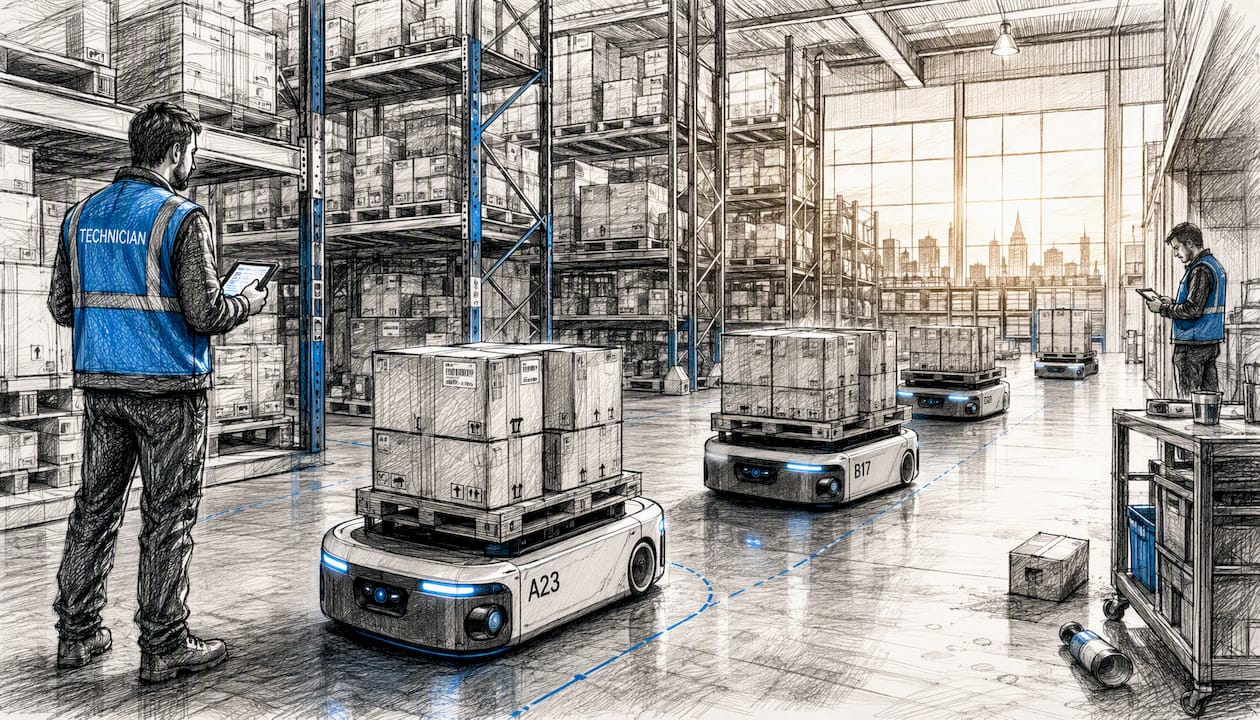
Multi-robot warehouse automation is the most mature MAS deployment. Systems coordinate fleets of autonomous mobile robots for pick-and-place tasks, with agents negotiating paths in real time to avoid collisions and optimise throughput. UK logistics operators have deployed these systems at scale.
Enterprise RAG and customer automation is the fastest-growing area for LLM-based MAS in the UK. A typical architecture routes customer queries through a classification agent, retrieves relevant documents via specialist retrieval agents, synthesises a response, and passes it through a compliance-checking agent before delivery. The TechUK/Elsewhen report highlights real-time decision-making across previously isolated systems as a primary driver of enterprise MAS adoption.
Automated trading strategy execution uses MAS to coordinate signal-generation agents, risk-management agents, and execution agents. Each operates on a different time horizon and data source. This is a production domain but one with strict FCA oversight; governance and auditability are non-negotiable.
UK-relevant context
UK organisations are actively piloting agentic enterprise systems. Surveys indicate organisations currently use an average of 13 AI agents, though integration and governance gaps cause disconnected workflows and duplicated automations. That reflects the current state: agents deployed, but not yet coordinated as a genuine MAS.
Common UK stack integrations include Microsoft Azure (for hosting and identity), Salesforce (CRM), and ServiceNow (ITSM). GDPR compliance is a design constraint from day one, not an afterthought.
Still experimental
Traffic and transport optimisation at city scale remains largely in research and pilot phases in the UK. Transport for London and several regional authorities have run simulation studies, but live deployment of fully autonomous multi-agent traffic management is not yet in production.
Multi-agent scientific research assistants (agents that autonomously run literature searches, design experiments, and synthesise findings) are active research areas at institutions including the Alan Turing Institute but are not yet production tools.
How do you design and implement a MAS? A practical checklist
A structured approach from problem scoping to production rollout prevents the most common failure modes: over-engineering the architecture before validating the use case, and under-investing in observability until something breaks in production.
Step-by-step implementation checklist
- Define the outcome precisely. Write a one-sentence success criterion before selecting any technology. "Reduce customer query resolution time by 40% while maintaining 95% accuracy" is a testable outcome. "Build an AI agent system" is not.
- Map the task decomposition. Identify every subtask in the workflow and assign each to an agent type. Draw the dependency graph. If the graph has more than eight nodes for a pilot, scope it down.
- Select your orchestration pattern. Choose centralised, decentralised, or hybrid based on the governance and latency requirements identified in step one.
- Design the memory model. Decide what each agent needs to remember within a run (working memory) and across runs (persistent memory). Choose your store: a vector database for semantic retrieval, a relational store for structured state, or both.
- Define the communication layer. Specify whether agents communicate synchronously or asynchronously. Document the message schema for every agent-to-agent interaction.
- Build the QA and validation layer. Insert automated guards (output schema validation, confidence thresholds, policy checks) and human validation gates at every decision point that carries downstream risk.
- Instrument for observability. Every agent input, output, latency, and error must be logged with a correlation ID that traces the full workflow. Set up dashboards before going live.
- Write the rollback plan. Define the conditions under which the system falls back to a human operator or a simpler automated process. Test the rollback before the live pilot.
- Run simulation and synthetic tests. Validate the full workflow against synthetic inputs before connecting to live data or production APIs.
- Stage the rollout. Start with a shadow deployment (agents run in parallel with the existing process, outputs compared but not acted on), then move to a controlled live pilot with a defined user group.
QA and validation in depth
Synthetic tests cover known-good and known-bad inputs. Integration tests verify that agent-to-agent message passing works correctly under load. Human validation gates are checkpoints where a human reviews agent outputs before they trigger an irreversible action (sending an email, executing a trade, updating a customer record). Automated guards catch schema violations, out-of-range confidence scores, and policy breaches before they reach a human gate.
Pro Tip: Containerise each agent independently from the start. When an agent needs to be updated or replaced, you want to swap one container without touching the rest of the system. Agent sprawl is significantly harder to manage when agents share a runtime environment.
Deployment considerations: use an API gateway to manage agent-to-external-system calls, apply rate limiting per agent to prevent one agent from exhausting a shared API quota, and use structured logging (JSON lines, not free text) so logs are queryable from day one.
How do you evaluate and benchmark a MAS?
Evaluation is where many MAS projects stall. Teams build a working prototype and then struggle to demonstrate that it is better than the process it replaces, because they did not define metrics before building.
Key metrics
- Task success rate: the percentage of end-to-end workflows completed correctly, as defined by the success criterion from step one of the implementation checklist
- Time-to-completion: wall-clock time from task initiation to validated output, compared against the baseline process
- Resource efficiency: compute cost and API call volume per completed task
- Coordination score: a domain-specific metric measuring how well agents collaborate (e.g., percentage of subtasks completed without retry or rerouting)
- Robustness to agent failure: task success rate when one or more agents are deliberately disabled or return malformed outputs
- Human oversight workload: the number of human validation interventions per hundred tasks, and the time cost of each
Testing methodology
Start in simulation. Build a testbed that replays historical inputs through the MAS and compares outputs against known-good results. This lets you iterate on agent logic without touching production data.
Replay testing uses real historical data to validate that the system handles the full distribution of inputs it will encounter in production, not just the happy path. A/B trials in controlled environments compare the MAS against the existing process on a matched sample of tasks. Staged rollouts move from shadow deployment to a small live cohort before full production.
Domain-specific testbeds are worth building when off-the-shelf benchmarks do not reflect your task distribution. A customer service MAS should be evaluated on your actual query types and your actual compliance requirements, not on a generic NLP benchmark.
For simulation tooling, PettingZoo provides a standard API for multi-agent environments in Python, compatible with most MARL frameworks. For enterprise workflow testing, LangSmith (part of the LangChain ecosystem) provides tracing and evaluation tooling specifically for LLM-based agent pipelines.
What are the safety, ethics, and governance requirements for MAS in the UK?
Governance is the area where UK organisations are most exposed. Computer Weekly reports that surveys found an average of 12 agents per organisation and that only around half have centralised governance for their agents. Deploying agents without governance is not a technical risk; it is a legal and reputational one.
UK regulatory context
The UK government's AI Insights guidance on agentic AI describes agentic AI as systems composed of agents that can behave and interact autonomously to achieve objectives. The guidance emphasises that orchestration frameworks should centralise discovery, accountability, and oversight, and that organisations must be able to explain which agent took which action and why.
The UK's current AI regulatory approach is sector-specific and principles-based rather than prescriptive. The ICO's guidance on AI and data protection applies directly to MAS: agents that access personal data are data processors, and their data access must be documented, minimised, and governed under GDPR.
GDPR considerations for MAS
- Data minimisation: each agent should access only the data it needs for its specific subtask. A retrieval agent querying a customer database should not have write access, and should not retrieve fields it does not use.
- Logging agent data access: every agent read or write involving personal data must be logged with a timestamp, agent ID, and purpose. This is required for Subject Access Requests and for demonstrating compliance in an audit.
- DPIAs: a Data Protection Impact Assessment is required when a MAS processes personal data at scale or makes automated decisions with significant effects on individuals. This includes customer-facing automation that affects service delivery.
- Handling SARs across agent memories: if an agent stores personal data in a vector store or a structured log, that data is in scope for a Subject Access Request. Design your memory architecture with data deletion and retrieval in mind from the start.
Risk mitigation checklist
- Define human-in-the-loop checkpoints for every decision that is irreversible or high-stakes
- Implement provenance logging: every output should carry a trace of which agents contributed to it and what data they accessed
- Version your agent policies and prompt templates so you can roll back to a known-good configuration
- Write and test a response playbook for agent failure: what happens when an agent returns an error, times out, or produces an output outside its expected range?
- Conduct regular red-team exercises where the MAS is deliberately fed adversarial inputs to test its guards
Governance insight: The UK government's agentic AI guidance makes clear that accountability cannot be delegated to an agent. A human or organisation remains responsible for every action an agentic system takes. Build your governance framework around that principle, not around the assumption that the system will self-govern.
This article provides general information on UK AI governance and data protection. Confirm current regulatory requirements with a qualified legal professional or the ICO directly.
What UK practitioners have learned from real MAS projects
The gap between a working MAS prototype and a production system that delivers measurable value is wider than most teams expect. The lessons below come from patterns observed across UK enterprise AI deployments.
That observation captures the most common failure mode. Teams build a technically functional MAS, deploy it, and then discover that the QA overhead has simply moved from the original process to the agent-monitoring process. The fix is architectural, not operational.
Common mistakes in UK MAS projects
- Over-agenting: creating a separate agent for every conceivable subtask, producing a system with 20 agents where 5 would suffice. More agents means more communication overhead, more failure points, and more governance surface area.
- Missing governance from day one: treating governance as a post-launch concern. By the time a MAS is in production, retrofitting provenance logging and human gates is expensive and disruptive.
- Poor observability: deploying without structured logging and distributed tracing. When something fails in a multi-agent pipeline, you need to trace the failure to a specific agent, a specific input, and a specific decision. Free-text logs do not support that.
- Lack of integration planning: building agents that work in isolation but cannot connect to the enterprise systems (CRM, ERP, identity providers) that hold the data they need. API-driven architecture must be a design constraint from the start, not an integration task at the end.
Quick wins for teams starting out
- Scope the pilot to three to five agents maximum, with a single, measurable success criterion
- Implement centralised logging with correlation IDs before writing any agent logic
- Insert one human validation gate per critical decision path in the first version
- Define KPIs (task success rate, time-to-completion, human oversight workload) before the pilot begins
Project timeline expectations: a focused pilot with three to five agents typically takes 6–12 weeks from scoping to validated results. An enterprise rollout covering multiple workflows, integrations, and compliance requirements typically takes 3–9 months, depending on the complexity of integrations and the maturity of the organisation's data infrastructure. These are planning estimates; actual timelines depend on team size, data readiness, and governance requirements.
How do you start a MAS prototype? A step-by-step playbook
A minimal viable MAS is not a scaled-down version of the full system. It is the smallest system that can validate the core architectural assumption: that distributing the task across specialist agents produces better results than a single agent or the existing process.
Seven-step pilot plan
- Select the pilot use case. Choose a workflow that is high-frequency, has a measurable baseline, and involves at least two distinct subtasks that benefit from specialisation.
- Map data sources and access requirements. Identify every data source each agent will need. Confirm API availability, authentication methods, and data governance constraints before writing code.
- Choose your framework. For LLM-based enterprise pilots, LangGraph is the current recommended starting point. For robotics, ROS 2. For MARL research, Ray.
- Build agents incrementally. Start with the orchestrator and one specialist agent. Validate the communication and memory model before adding more agents.
- Assemble validation tests. Write synthetic test cases covering the happy path, edge cases, and known failure modes before connecting to live data.
- Run simulations. Execute the full workflow against synthetic inputs. Measure task success rate, latency, and error rates. Iterate on agent logic until metrics meet the success criterion.
- Run the live pilot. Deploy in shadow mode first. Compare MAS outputs against the existing process on a matched sample. Move to live operation once shadow results meet the success criterion.
Roles and responsibilities
| Role | Responsibility | Typical background |
|---|---|---|
| Product owner | Defines success criteria, prioritises features, owns stakeholder communication | Product management, business analysis |
| Systems architect | Designs orchestration pattern, memory model, and integration architecture | Senior engineering, solutions architecture |
| ML/AI engineer | Builds and tunes agent logic, prompt engineering, MARL training if applicable | Machine learning, NLP engineering |
| Integration engineer | Connects agents to enterprise APIs, CRM, ERP, identity providers | Backend engineering, API development |
| QA/validator | Designs and runs synthetic tests, integration tests, human validation gates | QA engineering, domain expertise |
| Stakeholder/domain expert | Validates outputs against domain knowledge, provides labelled test data | Business function (finance, operations, customer service) |
Cost and time guidance
A focused pilot (three to five agents, one workflow, limited integrations) is the right starting point for validating architecture and measuring ROI before committing to a full enterprise rollout. Practical CTO guidance notes that larger enterprise projects can be an order of magnitude more costly than a scoped pilot, depending on integrations and compliance requirements. Build vs procure decisions should be made after the pilot validates the architecture, not before.
For teams without in-house AI engineering capability, a specialist consultancy can compress the pilot timeline significantly by bringing pre-built orchestration patterns, tested integrations, and governance frameworks that would otherwise take months to develop internally.
Key takeaways
Multi-agent systems deliver measurable value when tasks are genuinely parallel, multi-step, and require specialist reasoning at each stage, but governance and observability must be built in from the start, not added later.
| Point | Details |
|---|---|
| Start with a scoped pilot | Three to five agents, one measurable success criterion, 6–12 weeks to validated results. |
| Governance from day one | Only around half of UK organisations have centralised agent governance; build provenance logging and human gates before launch. |
| Match framework to project type | LangGraph for LLM enterprise automation, ROS 2 for robotics, Ray for MARL; off-the-shelf beats custom for most pilots. |
| Define KPIs before building | Task success rate, time-to-completion, and human oversight workload must be baselined before the pilot begins. |
| Real-studios for UK MAS delivery | Real-studios builds pilot MAS, RAG agents, and enterprise integrations for UK teams, with governance and post-launch support included. |
The judgement problem is the real design challenge
Most articles about multi-agent systems focus on the architecture. The orchestrator, the specialist agents, the memory model — these are solvable engineering problems with established patterns and mature frameworks. The harder problem is the one Sonali Fenner identified: the judgement problem.
A MAS does not eliminate human judgement. It redistributes it. If you build a system with no explicit human intervention points, you have not removed the need for oversight; you have hidden it inside a monitoring workflow that someone has to run. The governance overhead does not disappear; it shifts to whoever is watching the dashboards.
The teams that get the most value from MAS are the ones that treat human-in-the-loop design as a first-class architectural concern, not a compliance checkbox. They map every decision that carries downstream risk before writing a line of agent code. They define exactly what a human validator needs to see, and exactly when they need to see it. They measure human oversight workload as a KPI alongside task success rate.
The UK regulatory context reinforces this. The government's agentic AI guidance is explicit: accountability cannot be delegated to an agent. That is not a constraint to work around; it is a design principle to build from.
The other underappreciated challenge is integration. Most UK enterprise MAS projects do not fail because the agent logic is wrong. They fail because the agents cannot reliably connect to the data they need, when they need it. API-driven architecture, clean data contracts, and integration testing deserve as much attention as the agent reasoning layer.
Build the governance and integration layers first. The agent logic is the easy part.
Real-studios builds MAS for UK teams, from pilot to production
UK teams that have validated a MAS use case through this guide often face the same next question: build in-house or bring in a specialist? Real-studios, the Manchester-based AI consultancy behind AIthatworks, delivers exactly the kind of scoped, governance-first MAS pilots described here, without the months of internal ramp-up.
The concrete difference: Real-studios brings pre-built orchestration patterns, tested enterprise integrations for CRM, ERP, and API-driven systems, and post-launch support as standard. You get a working pilot with measurable KPIs in weeks, not quarters. Services cover the full delivery chain: pilot scoping, orchestration design, RAG agent builds, voice, chat, and email agent deployment, and the governance and observability layers that UK compliance requires.
For teams ready to move from concept to a validated prototype, the automation and agent delivery service is the right starting point. Book a discovery call to scope your pilot and get a clear timeline and cost estimate for your specific workflow.
Useful sources and further reading
The sources below are recommended in reading order: start with the foundational concepts, move to tooling, then governance.
- Multi-agent systems | The Alan Turing Institute — the UK's leading AI research institute; start here for academic grounding in MAS concepts, coordination, and emergent behaviour
- AI Insights: Agentic AI | UK Government — official UK government guidance on agentic AI; required reading for any UK team building MAS in a regulated context
- What is a multi-agent system in AI? | Google Cloud — clear commercial-cloud description of orchestrator and specialist agent roles; useful for briefing non-technical stakeholders
- Multi-Agent Systems | Hugging Face learn agents course — hands-on tutorial reference for orchestrator/specialist patterns and QA gate implementation
- Building the agentic enterprise | TechUK / Elsewhen — UK enterprise whitepaper on MAS productivity, API-driven architecture, and integration patterns
- Governance lags agentic AI adoption | Computer Weekly — UK survey data on agent governance maturity; essential context for the ethics and risk section
- Multi-agent system | Wikipedia — broad reference for definitions, history, and taxonomy of MAS architectures