LLM SEO for marketers: rank in AI search 2026
LLM SEO is the practice of structuring your content and brand signals so large language models can find, extract, and cite your pages in AI-generated answers. The single most important thing to do first is make your content extractable: A significant share of LLM citations come from the first portion of an article, so front-loading direct answers is not optional. Start here:
- Technical exposure: submit an XML sitemap, allow GPTBot and Bingbot in robots.txt, and add an llms.txt file at your domain root.
- Extractable answers: restructure your top five pages so every H2 opens with a direct, self-contained answer of roughly 100–160 words.
- Entity signals: align your brand description consistently across your website, LinkedIn, Crunchbase, and relevant UK directories.
- Schema stack: implement Article, FAQPage, Organisation, and Person schema on priority pages.
- Measurement baseline: record your current AI citation frequency across Google AI Overviews, Perplexity, ChatGPT Search, and Bing Copilot before making changes.
Brand authority is also a decisive factor. One study measured a 0.334 correlation between brand authority signals and citation selection, which means multi-platform presence is as much a ranking input as technical structure.
Table of Contents
- What is LLM SEO, and why does it matter for UK sites?
- How does LLM SEO differ from traditional SEO?
- How do LLMs actually find and cite your content?
- Practical tactics to get cited by LLMs
- How do you measure LLM visibility and GEO performance?
- UK implementation checklist: 30, 90, and 180 days
- How Real-studios operationalises GEO: process and deliverables
- Key takeaways
- What UK marketers should expect from LLM search in the next 12 months
- Real-studios GEO and RAG services for UK marketing teams
- Useful sources and tools
What is LLM SEO, and why does it matter for UK sites?
LLM SEO, more formally called Generative Engine Optimisation (GEO), is the discipline of positioning your brand and content so AI platforms such as Google AI Overviews, ChatGPT Search, Perplexity, and Bing Copilot cite or recommend you when users ask questions. The goal is not a blue-link ranking. It is a citation inside a generated answer.
For UK-facing sites, the distinction carries practical weight. A user asking "which Manchester agency builds AI agents?" is not browsing a SERP; they are reading a synthesised paragraph. If your brand is absent from that paragraph, you are invisible regardless of your organic position.
Being cited looks different across engines. Google AI Overviews typically attach source cards beneath the answer. Perplexity shows numbered footnotes inline. ChatGPT Search surfaces clickable references at the end of a response. In each case, the citation is earned at the extraction stage, not the ranking stage.
UK-specific signals matter here. Local knowledge graphs, UK business directories (Companies House data, Yell, Thomson Local), and mentions in UK trade publications all contribute to the model's confidence that your entity is real, regionally relevant, and authoritative. A brand that appears consistently in TechRadar UK, The Drum, and relevant LinkedIn communities carries stronger regional entity signals than one whose mentions are concentrated on US-only platforms.
Extractable vs. traditional paragraph — a quick contrast:
Traditional blog paragraph: "Our team has years of experience helping businesses grow through a range of digital strategies tailored to their unique needs."
AI-extractable answer block: "Generative Engine Optimisation (GEO) is the practice of structuring content so AI systems can retrieve and cite it in generated answers. It differs from traditional SEO in that success is measured by citation frequency and share of voice in AI responses, not by keyword rankings."
The second version is self-contained, factual, and answerable without surrounding context. That is what extraction systems prefer.
How does LLM SEO differ from traditional SEO?
The core difference is the output. Traditional SEO earns a position in a ranked list. GEO earns a mention inside a generated paragraph. Those two outcomes require meaningfully different signals.
| Dimension | Traditional SEO | LLM SEO / GEO |
|---|---|---|
| Primary goal | Rank in top search positions | Be cited in AI-generated answers |
| Success metric | Rankings, clicks, organic traffic | Citation frequency, share of voice, branded search lift |
| Key credibility signal | Backlinks, domain authority | Multi-platform mentions, entity consistency |
| Content format | Keyword-optimised long-form | Self-contained answer blocks, structured data |
| Platform scope | Google, Bing SERPs | Google AI Overviews, ChatGPT, Perplexity, Bing Copilot |
| Ownership concept | Rank for a keyword | Own a concept or entity across platforms |
What you keep from traditional SEO: technical accessibility, quality content, credible E-E-A-T signals, and backlinks. These remain necessary because AI retrieval systems index the same web your SEO already targets. What changes is the emphasis. Backlinks matter less than multi-platform brand mentions. Keyword density matters less than answer clarity. Page authority matters less than entity consistency.
There is a measurable correlation between brand authority signals and citation selection is the clearest evidence of this shift. There is a measurable correlation between brand authority signals and citation selection. A brand that appears coherently across LinkedIn, YouTube, UK trade press, and its own site is more likely to be cited than one with strong backlinks but weak off-site entity signals.
Pro Tip: Take your three highest-traffic pages and restructure each H2 to open with a direct, self-contained answer. You are not discarding existing rankings; you are adding an extraction layer on top of them. This is the fastest GEO win available without a full content rebuild.
How do LLMs actually find and cite your content?
Every modern LLM citation flows through a four-stage pipeline: retrieval, ranking of candidates, passage extraction, and attribution. Most pages fail at extraction, not retrieval.

Stage 1: Retrieval. The AI engine queries an index. For Google AI Overviews, this uses query fan-out, splitting the original question into sub-queries that each retrieve their own source pool. For Perplexity, it is a real-time web search. For ChatGPT with browsing enabled, it queries primarily Bing's index. If your pages are blocked by robots.txt or not indexed, you are eliminated here.
Stage 2: Ranking of candidates. Retrieved pages are scored by relevance and authority. Embedding similarity (how closely your content's semantic vector matches the query) and brand authority signals both influence this stage. Pages that rank well in traditional search tend to survive here, but the overlap between ChatGPT's citation pool and Google's top-10 organic results is small, so traditional rank alone does not guarantee inclusion.
Stage 3: Passage extraction. This is where most pages fail. The model identifies specific passages to pull into the answer. Passages that are self-contained, factual, and structured around a clear question-answer pattern extract reliably. Passages buried in narrative prose, dependent on surrounding context, or structured as marketing copy do not.
Stage 4: Attribution. The engine decides whether to cite the source. Freshness, publication date visibility, and consistent entity signals all influence this decision.
The extraction stage is where GEO work pays off. A page that ranks fifth but contains a perfectly structured 120-word answer block will often be cited ahead of a page that ranks first but buries its key claim in paragraph seven.
One additional dynamic worth noting: AI-generated documents show higher citation frequency than human-authored documents even after controlling for retrieval rank in some audits of Google AI Overviews. The implication is not to flood your site with AI copy. It is that structured, clear, factual writing, regardless of how it was produced, is what extraction systems prefer.
Practical tactics to get cited by LLMs
Restructuring existing top pages so H2 sections open with a direct answer is the fastest win in GEO. The tactics below are ordered by impact and effort.
Numbered action checklist
- Allow AI crawlers. Add GPTBot, PerplexityBot, and Bingbot to your robots.txt allow list. Check Google Search Console and Bing Webmaster Tools for crawl errors on priority pages.
- Add an llms.txt file. Place a plain-text file at yourdomain.com/llms.txt describing your entity scope, key pages, and content categories. This is one of the fastest technical GEO wins available.
- Restructure top-five pages. Every H2 should open with a direct answer sentence, followed by two to three supporting sentences. Keep each answer block to roughly 100–160 words.
- Implement the core schema stack. Add Article, FAQPage, Organisation, and Person schema. This schema combination covers the majority of structured-data needs for AI extraction.
- Add FAQ sections. Write five to ten Q&A pairs per priority page using the natural phrasing UK users would type or speak to an AI assistant. Conversational queries ("What does a GEO consultant do in the UK?") extract differently from keyword queries.
- Build multi-platform presence. Publish on LinkedIn, contribute to relevant UK forums and subreddits, and create YouTube content with accurate transcripts. Reddit and YouTube are prominent citation sources across verticals; Perplexity weights community and technical content heavily.
- Earn UK-specific mentions. Pitch to UK trade publications, contribute to industry surveys, and get listed in UK business directories. These regional signals strengthen entity confidence for UK-targeted queries.
- Add verifiable statistics and expert quotations. The Princeton GEO study found that adding statistics and expert quotations both improve citation probability noticeably. Cite your sources inline.
Implementation priority matrix
| Tactic | Impact | Effort | Priority |
|---|---|---|---|
| Allow AI crawlers in robots.txt | High | Low | Do this week |
| Add llms.txt | High | Low | Do this week |
| Restructure top-5 H2s | High | Medium | Week 1–2 |
| Core schema stack | High | Medium | Week 1–3 |
| FAQ sections with conversational queries | Medium | Medium | Month 1 |
| Multi-platform presence (LinkedIn, YouTube) | High | High | Month 1–3 |
| UK trade press mentions | Medium | High | Month 2–3 |
| Internal topical clusters | Medium | High | Month 2–4 |
Pro Tip: Plan your editorial calendar around topical clusters rather than individual keywords. An AI engine that sees five interlinked pages on "AI agents for UK professional services" treats your site as an authority on that concept, not just a page that mentions the phrase once.
How do you measure LLM visibility and GEO performance?
GEO outputs are measurable within 60–90 days for structured changes on priority pages when you monitor citations and brand mention frequency across engines. The key is establishing a baseline before you make any changes.
Core KPIs for AI search visibility
- AI citation frequency: how often your brand or pages appear in AI-generated answers per engine.
- Share of voice in AI answers: your citation rate compared to competitors across a defined prompt set.
- Branded search lift: month-on-month change in branded organic queries, a proxy for AI-driven awareness that does not convert to direct referral traffic.
- Referral traffic from AI: where available (Perplexity passes referral data; ChatGPT and Google AI Overviews are less consistent).
- Assisted conversions: organic-assisted conversion changes that correlate with GEO implementation dates.
Sample tracking prompt set (run monthly)
Run these prompts across Google AI Overviews, ChatGPT Search, Perplexity, Bing Copilot, and Gemini. Record which sources are cited for each.
| Prompt type | Example prompt | Engine |
|---|---|---|
| Category query | "Best AI consultancies in the UK" | All five engines |
| Problem query | "How do I get my business cited in AI search?" | All five engines |
| Comparison query | "GEO vs SEO: what is the difference?" | All five engines |
| Local query | "AI agent development Manchester" | Google AI Overviews, Bing Copilot |
| Branded query | "[Your brand name] reviews" | ChatGPT, Perplexity |
Google AI Mode typically cites 15–22 sources per answer, while ChatGPT cites fewer on average. That difference matters for your tracking: a brand absent from Google AI Overviews but present in Perplexity is not invisible; it is platform-specific. Normalise citation formats (pills, footnotes, source cards) into a single schema and track presence by prompt and engine rather than inferring from organic ranks alone.
Measurement tip: capture citation lists as screenshots and structured records on a fixed monthly date. Engine behaviour shifts quickly. Gemini 3 becoming the default model for AI Overviews in early 2026 caused a significant reshuffling of cited domains.
UK implementation checklist: 30, 90, and 180 days
UK marketing teams should treat GEO as a phased programme, not a one-off technical fix. All personal data handling in AI content pipelines must comply with the UK GDPR and ICO guidance; confirm your content automation workflows do not process personal data without a lawful basis.
30-day sprint (quick wins)
- Audit robots.txt and allow GPTBot, PerplexityBot, and Bingbot. Owner: developer. Effort: 2–4 hours.
- Create and publish llms.txt at domain root. Owner: marketing manager + developer. Effort: 3–5 hours.
- Identify top five pages by organic traffic and restructure each H2 to open with a direct answer block. Owner: content writer. Effort: 1–2 days.
- Establish citation baseline: run the tracking prompt set across all five engines and record results. Owner: data analyst or marketing manager. Effort: 3–4 hours monthly.
- Align brand descriptions across website, LinkedIn, Companies House, and key UK directories. Owner: marketing manager. Effort: 1 day.
90-day build
- Implement the core schema stack (Article, FAQPage, Organisation, Person) on priority pages. Owner: developer + content writer. Effort: 3–5 days.
- Add FAQ sections with conversational, voice-search-friendly Q&As to priority pages. Owner: content writer. Effort: 2–3 days.
- Publish at least two pieces of topical cluster content per month targeting UK-specific queries. Owner: content writer. Effort: ongoing.
- Begin LinkedIn publishing programme and contribute to relevant UK forums and subreddits. Owner: marketing manager. Effort: 2–3 hours per week.
- Pitch two to three UK trade publications for mentions or contributed articles. Owner: PR or marketing manager. Effort: 1–2 days outreach.
180-day scale
- Launch a YouTube channel or video series with accurate transcripts; service media capabilities can support transcript and media processing pipelines. Owner: content + developer. Effort: ongoing.
- Build out topical clusters covering your core service areas with interlinked supporting pages. Owner: content writer + SEO lead. Effort: 2–4 weeks.
- Commission a GEO audit from an external consultant if citation share has not improved by month four. Owner: marketing director. Effort: 2–4 weeks engagement.
- Integrate citation monitoring into monthly reporting dashboards. Owner: data analyst. Effort: 1–2 days setup.
How Real-studios operationalises GEO: process and deliverables
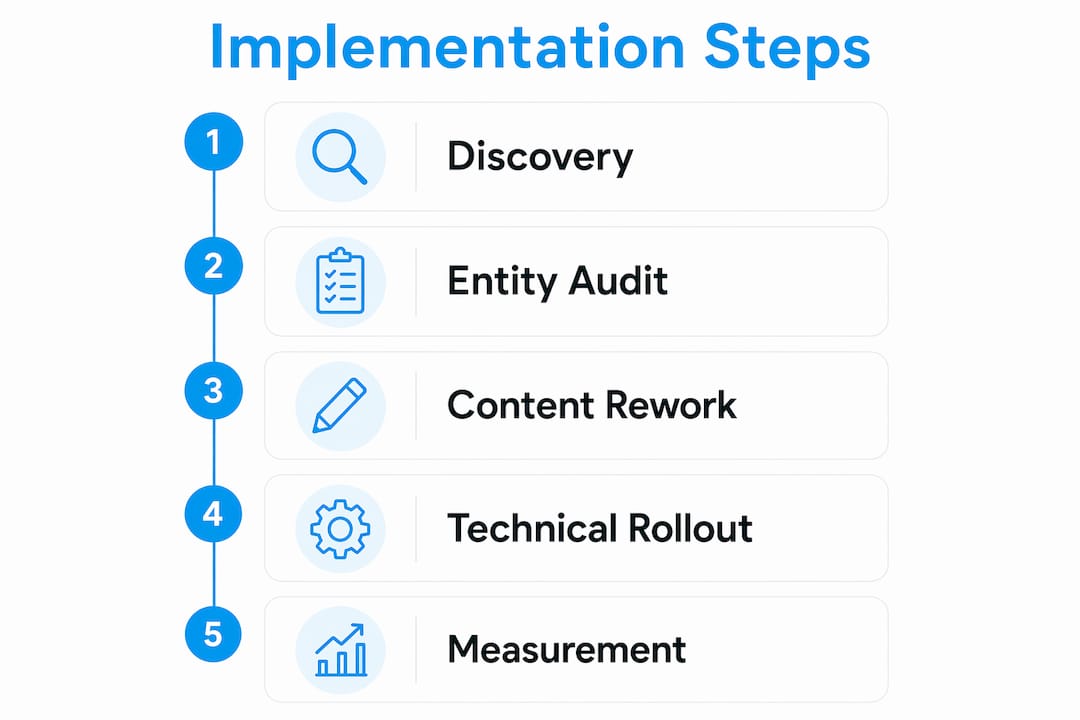
Real-studios (trading as AIthatworks) is a Manchester-based AI consultancy that delivers GEO as a structured engagement alongside its RAG, voice, chat, and email agent development services. The GEO process follows five phases.
Phase 1: Discovery and entity audit. Real-studios maps the client's existing entity signals across their website, social profiles, UK directories, and third-party mentions. Gaps in entity consistency are identified and prioritised.
Phase 2: Entity architecture. A canonical entity description is agreed and propagated across all owned and controllable platforms. Schema markup is specified and handed to the client's development team or implemented directly.

Phase 3: Content rework. Priority pages are restructured to meet extraction standards: H2s front-loaded with direct answers, FAQ sections added, and passage lengths calibrated to the 100–160 word extraction window.
Phase 4: Technical rollout. llms.txt is created and published. Robots.txt is audited for AI crawler access. AI service integrations are configured where clients require automated content pipelines or RAG-backed knowledge bases.
Phase 5: Measurement and reporting. Monthly citation monitoring is set up across Google AI Overviews, ChatGPT Search, Perplexity, Bing Copilot, and Gemini. Clients receive a structured citation report showing prompt-by-prompt presence, share of voice, and branded search trends.
Typical client deliverables from a GEO engagement include:
- Entity architecture document and brand description guidelines
- llms.txt file and robots.txt recommendations
- Restructured content for five to ten priority pages
- Core schema stack (Article, FAQPage, Organisation, Person) implemented or specified
- Monthly citation monitoring dashboard
- Quarterly GEO performance report with recommended next actions
Key takeaways
LLM SEO requires front-loaded, extractable content combined with consistent multi-platform entity signals and technical AI crawler access to generate measurable citation gains within 60–90 days.
| Point | Details |
|---|---|
| Front-load every answer | 44.2% of LLM citations come from the first 30% of an article; restructure H2s to open with direct answers. |
| Technical access is non-negotiable | Allow GPTBot, PerplexityBot, and Bingbot in robots.txt and publish an llms.txt at domain root. |
| Brand authority drives citations | One study measured a 0.334 correlation between brand authority signals and citation selection; multi-platform presence is a core input. |
| Measure by engine, not by rank | Track citation frequency per prompt across all five major AI engines; organic rank does not predict citation inclusion. |
| Real-studios delivers GEO end-to-end | Real-studios provides entity architecture, extraction-ready content, schema implementation, and monthly citation reporting for UK teams. |
What UK marketers should expect from LLM search in the next 12 months
The most important thing to understand about LLM-driven search right now is that it is not one platform. It is five distinct platforms with divergent source pools, citation behaviours, and update cycles. Only 11% of domains get cited by both ChatGPT and Perplexity. That fragmentation is not a temporary state; it is the structural reality of a market where each engine trains on different data and retrieves from different indices.
What this means practically is that "ranking in AI search" is a misleading frame. You are not optimising for a single algorithm. You are building a presence that is coherent, extractable, and authoritative enough to survive five separate retrieval and extraction decisions simultaneously. UK teams that treat GEO as a one-time technical fix will see early gains erode as engine behaviour shifts. Gemini 3 becoming the default for AI Overviews in January 2026 erased 42.4% of previously cited domains from sources. That kind of volatility is not going away.
The teams that will hold citation share are the ones building durable signals: consistent entity descriptions, topical cluster depth, genuine multi-platform presence, and a measurement cadence that catches engine shifts before they become invisible losses. Cross-functional collaboration between content, SEO, PR, and technical teams is not a nice-to-have for GEO. It is the only way to maintain the breadth of signals these engines require. Marketing teams that silo GEO inside the SEO function will underperform against those that treat it as a brand and communications discipline.
Real-studios GEO and RAG services for UK marketing teams
UK marketing teams that want AI citation gains without rebuilding their entire content operation have a direct route: commission a GEO engagement with Real-studios. The Manchester consultancy delivers measurable citation improvements through a structured five-phase process, from entity architecture to monthly citation reporting, without requiring a long-term contract or a full agency retainer.
The core deliverables are practical and scoped: entity architecture, extraction-ready content for priority pages, a full schema stack, and a citation monitoring dashboard across all five major AI engines. For teams that also need RAG systems, voice agents, or automated content pipelines, Real-studios builds those as integrated projects rather than separate engagements.
- Entity architecture and brand alignment across your website, LinkedIn, and UK directories
- Extraction-ready content for five to ten priority pages, calibrated to the 100–160 word extraction window
- Monthly citation monitoring across Google AI Overviews, ChatGPT, Perplexity, Bing Copilot, and Gemini
To discuss a scoped GEO project for your team, request a consultation with Real-studios.
Useful sources and tools
The following resources are referenced in this article or provide authoritative further reading for UK marketing teams implementing GEO.
Platform and engine documentation
- Bing Webmaster Tools — crawl diagnostics, GPTBot access, and index coverage for Microsoft's AI surfaces
- Google Search Console — index coverage, Core Web Vitals, and AI Overviews appearance data
- Schema.org — canonical reference for Article, FAQPage, Organisation, Person, and BreadcrumbList schema types
Research and GEO primers
- How LLM Citations Work (2026): The 4-Stage Pipeline Explained — pipeline mechanics and the 44.2% first-30% citation finding
- LLM Citations: How Each AI Engine Actually Cites Sources — per-engine citation behaviour and platform source pools
- Generative Engine Optimization: Best Practices 2026 — schema stacks, answer block structure, and the 60–90 day measurement window
- Auditing citation behaviour in AI-generated search summaries — academic audit of Google AI Overviews citation dynamics
- Generative engine optimization (GEO): How to win AI mentions — Search Engine Land's practitioner overview
Monitoring and citation tracking
- Semrush AI Visibility Toolkit — tracks brand presence across ChatGPT, Claude, and Google AI Overviews
- Real-studios GEO and AI services — bespoke citation monitoring, entity architecture, and RAG implementation for UK businesses