Fix Survivorship Bias with Hybrid Lead Scoring AI for Revenue Teams
AI lead scoring ranks every lead in your pipeline by likelihood to convert, replacing static point systems with models trained on your actual win and loss history. It works best once you have enough historical outcomes to train against, usually several hundred closed deals, and a CRM disciplined enough to feed the model clean signals. Get both right and scoring drives faster routing and fewer wasted sales hours.
TL;DR:
- AI lead scoring requires at least 500 clean, historical converted leads for reliable model training, especially for structured data models.
- Hybrid models combining rule-based filters with predictive or LLM-assisted scoring deliver better results by handling disqualifications and ambiguous cases efficiently.
- Regular data audits, phased pilots, and ongoing monitoring ensure trusted, effective scoring systems, with models needing retraining at least quarterly for best performance.
- Model failure often stems from incomplete data, inconsistent stage definitions, or biases towards familiar deal types, which can be mitigated with proper data hygiene and override tracking.
- Connecting scores to automated routing workflows amplifies value, with timely retraining and drift detection essential for maintaining prediction accuracy.
Table of Contents
- What is AI lead scoring and how does it differ from rule-based scoring?
- Why AI lead scoring matters for revenue teams
- Which model architecture fits your data: predictive ML, LLM-assisted or hybrid?
- How much data do you need before AI lead scoring works?
- How do you implement AI lead scoring from audit to go-live?
- What causes AI lead scoring to fail, and how do you catch it?
- How do you monitor and retrain an AI lead scoring model?
- How Real Studios and AIthatworks approach AI lead scoring in practice
- What I'd tell a revenue team starting this today
- Get help building your AI lead scoring pilot
- Sources
What is AI lead scoring and how does it differ from rule-based scoring?
Rule-based scoring assigns fixed points for attributes like job title or company size, set by a marketing team's best guess. AI lead scoring instead trains a model on your closed-won and closed-lost history, learning which combinations of signals actually predict conversion rather than which ones sound plausible on a whiteboard.
The model draws on four signal categories:
- Firmographic data: company size, industry, revenue band.
- Behavioural data: page visits, email opens, demo attendance.
- Intent signals: pricing page views, competitor comparisons, third-party research activity.
- Unstructured signals: call transcripts, support tickets, free-text form fields.
| Approach | Learns from history | Handles unstructured data | Best fit |
|---|---|---|---|
| Rule-based | No | No | Very early stage, no historical data |
| Predictive ML | Yes | Limited | 500+ historical outcomes, structured CRM |
| LLM-assisted | Partially | Yes | Smaller datasets, rich text signals |
The mechanism matters less than the discipline behind it. A model is only as good as the outcomes it learns from.
Why AI lead scoring matters for revenue teams
The core payoff is prioritisation: reps spend time on leads statistically likely to close instead of working a list top to bottom. That sounds obvious, but most sales teams still triage by gut feel or lead-creation date.
Real gains show up in three places:
- Conversion: models surface patterns humans miss across dozens of interacting variables.
- Response time: wiring scores into automated routing shortens the gap between lead capture and first outreach.
- Efficiency at scale: teams handling hundreds of leads a week benefit more than a two-person sales team working a handful of accounts personally.
Pipeline efficiency gains of 15 to 40 percent are commonly reported when deployments meet three operational prerequisites: sufficient closed-won history, a sales team large enough for routing to matter, and disciplined CRM hygiene. Skip any one of those and the same model produces mediocre results. Smaller inside-sales teams with high lead volume and low average deal size tend to see the fastest payback, since routing decisions repeat often enough for the efficiency gain to compound.
Which model architecture fits your data: predictive ML, LLM-assisted or hybrid?
Predictive machine learning models, typically gradient-boosted trees or logistic regression, win when you have hundreds of clean historical outcomes and mostly structured data. They're fast, cheap to run at scale, and easy to monitor with standard classification metrics.
LLM-assisted scoring earns its place when historical data is thin or the useful signal sits in unstructured text, a support ticket, a call transcript, a free-text "tell us about your project" field. It can reason over context a structured model would never see, though it carries higher per-lead cost and more output variance.
Most production systems in 2026 land on a hybrid architecture, and for good reason: rule-based filters handle the hard disqualifications (wrong geography, competitor domains) while a model layer scores the ambiguous middle. A hybrid build needs five components:
- Data ingestion from CRM and marketing platforms.
- Feature engineering pipelines.
- A model layer (ML, LLM, or both).
- Integration with routing and CRM workflows.
- Continuous monitoring for drift.
Combining LLM reasoning for novel signals with predictive models for scale is becoming the default pattern rather than the exception.
How much data do you need before AI lead scoring works?
The most common failure isn't a bad algorithm, it's launching before there's enough history to learn from. A widely cited benchmark puts the minimum viable dataset at around 500 clean, historical converted leads for reliable predictive performance. Below that threshold, LLM-assisted or hybrid approaches tend to outperform a pure ML model trained on too little.
Three data problems show up repeatedly, and each has a straightforward fix:
- Duplicate records distort win rates. Run deduplication before training, not after.
- Inconsistent stage definitions across sales reps corrupt the labels the model learns from. Agree on one definition of "qualified" and enforce it in the CRM.
- Missing timestamps on stage transitions make it impossible to build early-touch features. Timestamp every stage change going forward, even if historical data can't be fixed retroactively.
On feature engineering: train only on signals available at the point of scoring, not fields populated after a deal closes. A "contract value" field filled in during negotiation will leak information the model shouldn't have had when the lead was new, inflating accuracy in testing and collapsing it in production.
Pro Tip: Before building anything, pull 500 closed deals and check what percentage have complete data at the point they became an MQL. A model trained on incomplete records will simply encode that incompleteness as a prediction rule.
How do you implement AI lead scoring from audit to go-live?
Treat this as a runbook, not a one-off project. Skipping steps to move faster almost always costs more time later fixing a model nobody trusts.
- Audit existing data. Baseline your current conversion rate, average response time, and CRM field completeness before touching a model.
- Design a pilot. Score a subset of live leads without changing routing yet, measure how scores would have performed against actual outcomes, and set a clear success threshold in advance.
- Integrate scores into routing. Build three automated bands: high-confidence leads go straight to a rep with an SLA, mid-confidence leads enter a nurture sequence, low-confidence leads get lightweight automated follow-up.
- Roll out gradually. Expand from the pilot segment once the A/B comparison against your existing process shows a real lift, not just a plausible one.
- Set a retrain schedule. Quarterly retraining is a reasonable default for most B2B motions; faster-moving markets may need monthly retraining.
Connecting scores to automated routing and workflows is where most of the value actually gets captured, not in the scoring model itself.
What causes AI lead scoring to fail, and how do you catch it?
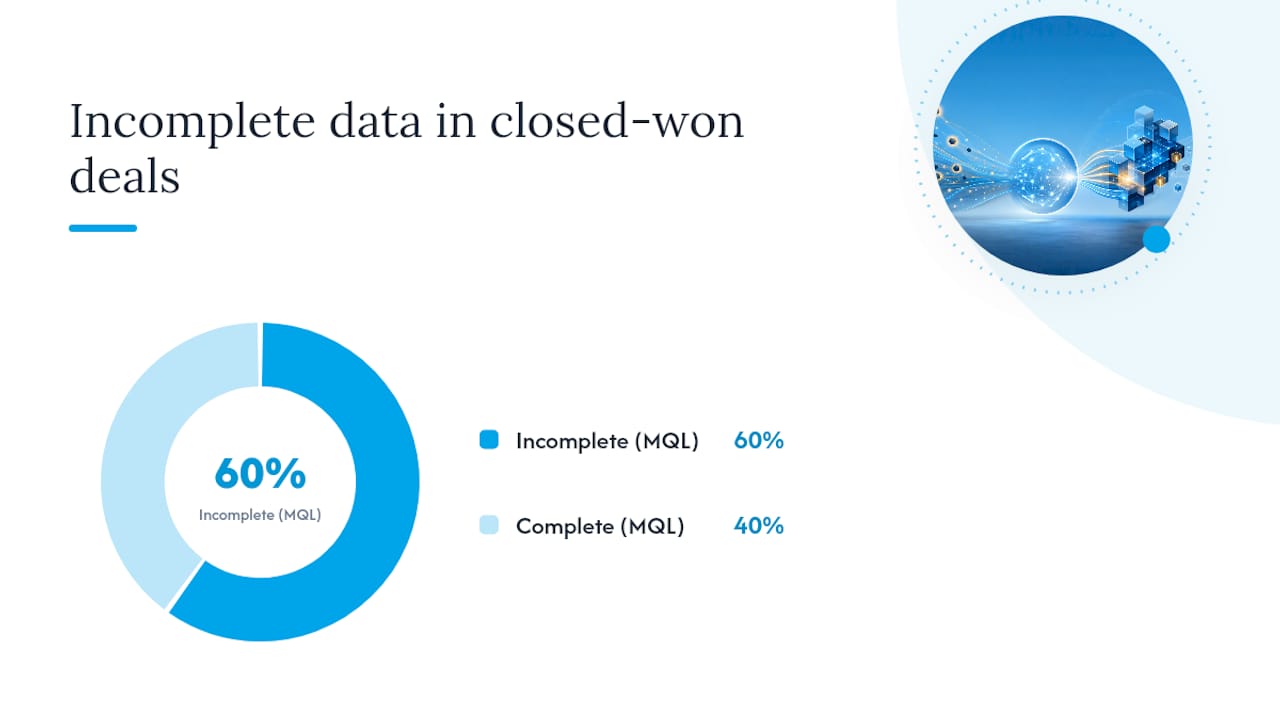
The most damaging failure mode is survivorship bias: models learn from complete records belonging to past winners, because those are the deals with clean, filled-in CRM fields. One analysis found that up to 60% of closed-won deals outside the ideal customer profile had incomplete data at MQL stage, meaning the model never properly learned what an unconventional but winnable lead looks like.
Watch for these symptoms and responses:
- Symptom: the model consistently underscores leads that later convert. Fix: audit whether those leads share a data-completeness gap at capture time.
- Confidence-based routing: leads the model scores with low certainty, not just low probability, should escalate to a human rather than get auto-deprioritised.
- Human overrides: every time a rep overrides a score, capture the reason.
Pro Tip: Make override capture nearly frictionless, a two-sentence justification typed into Slack is enough. That short note becomes retraining data that teaches the model exactly the edge cases it currently misses.
How do you monitor and retrain an AI lead scoring model?
Production scoring needs the same operational rigour as any other system reps depend on daily. Track these by score band, not just in aggregate:
- Precision and recall per band (high, medium, low confidence), since a model can look accurate overall while failing badly in one band.
- Conversion rate by band, checked against what the model predicted.
- Data and concept drift, flagged when incoming lead characteristics shift from the training distribution.
- Explainability, surfacing the top signals behind each score so reps trust, rather than ignore, the number.
A well-built pipeline should evaluate models on precision, recall and AUC alongside business metrics like pipeline velocity, not accuracy figures alone. Reserve full retraining for quarterly cycles as a baseline, with lightweight recalibration whenever drift alerts fire in between.
How Real Studios and AIthatworks approach AI lead scoring in practice
AIthatworks, the Manchester-based consultancy behind Real Studios, builds the kind of hybrid systems this guide describes rather than treating scoring as an off-the-shelf plug-in. The practical work spans several stages:
- Data audit: assessing CRM completeness and historical outcome volume before recommending any model type.
- Integrations: connecting scoring outputs to CRM fields and routing logic so scores trigger action, not just sit in a dashboard.
- RAG agents: deploying retrieval-augmented systems that reason over unstructured signals, call notes, support tickets, when structured data alone isn't enough.
- Ongoing support: monitoring drift and retraining after launch, rather than handing over a model and disappearing.
A typical starter engagement begins with a data readiness audit, moves into a scoped pilot against a defined success metric, and expands into full routing integration once the pilot clears that bar. AIthatworks also builds Generative Engine Optimisation work alongside scoring projects, recognising that revenue teams increasingly need visibility in AI-driven search as much as accurate pipeline prioritisation.
What I'd tell a revenue team starting this today
Three heuristics hold up consistently: check your data before you touch a model, wire every score to an automated action or it's dead weight, and route anything below a confidence threshold to a human rather than trusting a number blindly. If you're starting from zero, the single highest-leverage move is auditing your last 500 closed deals for completeness before you evaluate a single vendor or model.
— Oded
Get help building your AI lead scoring pilot
Real-studios builds the hybrid scoring systems this guide describes, rather than selling a generic scoring dashboard that needs three more integrations before it does anything useful. If your CRM has the historical data but not the routing logic, Service Integrations covers connecting scores to your existing sales workflow, and Service MVP is built for exactly the kind of scoped pilot this guide recommends running before a full rollout.
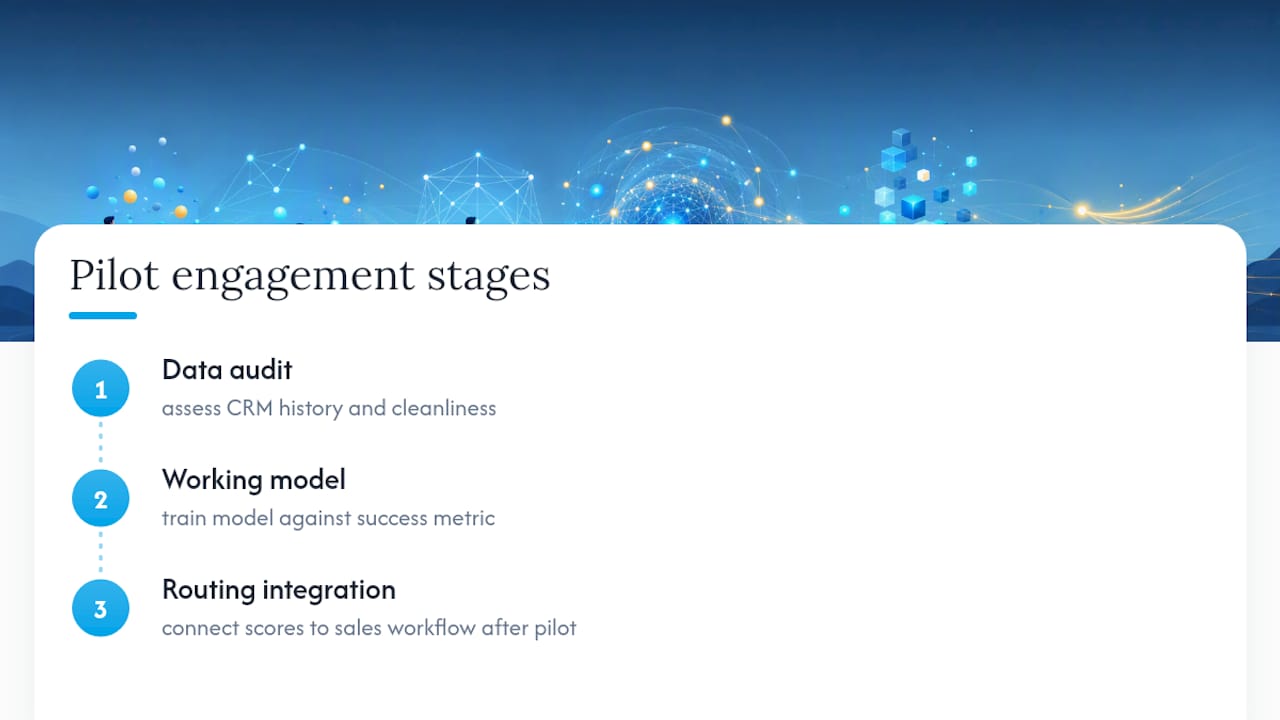
A typical starter engagement runs as a short pilot: a data audit, a working model against a defined success metric, and a routing integration once the pilot clears that bar. If you're weighing whether your CRM has enough clean history to start, request a data readiness audit through Real Studios and get a straight answer before committing to a full build.
Sources
- How to Build an AI Lead Scoring System for B2B SaaS. - The SaaS Library
- AI lead scoring can increase leads and appointments and improve prioritisation