Generative engine optimization: a practical GEO playbook
Generative engine optimization (GEO) is the practice of structuring your site, content, and entity signals so that AI engines cite your business in their generated responses. The goal is not a ranking position but a citation. Start today by auditing crawler access, rewriting your top five H2 sections to open with a standalone answer in the first 40 words, and adding Organization schema with sameAs links to your homepage.
Immediate actions (do these first):
- Check
robots.txtto confirm GPTBot, ClaudeBot, and PerplexityBot are not blocked - Rewrite the opening sentence of your top five H2 sections to deliver a direct answer before any context
- Add a placeholder
llms.txtfile to your root directory listing your key pages and their purpose - Implement
Organizationschema withsameAspointing to your Wikidata, LinkedIn, and Companies House profiles
Analysis of AI citation patterns shows that a significant portion of AI citations are drawn from the first part of a page. Front-loading your answers is not a stylistic preference; it is the single highest-leverage technical edit you can make this week.
Table of Contents
- What is generative engine optimization?
- How does GEO differ from traditional SEO?
- Why should UK businesses prioritise GEO now?
- What core signals does GEO depend on?
- Practical GEO tactics you can apply this week
- Technical prerequisites your site must meet
- How do you measure GEO performance?
- Which tools and resources should you use?
- What are the risks and limits of GEO?
- How to get started: a 90-day GEO plan
- E-E-A-T in practice: how Real-studios implements GEO
- Key takeaways
- Real-studios helps UK businesses get cited by AI engines
What is generative engine optimization?
GEO is the discipline of making your content and entity signals legible to AI engines so they surface your brand inside generated answers. It sits alongside answer engine optimisation (AEO), LLM SEO, and agentic search optimisation — terms that describe overlapping practices with slightly different emphases.
Related terms mapped:
- AEO (Answer Engine Optimisation): optimising for direct-answer retrieval, typically in voice and featured snippets; GEO extends this to generative models
- LLM SEO: the subset of GEO focused specifically on large language model retrieval and citation behaviour
- Agentic search: AI systems that autonomously browse and synthesise sources; GEO signals help agents identify your content as authoritative
Concrete outputs of GEO work include appearing as a cited source in a Google AI Overview, being referenced by name in a ChatGPT Search response, or having your brand mentioned in a Perplexity summary with a link back to your site. The scope spans two levels: entity-level signals (who you are, what you do, how you are corroborated externally) and page-level signals (whether individual passages can be extracted and attributed accurately). Both levels must be addressed; Wikipedia's overview of GEO confirms the field covers both content structure and entity authority.
How does GEO differ from traditional SEO?
GEO does not replace SEO. It sits on top of the SEO foundation, and that dependency is non-negotiable. AI citations overwhelmingly come from pages that are already crawlable and rank organically. Skipping SEO to jump straight to GEO is the most common failure mode practitioners report.

| Dimension | Traditional SEO | GEO layer |
|---|---|---|
| Primary objective | Rank in organic results | Be cited in AI-generated answers |
| Key signals | Backlinks, on-page relevance, Core Web Vitals | Entity authority, extractable passages, schema, corroboration |
| Success metric | Position 1–10, click-through rate | Citation frequency, brand mention share of voice |
| Timeline to results | 3–6 months typical | 30–90 days for quick wins; 3–6 months for authority |
| Content format priority | Keyword-optimised prose | Standalone H2 answers, FAQPage schema, structured tables |
ChatGPT Search citations overlap with Bing's top organic results roughly 87% of the time, which illustrates how tightly the two disciplines are coupled. Google AI Overviews draw heavily from top organic results and structured data. The practical implication: every technical SEO fix you make also improves your GEO standing.
Pro Tip: The fastest extractability win is rewriting H2 openings. A section that begins "The answer is X because Y" gives an AI engine a complete, attributable passage in under 40 words. Sections that open with context, history, or caveats are routinely skipped by retrieval models.
Why should UK businesses prioritise GEO now?
GEO increases the probability that your brand is surfaced inside AI responses, which raises brand discovery and trust at the moment a potential client is forming a decision. For UK businesses, this matters because AI engines are increasingly the first point of research for professional buyers.
Measurable business impacts:
- Brand mention share of voice: the proportion of relevant AI-generated answers that name your brand, trackable via prompt-map testing
- Attribution rate: the percentage of AI citations that include a link or explicit reference back to your domain
- Reduced paid channel dependency: organic AI citations can offset some demand-generation spend over time
- Trust signals at zero click: a buyer who sees your brand cited in a ChatGPT response has already received a third-party endorsement before visiting your site
For UK businesses operating in regulated or YMYL (Your Money or Your Life) categories, professional registers and industry bodies carry particular weight. A law firm cited by the Solicitors Regulation Authority directory, or a financial services provider listed on the FCA register, gains corroboration signals that AI engines treat as high-confidence sources. Gartner predicts traditional search engine volume will drop 25% by 2026 due to AI chatbots and virtual agents. The shift is already under way.
What core signals does GEO depend on?
GEO depends on four pillars: a crawlable foundation, extractable passages, entity architecture, and external corroboration. Miss any one of them and the others underperform.
The four pillars explained:
- Crawlable foundation: AI crawlers (GPTBot, ClaudeBot, PerplexityBot) must be permitted in
robots.txtand your content must be server-rendered or pre-rendered. JavaScript-only rendering is a hard blocker. - Extractable passages: Each H2 section should open with a standalone answer. Front-loading direct answers in section openings materially improves AI extractability, with measurable gains typically visible within 60–90 days.
- Entity architecture: Your brand name, canonical URL, and description must be identical across your site and every external profile.
Organizationschema withsameAsJSON-LD links to Wikidata, LinkedIn, and Companies House creates the confidence signal LLMs need to attribute citations to your organization accurately. - External corroboration: Unlinked brand mentions on authoritative platforms, community sites, and industry directories correlate with higher AI citation frequency. A backlink is useful; a mention on a trusted platform is often more useful for LLM retrieval.
Pro Tip: Consistent brand naming matters more than an extra backlink. If your site says "Real-studios", your LinkedIn says "Real Studios Ltd", and your Wikidata entry says "RealStudios", LLMs cannot confidently attribute citations to a single entity. Resolve naming inconsistencies before building new mentions.
| Schema type | GEO purpose | Priority |
|---|---|---|
| Organization | Entity identity, sameAs links | Critical |
| FAQPage | Maps Q&A pairs for direct extraction | High |
| Article / BlogPosting | Author, date, publisher attribution | High |
| BreadcrumbList | Site structure signal | Medium |
| Person | Author E-E-A-T for YMYL content | Medium |
Structured data covering these schema types materially improves passage retrieval across AI engines.
Practical GEO tactics you can apply this week
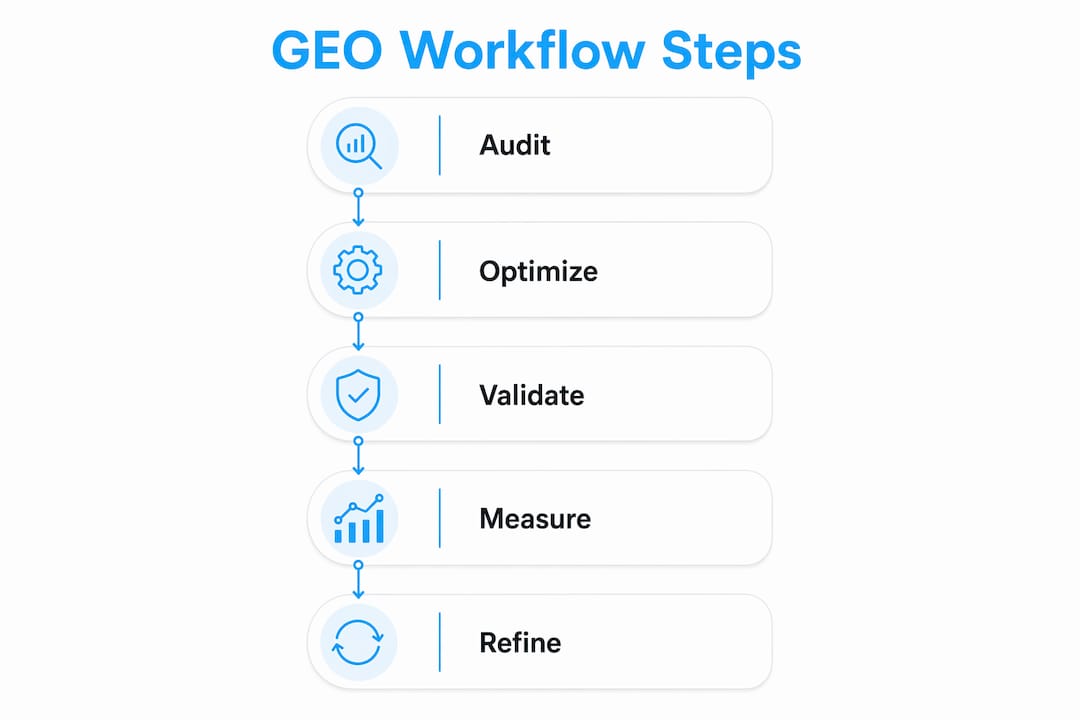
Work through pages in order of commercial priority: your homepage, your top three service or product pages, and your highest-traffic blog posts. The order of operations is: audit, structure, schema, distribution, monitor.
Step-by-step implementation:
- Audit — crawl your site with a tool such as Screaming Frog or Sitebulb; flag pages blocked to AI crawlers, pages with no H2 structure, and pages missing schema
- Structure — rewrite H2 openings to lead with a direct answer; add FAQ sections to service pages and mark them up with
FAQPageschema; replace prose comparisons with structured tables - Schema — deploy the core stack:
Organization(homepage),ArticleorBlogPosting(editorial content),FAQPage(Q&A sections),Person(author pages) - Distribution — publish supporting content on YouTube (transcripts matter), submit to relevant UK industry directories, and build consistent profile copy across LinkedIn, Google Business Profile, and sector-specific registers
- Monitor — run a prompt-map test across Google AI Overviews, ChatGPT Search, and Perplexity; record baseline citation frequency before any changes
For content edits specifically:
- Open every H2 with the answer, not the question or context
- Use numbered lists for processes (AI engines extract ordered steps reliably)
- Add a comparison table wherever you currently use a prose paragraph to compare options
- Map every FAQ entry to a
FAQPageschema block
Perplexity weights community validation heavily, so community platforms and technical documentation are strong citation sources for that engine specifically. Tailor your distribution accordingly.
Pro Tip: For YouTube content, publish a full transcript as a companion blog post. AI engines can cite text; they cannot reliably extract meaning from audio alone. A transcript doubles your extractable surface area at near-zero marginal cost.

Technical prerequisites your site must meet
Without crawlable, server-rendered content, GEO work cannot produce citations. Technical fixes come before content edits.
Non-negotiables:
robots.txtmust explicitly allow GPTBot, ClaudeBot, and PerplexityBot (or use a permissive wildcard with no AI-crawler exclusions)- Content must be server-side rendered or pre-rendered; client-side JavaScript rendering blocks AI crawlers that do not execute JS
- Canonical tags must be correct; duplicate or missing canonicals cause AI engines to attribute content to the wrong URL
- An XML sitemap must be submitted to Google Search Console and kept current
- Core Web Vitals should meet Google's thresholds; slow pages are prioritised in retrieval
Verification tools:
- Google Search Console — use the URL Inspection tool to confirm indexing status and check for crawl errors; the Rich Results Test validates your schema implementation
- Crawl simulators — Screaming Frog, Sitebulb, or similar tools to audit
robots.txtcompliance and rendering llms.txt— publish a plain-text file atyourdomain.com/llms.txtlisting your key pages, their purpose, and your canonical brand description; this is an emerging convention that several AI crawlers already read
Google's official guidance recommends applying foundational SEO practices, making content valuable and structured, and implementing structured data when optimising for generative AI features. That guidance is the authoritative starting point for any technical GEO audit.
Skipping technical foundations is the primary cause of failed GEO projects. Superficial content tweaks without the engineering fixes underneath yield no citation gains.
How do you measure GEO performance?
The core metric set for GEO is: AI citation frequency, attribution rate, AI share of voice, brand mention volume, and accuracy rate (whether the AI's description of your brand is correct).
| Metric | What it measures | How to track |
|---|---|---|
| AI citation frequency | How often your domain appears in AI-generated answers | Prompt-map tests across Google AI Overviews, ChatGPT Search, Perplexity |
| Attribution rate | % of citations that include a link or explicit brand reference | Manual prompt testing; emerging citation-tracking tools |
| AI share of voice | Your citations vs. category competitors in AI responses | Prompt-map comparison across a defined query set |
| Brand mention volume | Total unlinked and linked brand mentions across the web | Google Alerts, media monitoring tools |
| Accuracy rate | Whether AI descriptions of your brand are factually correct | Manual review of AI-generated answers |
Timeline expectations:
- 30–90 days: measurable improvement in extractability for restructured pages; initial citation appearances for well-corroborated entities
- 3–6 months: meaningful AI share of voice gains for competitive queries; schema and entity signals fully indexed
- 6 months+: compounding authority from third-party mentions and consistent entity signals
Baseline your prompt map before making any changes. Run cross-engine checks across Google AI Overviews, ChatGPT Search, and Perplexity for your top 10 queries and record domain citation frequency. Without a baseline, you cannot attribute gains to specific interventions.
Which tools and resources should you use?
Start with official documentation, then layer in practical tooling.
Official and primary sources:
- Google Search Central's AI optimisation guide — the authoritative reference for structured data, crawlability, and generative feature optimisation
- Google Search Console — indexing reports, URL Inspection, and Rich Results Test for schema validation
- Google's Rich Results Test — validates FAQPage, Article, and Organization schema before deployment
- Semrush's GEO practical guide — one of the most thorough practitioner references for schema stacks and citation tactics
Practical tooling:
- Screaming Frog / Sitebulb — crawl audits,
robots.txtchecks, rendering verification - Google Alerts / media monitoring tools — brand mention tracking for corroboration signals
- Transcript tooling — Descript, Otter.ai, or YouTube's auto-captions for companion blog posts
UK-specific resources:
- Companies House — a high-authority UK register; listing your business here and linking it via
sameAsis a strong entity signal for UK-focused AI engines - FCA Register, SRA, ICO — for regulated UK sectors, presence on the relevant professional register is a corroboration signal AI engines treat as high-confidence
- GOV.UK — where your business has any regulatory or compliance presence, that GOV.UK reference is one of the strongest UK entity corroboration signals available
What are the risks and limits of GEO?
GEO can improve visibility, but it also risks amplifying stale or inaccurate content at scale. AI engines cite what they find; if your content contains an outdated claim, that claim may be surfaced to thousands of users before you notice.
Key risks to manage:
- Hallucination amplification: if your content lacks clear source attribution, AI engines may blend it with other sources and produce inaccurate composites; always cite your sources explicitly within the content itself
- Training data bias: AI engines reflect the biases of their training data; if your sector is underrepresented, you may need more corroboration signals than a mainstream category
- YMYL caution: for UK regulated sectors (financial services, legal, medical), inaccurate AI citations carry compliance risk; add date stamps, author credentials, and conservative claims to every YMYL page
- Over-optimisation for machines: content restructured purely for extraction can degrade the human reading experience; always test restructured pages with real readers before publishing
- Citation errors: AI engines sometimes attribute content to the wrong source; monitor accuracy rate as a standing KPI
This article provides general guidance on GEO practices. For regulated sectors, confirm current requirements with the relevant UK regulatory body or a qualified professional.
How to get started: a 90-day GEO plan
Steps 1–8:
- Audit crawler access (Week 1, Dev) — check
robots.txtfor AI crawler blocks; fix any exclusions; confirm server-side rendering - Baseline prompt map (Week 1, SEO) — test your top 10 queries across Google AI Overviews, ChatGPT Search, and Perplexity; record citation frequency
- Rewrite H2 openings (Weeks 2–3, Content) — prioritise homepage, top service pages, and highest-traffic blog posts; each H2 must open with a standalone answer
- Deploy core schema stack (Weeks 3–4, Dev) —
OrganizationwithsameAs,FAQPageon service pages,Articleon editorial content - Publish
llms.txt(Week 4, Dev) — list key pages, canonical brand description, and contact information - Build corroborating mentions (Months 2–3, PR/Content) — target UK industry directories, Companies House, professional registers, and YouTube transcripts
- Set up measurement cadence (Month 2, SEO) — monthly prompt-map tests, Google Alerts for brand mentions, quarterly accuracy audits
- Iterate on schema and content (Month 3, Content/Dev) — use citation data to identify which pages are being cited and which are not; restructure underperforming pages
30/60/90 milestones:
- Day 30: crawler access confirmed, baseline recorded, top five pages restructured, core schema live
- Day 60:
llms.txtpublished, FAQ schema deployed, first distribution push complete, first citation gains visible - Day 90: full prompt-map review, accuracy audit, third-party mention programme running, measurement cadence established
If you can only change content: prioritise H2 rewrites and FAQ sections. These deliver the highest citation lift without engineering support.
If you can only change technical settings: fix robots.txt, deploy Organization schema, and publish llms.txt. These unblock citation potential for all future content work.
E-E-A-T in practice: how Real-studios implements GEO
Real-studios, the Manchester-based AI consultancy behind this guide, applies the same GEO methodology to its own site and to client engagements across the UK. The outcome: measurable increases in AI citation frequency and brand mention volume within the 30–90 day window described above.
The methodology in practice:
- Audit phase: crawl audit to confirm GPTBot and ClaudeBot access; baseline prompt-map test across Google AI Overviews, ChatGPT Search, and Perplexity for the consultancy's core service queries
- Passage restructuring: H2 openings rewritten to lead with direct answers; FAQ sections added to all service pages and marked up with
FAQPageschema - Schema stack:
Organizationschema withsameAslinks to Companies House, LinkedIn, and Wikidata;Personschema for named authors on YMYL-adjacent content llms.txtdeployment: published at root, listing service pages, canonical brand description, and contact details- Third-party mention strategy: submissions to UK AI and technology directories, YouTube transcript publication for video content, and consistent profile copy across all external platforms
- Timeline: initial citation appearances within 30 days of technical fixes; meaningful share of voice gains by month three
Real-studios's service integrations work connects GEO signals directly to RAG pipelines and AI agent deployments, so citation visibility and operational AI work reinforce each other.
Key takeaways
GEO requires a crawlable technical foundation, extractable content passages, consistent entity architecture, and external corroboration — all four pillars must be in place before citation gains become reliable.
| Point | Details |
|---|---|
| Confirm crawler access first | Block GPTBot or ClaudeBot in robots.txt and no amount of content work will produce citations. |
| Front-load every answer | 44.2% of AI citations come from the first 30% of a page; rewrite H2 openings to lead with the answer. |
| Entity architecture beats extra backlinks | Consistent brand naming and Organization sameAs markup give LLMs the confidence to attribute citations accurately. |
| Measure before and after | Baseline your prompt map across Google AI Overviews, ChatGPT Search, and Perplexity before making changes. |
| Real-studios delivers end-to-end GEO | Real-studios audits, restructures, and deploys the full GEO stack for UK businesses, with schema, llms.txt, and distribution included. |
Why GEO is the most underestimated shift in digital marketing right now
Most digital marketing teams are still treating AI search as a future problem. It is not. The shift from ranked results to generated answers is already affecting brand discovery for professional services, technology, and B2B categories in the UK. The businesses being cited in AI responses today are not necessarily the biggest or the best-funded. They are the ones that made their content extractable and their entity signals consistent before their competitors noticed the change.
The conventional wisdom says "wait and see how AI search matures." The problem with that position is that entity authority and corroboration signals take months to build. A business that starts in January will have a meaningful head start over one that starts in July. GEO is not about gaming AI engines. It is about being a clear, credible, well-structured source of information. That is what good content has always required. The difference now is that the reader is sometimes a machine, and machines need explicit signals that humans can infer.
The teams that will win in AI-driven search are the ones treating GEO as infrastructure, not as a campaign.
Real-studios helps UK businesses get cited by AI engines
UK businesses that want to appear in AI-generated answers need more than a content refresh. They need a structured GEO architecture: confirmed crawler access, extractable passages, a deployed schema stack, llms.txt, and a third-party mention programme that builds corroboration over time.
Real-studios delivers exactly that. As a Manchester-based AI consultancy, we run GEO audits, restructure priority pages for passage extraction, deploy the full schema stack, and connect GEO signals to RAG pipelines and AI agent integrations. The result is a business that AI engines can identify, trust, and cite. Explore our full GEO and AI services or get in touch to discuss a scoped GEO audit for your site.
Useful sources
- Google Search Central: optimising for generative AI features — the authoritative technical reference; start here for crawlability, structured data, and generative feature guidance
- Semrush: Generative Engine Optimization — a practical guide — schema stacks, citation tactics, and measurement frameworks; use during implementation phases 3–5
- WhyIQ: Does AEO/GEO replace SEO? — data on citation overlap with organic rankings; useful for setting stakeholder expectations
- Wikipedia: Generative engine optimization — scope overview and terminology reference
- Zealousweb: GEO best practices — practitioner guidance on H2 front-loading, llms.txt, and layered rollout
- Google Search Console — use throughout for indexing verification, URL Inspection, and Rich Results Test validation