Architecture First GDPR for Chatbots: 2026 Runbook for UK & EU Teams
Yes: GDPR, including UK GDPR, applies whenever a chatbot processes personal data. First, map every data flow the chatbot creates, decide and document your lawful basis, and run a DPIA if the bot uses AI or handles higher risk queries. The sections below cover lawful basis, transparency, retention, DPIAs and provider checks in the order you need to tackle them.
TL;DR:
- Mapping all data flows, deciding lawful bases per processing activity, and conducting DPIAs is essential before deploying an AI chatbot handling personal data.
- Transparent privacy notices must include clear in-chat disclosures and full notices detailing data use, retention, third-party sharing, and model training, with disclosures layered for usability.
- Implementing architecture controls like server-side redaction, purpose tagging, and strict access restrictions reduces privacy risks more effectively than relying solely on privacy notices.
- Retention periods should match the purpose, typically 30 to 90 days for active support, with longer but time-limited retention for quality and investigation records; deletion should be automated.
- Use signed data processing agreements with all third-party LLM providers, verify data transfer mechanisms, and establish breach detection tools to meet GDPR requirements and ensure ongoing compliance.
Table of Contents
- GDPR compliance chatbots: scope, roles and what counts as personal data
- Choosing and documenting a lawful basis for chatbot processing
- Chatbot privacy regulations: what your transparency notice must say
- Data protection for chatbots: engineering patterns that reduce risk
- Chatbot data security under GDPR: retention, deletion and subject access
- DPIA for AI chatbots: structure, risks and sign-off
- Third-party LLMs and cross-border transfers: what to demand from providers
- Security controls and prompt-injection mitigation
- Automated decision-making and human oversight under Article 22
- Practitioner runbook: proving your chatbot is compliant
- Cookie and tracking rules alongside chatbot operations
- Chatbot logs and breach notification obligations
- Training and use of chatbots on datasets containing personal data
- Handling minors and special category data in chat interactions
- Author perspective: build the architecture before the policy
- How Real-studios helps you build GDPR-aware chatbots from day one
- Sources
- FAQ
GDPR compliance chatbots: scope, roles and what counts as personal data
A chatbot that collects names, email addresses, account details, or even just an IP address alongside a query is processing personal data. That triggers GDPR obligations the moment the conversation starts, regardless of whether the business calls it "support" or "sales enablement".
Your organisation is the controller when it decides why the chatbot exists and what data it collects. The AI vendor supplying the underlying model is usually a processor, acting only on your instructions. That distinction collapses if the vendor also uses your conversation data to improve its own models. At that point you may be joint controllers, and your contract needs to say so explicitly.
Personal data in chat logs goes well beyond the message text:
- The conversation content itself, including anything a user types voluntarily
- Metadata: timestamps, session IDs, device type, browser fingerprint
- IP addresses and approximate location
- Inferred data: sentiment scores, intent classifications, purchase likelihood
Special category data under Article 9 gets engaged more easily than teams expect. A user typing "I need help with my diabetes medication order" into a retail chatbot has just disclosed health data, whether or not the bot was designed to ask for it.
Choosing and documenting a lawful basis for chatbot processing
There is no single "chatbot lawful basis". The correct choice depends on what the conversation is actually for, and the ICO's guidance on lawfulness in AI is explicit that this decision needs documenting per processing activity, not once for the whole system.
- Contractual necessity fits transactional exchanges, such as an order status bot handling a query tied to an existing purchase.
- Legitimate interests suits general customer support and lead qualification, where the business benefit is clear and the impact on the individual is limited.
- Consent becomes necessary when the bot collects special category data, targets marketing, or operates outside what a reasonable user would expect.
Treat research and training separately from live deployment. A model fine-tuned on historical support transcripts needs its own lawful basis assessment distinct from the basis covering a customer's live chat today. The ICO is clear that conflating the two is one of the most common accountability failures in AI-driven systems.
A Legitimate Interest Assessment for a chatbot does not need to be long. State the specific interest (faster query resolution, reduced support costs), confirm the processing is necessary to achieve it, and weigh that against the individual's expectations. If a reasonable user would be surprised the chatbot retains their message for six months, legitimate interests probably will not survive scrutiny; move to consent instead.
Pro Tip: Write your lawful basis decision into the chatbot's design document before development starts, not after launch. Retrofitting a basis after a regulator asks the question rarely goes well.
Chatbot privacy regulations: what your transparency notice must say
Every chatbot needs two layers of transparency: a full privacy notice and a short, visible disclosure inside the chat window itself.
The in-chat disclosure should cover four things in one or two lines: that the user is talking to an AI system, why data is being collected, how long it is kept, and a link to the full notice. Something like "You're chatting with our AI assistant. Messages are stored for 90 days to improve support and are not used for marketing. Full privacy notice here" does the job without disrupting the conversation.
Full privacy notices should specify:
- The legal basis for each type of processing the chatbot performs
- Whether messages are used to train or fine-tune any model
- Which third parties (including LLM providers) receive the data
- Retention periods and how users can request deletion or export
Layer the detail rather than dumping it all on the user at once. A short line at the first message, a hover tooltip on a small "i" icon, and a persistent link in the chat footer together satisfy both usability and the transparency principle without turning the interface into a legal document.
If the bot asks a question that touches special category data, such as health, religion, or sexual orientation, that specific moment needs its own micro-disclosure and, in most cases, explicit consent captured before the answer is processed further.
Pro Tip: Test your disclosure wording on someone outside the compliance team. If they cannot explain in one sentence what happens to their message after they send it, rewrite the notice.
Data protection for chatbots: engineering patterns that reduce risk
Most compliance value in an AI chatbot comes from architecture decisions, not from the wording on a privacy notice, as explained in AI - Amazing Devs. A server-in-the-middle pattern, where your own backend sits between the user and the LLM provider, gives you one place to enforce every control rather than hoping the model behaves.
That middleware layer should handle:
- Redaction before the prompt leaves your system. Strip obvious identifiers such as full names, phone numbers, and card numbers before the message reaches the LLM API.
- Context window discipline. Keep only what the model needs to answer the current query, not the user's entire chat history by default.
- Pseudonymisation of identifiers. Replace account numbers with internal tokens the LLM never sees in raw form.
- Purpose tagging on stored logs. Mark each conversation record with why it was kept (support quality, fraud investigation, legal hold) so it cannot quietly get reused for an unrelated purpose later.
- Role-based access controls. Restrict who inside the business can read raw conversation logs, and log every access.
This approach also solves a problem privacy notices cannot: it stops sensitive data reaching a third-party model in the first place, rather than just disclosing that it might. A retail chatbot that redacts card numbers server-side before calling the LLM has removed the risk entirely, not just documented it.
Chatbot data security under GDPR: retention, deletion and subject access
Retention windows should map to the actual purpose, not a default "keep everything forever" setting.
- Active support conversations: 30 to 90 days is usually enough to resolve follow-up queries, after which the operational need drops sharply.
- Conversations flagged for quality review or fraud investigation: a longer window, but time-boxed and documented, typically 6 to 12 months.
- Anonymised or aggregated analytics data: can be kept longer once identifiers are genuinely and irreversibly removed.
Build deletion as an API endpoint, not a manual database query someone runs when they remember. A workable test case: create a test user, generate several chat sessions, trigger deletion, then confirm via a database query that no row referencing that user ID remains in the logs, backups excluded but documented separately.
Mapping conversations to user identifiers matters for subject access requests. If a user's chatbot history is scattered across three systems with no shared key, you cannot fulfil a SAR within the one-month UK GDPR deadline. Build the identifier mapping before you need it under time pressure, not during a live request.
Portability requests need the export in a structured, commonly used format such as JSON or CSV, covering the full conversation history tied to that user, not a partial summary.
DPIA for AI chatbots: structure, risks and sign-off
A DPIA is not optional for most AI-driven chatbots. The ICO's guidance on accountability and governance treats it as the primary way to demonstrate compliance, and AI chatbots routinely trip several DPIA triggers at once: new technology, large-scale processing, automated decision-making and systematic monitoring, as Janus Compliance's DPIA guidance sets out.
A defensible DPIA for a chatbot should include:
- A plain-language system summary describing what the bot does and who uses it
- A data inventory covering every field collected, including inferred data
- A flow map showing every hop, including calls to external LLM providers
- Identified risks: re-identification, bias, over-retention, third-party misuse
- Mitigations mapped to each risk, with an owner and a date
- Residual risk rating and formal sign-off
| DPIA element | What to capture | Typical owner |
|---|---|---|
| System summary | Purpose, users, data types | Product owner |
| Data flow map | Every system and API the data touches | Engineering lead |
| Risk register | Re-identification, bias, retention, transfer risks | Data protection lead |
| Mitigations | Specific technical or policy fix per risk | Engineering + legal |
| Sign-off | Residual risk accepted or escalated | DPO or senior owner |
Budget two to four weeks for a first DPIA on a moderately complex chatbot, longer if multiple LLM providers are involved. Loop in your Data Protection Officer early rather than at the sign-off stage, and consider prior consultation with the ICO only where residual risk remains high after mitigation, which is rare once the redaction and retention controls above are in place.
Third-party LLMs and cross-border transfers: what to demand from providers
Every LLM provider your chatbot calls needs a signed Data Processing Agreement before a single production message reaches their API. Treat the contract review as a checklist, not a formality:
- Confirm a Data Processing Agreement is in place and explicitly covers chatbot conversation data
- Ask whether a zero-retention or no-training option exists, and enable it where offered
- Request the current sub-processor list and check it against your own risk appetite
- Confirm data residency settings, particularly if the provider defaults to US-based processing
Where personal data leaves the UK or EEA, you need a transfer mechanism, typically Standard Contractual Clauses, backed by a documented Transfer Impact Assessment. The GDPR text itself sets the baseline requirement that transfers to third countries need an adequate safeguard, and SCCs remain the most common route for AI provider contracts.
Do not take the vendor's compliance page at face value. Ask for evidence: a screenshot of the account-level retention setting, a sample deletion confirmation, or an audit log showing the zero-retention flag is actually active on your account, not just available in theory.
Security controls and prompt-injection mitigation
Standard security hygiene still applies: TLS in transit, encryption at rest, secrets kept in a managed vault rather than environment files, and access controls reviewed on a schedule.
Chatbot-specific risks need their own layer:
- Prompt hardening to stop a user's input overriding the bot's system instructions and extracting data it should not disclose
- Response sanitisation that filters output before it reaches the user, catching accidental data leakage from the model
- Conversation isolation so one user's session cannot influence another's context or retrieve their data
- Monitoring for anomalous prompt patterns, particularly repeated attempts to manipulate the bot into revealing system prompts or other users' data
Run a dedicated prompt-injection test before every major release, not just a general penetration test. Feed the bot deliberately manipulative inputs, such as instructions asking it to ignore prior rules, and confirm it neither leaks its system prompt nor discloses data outside the current session.
Pro Tip: Log every prompt-injection attempt separately from ordinary conversation logs. A spike in these attempts is often the earliest signal of an active attack, well before any data actually leaks.
Automated decision-making and human oversight under Article 22
A chatbot that recommends a product or answers a support query is not making a decision with legal or similarly significant effect, so Article 22 does not usually apply. A chatbot that autonomously approves or denies a refund, sets a credit limit, or rejects a job application is a different matter entirely, and that is where Article 22 of the GDPR is engaged.
Meaningful human oversight is not a rubber stamp. It requires a person with genuine authority to override the outcome, not just a nominal review step that never changes the result in practice. That reviewer needs enough context, and enough time, to actually assess the case rather than approve a queue of automated decisions in seconds.
Where automated decisions carry significant effects, keep records showing: what data fed the decision, what logic or model produced it, how often a human actually overrode the outcome, and how the affected person was told they could challenge it.
Practitioner runbook: proving your chatbot is compliant
Documentation proves intent. Test logs prove the controls actually work.
- Retention deletion test: create a test conversation, trigger the retention job, and query the database directly to confirm no orphaned rows remain after the window closes.
- Export test: request a full data export for a test user and verify the file contains the complete conversation history in a structured format.
- Provider DPA verification: pull the signed agreement and confirm the zero-retention or no-training clause matches what the account dashboard actually shows.
- Prompt-injection pen test: attempt to extract the system prompt or another session's data using adversarial inputs, on a fixed schedule.
- Human-review audit: sample a set of automated decisions and confirm a documented human review exists for each one flagged as significant.
Keep the raw output of each test, not just a summary, since a regulator or auditor will ask for the evidence rather than the conclusion.
Cookie and tracking rules alongside chatbot operations
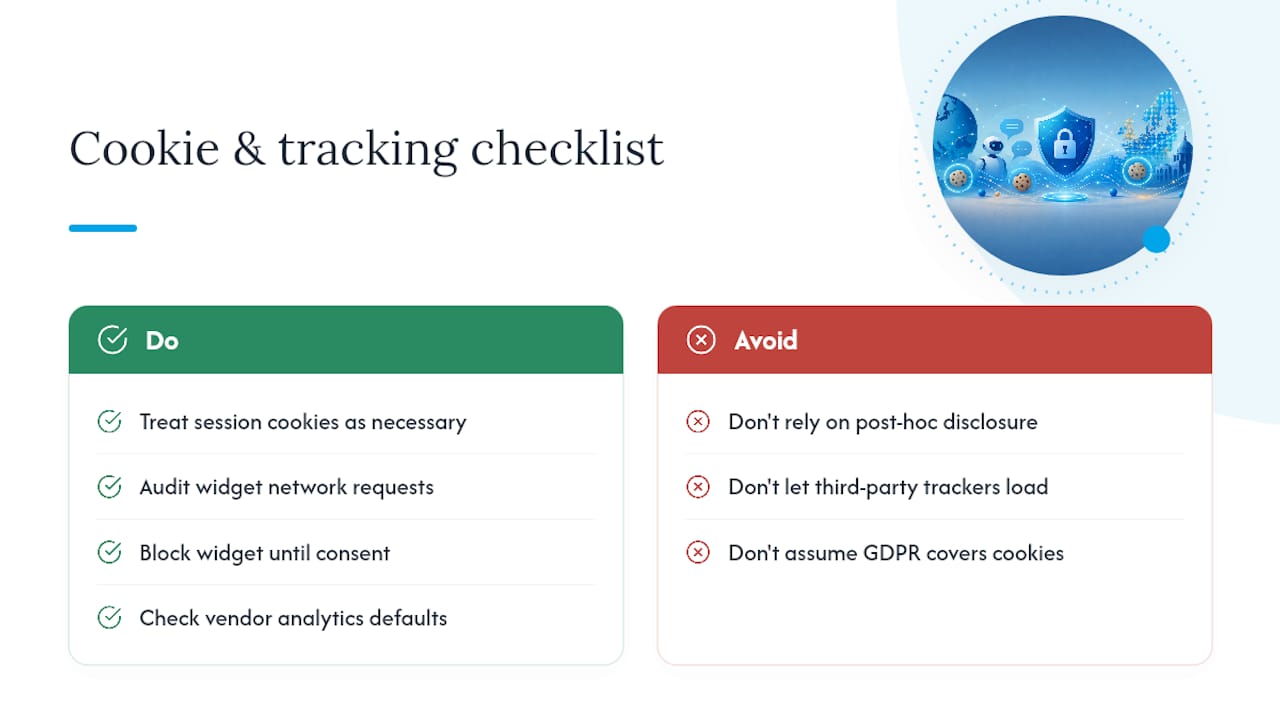
Chatbots rarely operate in isolation from a site's cookie and tracking stack, and that overlap creates its own compliance obligations separate from GDPR itself. If your chatbot sets a session cookie to remember a returning visitor, or if it feeds data into an analytics or advertising pixel to track engagement, that falls under the ePrivacy rules governing cookies and similar technologies, not GDPR alone.
Strictly necessary cookies, such as one that simply keeps a chat session open while the user navigates the page, do not need consent. Anything beyond that, such as a cookie that links chatbot engagement to an advertising profile or retargeting list, needs the same prior consent as any other non-essential tracking technology.
This matters more than teams expect because chatbot vendors often bundle analytics by default. A widget that silently drops a third-party tracking cookie the moment it loads, before the user has said a word, is functionally no different from an unconsented ad tracker and carries the same compliance exposure.
Audit your chatbot's network requests, not just its visible cookie banner. Open a browser's developer tools, load the chat widget, and check what it calls out to before any consent has been given. If it is firing requests to an analytics or advertising domain at that point, your cookie consent tool needs to block the widget until consent is captured, not just disclose it after the fact.
Chatbot logs and breach notification obligations
Chatbot logs are a common blind spot in breach response planning, largely because teams think of "the database" as the thing to protect and forget that conversation logs, exports, and backups often live in separate systems with separate access controls.
A breach involving chatbot data still triggers the standard UK GDPR clock: notify the ICO within 72 hours of becoming aware, where the breach is likely to result in a risk to individuals' rights and freedoms. The complication with chatbot logs is speed of detection. If logs are scattered across the LLM provider's systems, your own database, and a third-party analytics tool, working out what was actually exposed can eat into that 72-hour window before you have even confirmed the scope.
Build the detection capability before you need it: a single, queryable index of where every category of chatbot data lives, updated whenever a new integration is added. When an incident happens, that index is what lets you answer "which users, which messages, which systems" fast enough to meet the notification deadline with an accurate assessment rather than a guess.
Document every access to raw conversation logs as a matter of course. That audit trail is what separates a contained internal access issue from a reportable breach when something goes wrong, and it is exactly the kind of operational evidence regulators ask for after the fact.
Training and use of chatbots on datasets containing personal data
Using historical conversation data to train or fine-tune a chatbot model is a distinct processing activity from the live deployment, and it needs its own lawful basis assessment rather than inheriting the basis that covered the original support conversation.
A user who consented to a chatbot answering their billing query did not automatically consent to that conversation becoming training data for a future model version. If the intended use includes training, that needs disclosing at the point of collection, not discovered later in a privacy notice nobody read.
Anonymisation is frequently claimed but rarely achieved properly. Stripping a name from a transcript does not anonymise it if the conversation still contains an account number, a specific order date, and a distinctive complaint that together re-identify the person. Genuine anonymisation for training purposes usually means aggregating patterns rather than retaining full transcripts, or applying rigorous redaction that a technical reviewer, not just the product team, has verified.
Special category data poses a sharper problem for training sets. A support archive containing health-related queries cannot simply be fed into a fine-tuning pipeline without a specific Article 9 condition covering that training use, separate from whatever basis covered the original support interaction.
Handling minors and special category data in chat interactions
Children interacting with a chatbot need protections that go beyond the standard notice-and-consent model, because a child cannot be expected to meaningfully assess a privacy notice the way an adult user can.
Where a chatbot is likely to be accessed by children, whether that is a retailer's general support bot or a service explicitly aimed at younger users, age-appropriate design matters more than the wording of the privacy notice. That means avoiding data collection beyond what is strictly needed to answer the query, and building in extra friction, such as a parental contact route, if the bot detects a user is likely to be a minor.
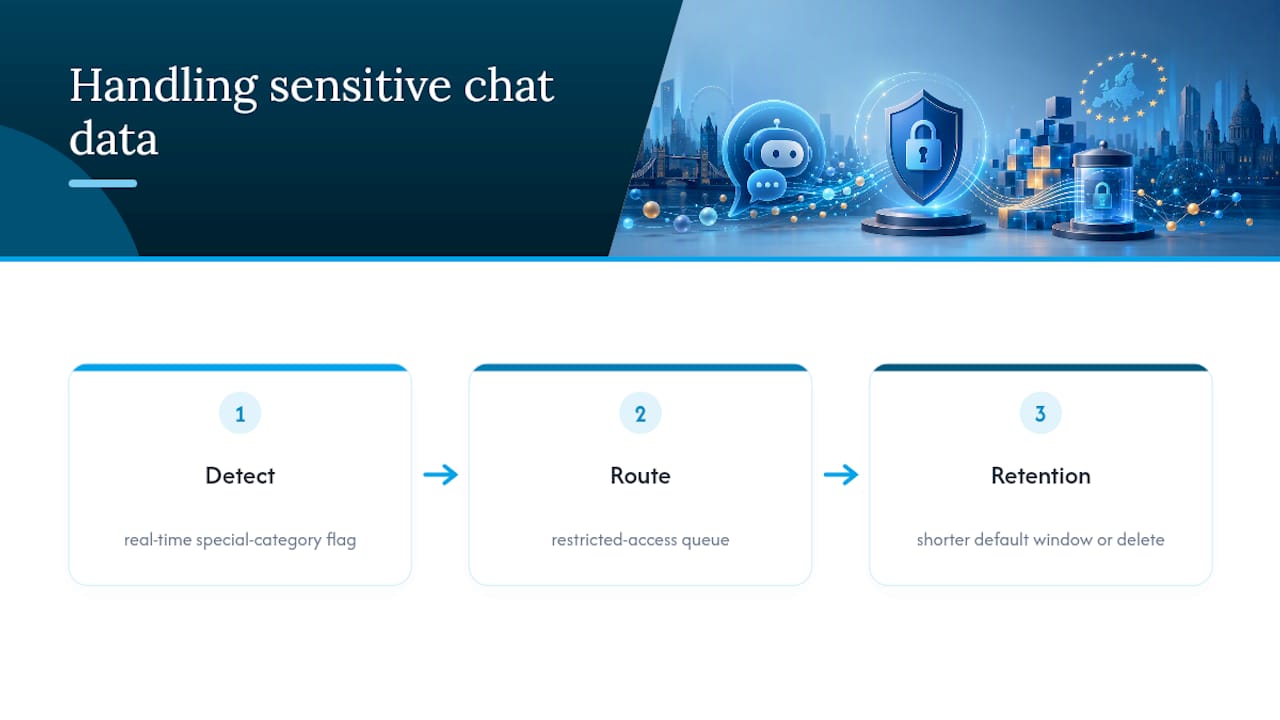
Special category data disclosed inside a chat, health conditions, sexual orientation, religious belief, financial hardship, needs its own handling path regardless of who is on the other end of the conversation. The safest default is to design the bot so it does not actively solicit this information and to flag it for immediate deletion or restricted access if a user volunteers it unprompted.
Practically, that means building a detection layer that recognises likely special category disclosures in real time, routes them to a restricted-access queue rather than the general support log, and applies a shorter retention window by default. Waiting to handle this at the policy level, rather than the architecture level, is how sensitive disclosures end up sitting in an ordinary, widely accessible database for months.
Author perspective: build the architecture before the policy
The businesses that get chatbot compliance wrong usually write the privacy policy first and the data flow second. That order should be reversed. A DPIA done properly, before a line of code ships, tells you what the architecture needs to prevent, not just what the notice needs to disclose.
Test your deletion and export features the same way you would test a payment flow, with real queries against a real database, not a checklist tick. Document every design decision with a measurable acceptance criterion. And treat this as one project owned jointly by product, engineering and legal, not a compliance task thrown over the wall at the end.
— Oded
How Real-studios helps you build GDPR-aware chatbots from day one
Real-studios is the alternative to bolting compliance onto a chatbot after launch. Because the AI agent and the surrounding architecture are built together, controls like server-side redaction, retention enforcement and deletion APIs get designed in from the first sprint, not retrofitted once legal flags a gap.
A typical engagement covers AI agent development, automation and integration, with DPIA support built into the discovery phase rather than treated as a separate legal exercise. That means working demos, testable deletion and export features before launch, and ongoing support once the bot is live. If your chatbot needs LLM connections managed through a compliant middleware layer, AI integrations and enablement covers that specific piece, and automations and workflow design can operationalise the retention and deletion jobs described above.
Hiring a specialist is optional. Everything in this article can be implemented in house. If you would rather have it built correctly the first time, get in touch with Real-studios to scope your chatbot project.
Sources
Keep the ICO's AI and data protection guidance for regulator expectations, the GDPR text on EUR-Lex and the Data Protection Act 2018 for the underlying law, and Janus Compliance's DPIA guidance for a practitioner-tested DPIA structure.
FAQ
Does GDPR apply to AI chatbots?
Yes. GDPR applies whenever an AI system, including a chatbot, processes personal data, regardless of how the underlying model was built. The ICO's guidance on AI and data protection treats AI systems as subject to the same core obligations as any other processing activity.
What regulations apply specifically to AI chatbots?
There is no separate "chatbot law" in the UK or EU. GDPR and UK GDPR govern the personal data side, ePrivacy rules govern cookies and tracking the bot might use, and Article 22 applies specifically if the bot makes automated decisions with legal or similarly significant effects.
Can using AI put a business in breach of GDPR?
Using AI itself is not a breach, but deploying it without a lawful basis, adequate transparency, or a DPIA where one is required almost certainly is. Most breaches trace back to skipped documentation, such as never running the DPIA that AI chatbots typically trigger under the ICO's accountability guidance, rather than the AI technology itself.
Does GDPR apply to chatbots on social media platforms?
Yes, in the same way it applies to a chatbot on your own website. If a business operates a chatbot through a social media platform's messaging system, the business remains the controller for the data it collects, even though the platform also processes that data under its own terms.
What does Real-studios charge for GDPR-aware chatbot development?
Pricing depends on project scope, so current rates are available directly on the Real-studios services page rather than as a fixed published figure.