Fast AI deployment: a 30 to 60 day production playbook
A focused, workflow-first pilot with shadowing, clear gates and senior governance is the fastest reliable route to production AI. Skip the strategy deck and start narrow: one workflow, one agent, measurable exit criteria.
Next around one month:
- Pick one high-frequency, low-risk workflow and run an operational assessment
- Build a minimal viable agent and shadow it against live traffic for 7 to 14 days
Next 60 days:
- Move to a phased canary rollout with defined gate thresholds
- Scale across locations using the GLOE lifecycle framework for staged environments and human oversight
Key Takeaways
A time-boxed pilot with an operational assessment, staged canary gates and senior-led governance is what separates production AI from an expensive demo.
| Point | Details |
|---|---|
| Start narrow | Pick one high-frequency, low-risk workflow for the 30-day pilot rather than an ambitious multi-team rollout. |
| Assess before you build | Map workflows, volumes, exceptions and systems first to avoid automating a broken process. |
| Use staged canary gates | Progress traffic through 5%, 25%, 50% and 100% with automated rollback on failed thresholds. |
| Engineer for production, not demos | Bounded loops, timeouts, persisted indexes and structured outputs separate stable services from brittle prototypes. |
| Work with a build-and-assess partner | Real-studios combines the operational assessment with delivery, taking pilots to canary within around one month. |
Table of Contents
- The three-phase rapid deployment blueprint
- What must an operational assessment produce?
- How does a canary rollout actually work?
- What engineering controls make an agent production-ready?
- Who should own governance during a fast rollout?
- How do you integrate agents into existing systems at scale?
- What ROI and timeline should you expect?
- How do you pick a deployment partner fast?
- How Real-studios accelerates fast AI deployment
- Where fast deployments actually stall
- Start your 30-day pilot with a rapid operational assessment
- Frequently asked questions
- Sources
The three-phase rapid deployment blueprint
Every fast AI deployment that survives contact with production follows the same shape: pilot, canary, scale. Skipping a phase is how teams end up rebuilding in month four.
The pilot phase targets a single, narrow wedge of work, ideally something repetitive with a clear success definition, such as invoice triage or first-line email responses. Some teams following a disciplined four-phase 14-day playbook get a working agent into shadow mode inside two weeks for genuinely simple workflows. A 30-day pilot is a more realistic default for most business processes.
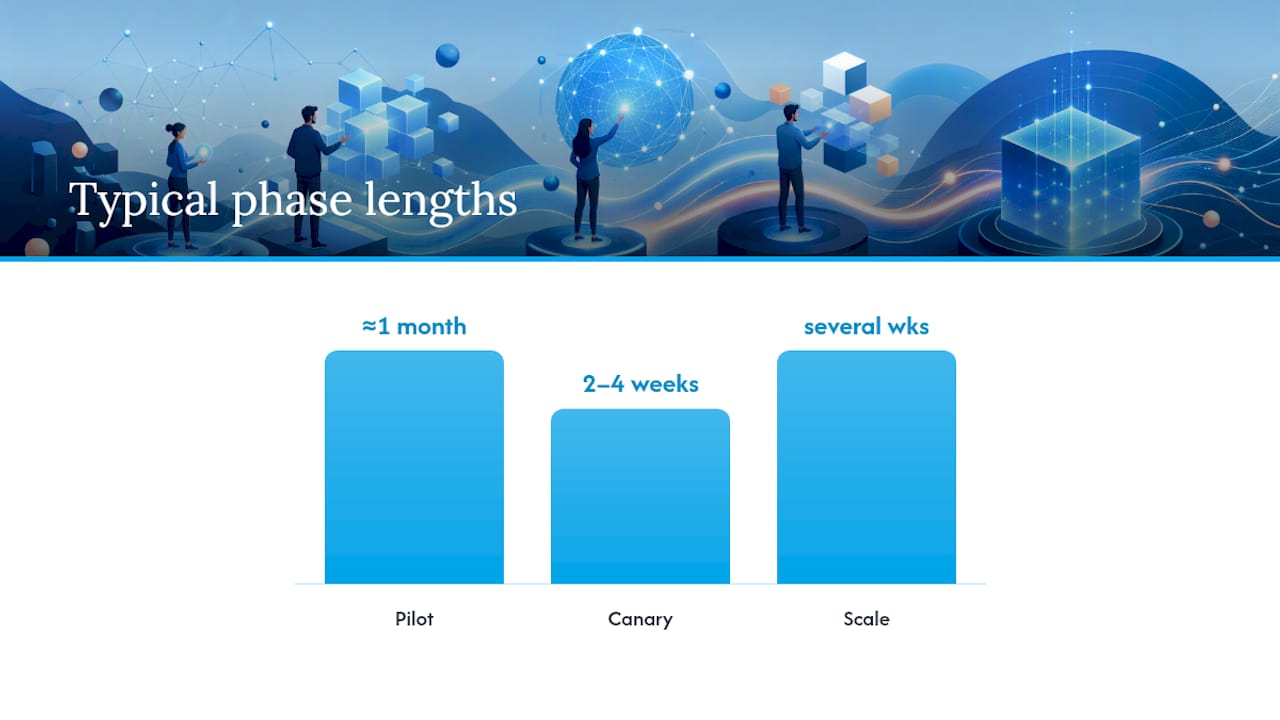
| Phase | Objective | Success gate | Typical length |
|---|---|---|---|
| Pilot | Prove the agent handles one workflow accurately | Match or beat human accuracy in shadow mode | around one month |
| Canary | Validate under real traffic at controlled volume | Meets latency, cost and error thresholds at each stage | 2 to 4 weeks |
| Scale | Roll out across teams, sites or entities | Stable metrics across all deployed instances | several weeks |
Pro Tip: Choose the pilot workflow by frequency and reversibility, not by ambition. A high-volume, low-stakes task teaches you more in around one month than a high-value, rarely-run one ever will.
What must an operational assessment produce?
An assessment that only produces opinions is a wasted week. A useful one produces a build-ready blueprint within days, not months.
At minimum, it should map:
- Every step in the target workflow, including manual handoffs and exception paths
- Transaction volumes and how they fluctuate by day, week or season
- Current exception rates and the cost of each error type
- The full system inventory the agent will need to read from or write to
- Who currently holds decision authority at each step
- Any regulatory or contractual constraints on automation
An operational assessment framework built around these dimensions typically outputs a deployment blueprint quantifying cost, integration order and expected return, with many operational rollouts landing in the 150 to 400% Year‑1 ROI range. Skipping this step and automating a broken process straight away is the single most common reason fast deployments fail; you end up scaling the failure mode instead of removing it.
| Assessment output | What it tells stakeholders |
|---|---|
| Workflow map | Where the agent starts, stops and hands back to a human |
| Volume and exception data | Expected load and the edge cases the agent must handle |
| System inventory | Integration scope and connector requirements |
| Cost and ROI estimate | Whether the business case justifies the build |

How does a canary rollout actually work?
Canary rollout is the mechanism that turns a pilot into a production service without betting the whole workflow on day one. Production-grade AI deployments generally follow a staged traffic progression rather than a single cutover:
- 5% of traffic — verify the agent behaves correctly under real, unfiltered inputs
- 25% of traffic — check performance holds as volume and variety increase
- 50% of traffic — confirm cost and latency stay within budget at scale
- 100% of traffic — full handoff, with monitoring still active
This progression usually plays out over several weeks for most business workflows. Each stage needs a gate before you move on, not a calendar date. Typical thresholds: success rate above 95%, latency under an agreed ceiling (a few seconds latency for chat interactions), cost per transaction within a set band, and an error ceiling that triggers automatic rollback if breached.
- Rollback should be automatic, not a Slack message someone might miss
- Every rollback triggers a logged incident and a short post-mortem before the next attempt
- A named owner, not "the team," approves re-entry into the canary
What engineering controls make an agent production-ready?
A demo that works in a meeting is not the same as a service that works at 2am with no one watching. The gap between the two is entirely engineering discipline.
Before approving live traffic, verify the agent has:
- Bounded loops, so a confused agent cannot spiral into infinite retries
- Timeouts and retry logic on every external call, including model calls
- Persisted indexes, so retrieval systems don't rebuild embeddings on every restart
- Structured JSON outputs with schema validation, not free-text parsing
- Source attribution on any answer drawn from retrieved documents
- Concurrency-safe, async-capable execution under real load
These controls come straight from what a nine-point production checklist treats as non-negotiable, and they matter because agentic AI is a platform engineering problem, not a prompt engineering one. Observability matters just as much as the controls themselves: you need traces across every model and tool call, a latency breakdown by step, an error budget, and a running cost-per-transaction figure that flags drift before it becomes a bill shock.
Pro Tip: Rebuilding indexes or embeddings at startup is one of the quietest production killers. It looks fine in testing and then adds seconds of latency the moment real concurrent traffic hits.

Who should own governance during a fast rollout?
Governance has to sit with senior leadership, not get quietly delegated to the engineering team. Deloitte's research on enterprise AI found Only a minority of companies report a mature model for autonomous agent governance, despite Many companies report measurable productivity gains from AI adoption. Speed without oversight is how a pilot becomes a headline.
Deloitte's data shows 73% of enterprises name data privacy and security as their primary AI-related concern, ahead of accuracy or cost.
Build oversight into the deployment gates themselves, not a separate compliance step at the end:
- A named senior owner signs off on each canary stage, not just the final launch
- Exception handling has a clear escalation path back to a human decision-maker
- Access control and data handling are reviewed before the pilot starts, not after
How do you integrate agents into existing systems at scale?
Integration is where fast deployments usually slow down, because every location seems to need its own bespoke build. The fix is treating the agent as a service that sits above your existing software layer, using connector libraries for CRM, ERP and finance systems rather than one-off code for each client. Real-studios's service integrations approach reflects this: a library of pre-cleared integrations makes each new deployment faster than the last.
For multi-location rollouts:
- Pilot at one site and measure for around one month
- Turn what worked into a repeatable template
- Deploy to 2 to 3 further locations at a time, not all at once
- Feed results into a centralised dashboard for roll-up reporting
Local business rules can stay local. Without a shared intelligence layer connecting the data underneath, though, agents scale activity rather than decision quality.
What ROI and timeline should you expect?
Five metrics matter more than the rest: cycle time reduction, the value of errors avoided, direct cost savings, revenue acceleration, and adoption penetration across the target user base.
A workable ROI formula: (cost savings + revenue gains + error-cost avoided) minus (build, licensing and running costs), measured against the pilot period and then annualised.
| Milestone | Typical timing |
|---|---|
| Pilot complete, shadow-mode results in hand | around one month |
| Canary rollout to full traffic | several weeks after pilot |
| Year‑1 ROI realised | 150 to 400% in typical operational deployments with measurable returns |
- Track adoption penetration weekly, not just at launch. It usually predicts ROI better than accuracy alone.
- Revenue acceleration often lags cost savings by a full quarter, so don't judge a pilot on revenue numbers alone.
How do you pick a deployment partner fast?
Choosing a partner should take days, not a three-month tender process. Look for evidence of recent production deployments, not just pilots that never shipped, and confirm the partner can genuinely commit to a 30-day delivery window for a scoped workflow.
- Ask for a live production example in a comparable vertical
- Ask what their exception-handling framework looks like before build starts
- Ask how pricing works: fixed scope, time and materials, or a hybrid
- Ask who owns the integration work: your team, theirs, or shared
Red flags include vague timelines, resistance to defining a canary gate up front, and pricing that only becomes clear after a lengthy discovery phase. A combined assessment-and-delivery partner nearly always beats a strategy-only consultancy on time-to-value, because there's no handoff gap between the recommendation and the build. Firms like Byram Advisory Group offer useful external perspectives on structuring that assessment phase if you want a second opinion before committing.
How Real-studios accelerates fast AI deployment
Real-studios runs this exact blueprint for UK businesses: an operational assessment, a minimal viable agent build, integration into the systems you already run, and a 30-day pilot that leads into a canary rollout rather than a big-bang launch.
During the pilot, you get:
- A deployment blueprint mapping workflow, volume and exception data
- A working agent running in shadow mode against live traffic
- A measurement dashboard tracking the gate metrics that decide the canary rollout
The service automations offering covers the assessment and build stage; the service integrations work covers CRM, ERP and finance connectors where the pilot needs system access from day one.
Where fast deployments actually stall
Most fast deployments don't fail on the model. They stall because no one in the business owns the rollout once the engineers hand it back, so gates get skipped and canary stages drift past their review dates.
The single biggest change leaders can make is embedding a deployment owner inside the business unit, not just in the technical team, from day one.
Start your 30-day pilot with a rapid operational assessment
There are other ways to approach this: a strategy-only consultancy, an in-house build from scratch, or a generic no-code automation tool. Each comes with its own drag on speed, whether that's a lengthy discovery phase with no working software at the end, or a DIY build without the platform engineering hygiene production traffic demands.
Real-studios runs the assessment and the build under one roof, so there's no handoff gap between recommendation and working software. You get a deployment blueprint, a minimal viable agent in shadow mode, and a canary-ready pilot inside around one month, not a slide deck. Request the operational assessment through Service Automations or explore build options via the AI Studio page to scope your first workflow this week.
Frequently asked questions
What is the fastest realistic timeline for fast AI deployment? A 30-day pilot for a single workflow, followed by a 4 to 8 week canary rollout, is realistic for most business processes. Simple, repeatable workflows can move faster under a disciplined 14-day playbook.
Do I need a full operational assessment before building anything? Yes. Skipping it usually means automating a broken workflow, which scales the problem rather than solving it. A structured assessment takes days and produces the blueprint your build team needs.
What causes fast AI deployments to fail after launch? Missing engineering controls (unbounded loops, no timeouts, unpersisted indexes) and governance that gets delegated away from senior leadership are the two most common causes.
How much should I expect to spend, and what's the return? Costs vary by workflow complexity, integration scope and whether you need custom connectors. Many operational deployments report 150 to 400% Year‑1 ROI once cost savings, error reduction and revenue acceleration are combined.
Can one agent handle multiple locations at once? Not directly. Pilot at one location, template what works, then roll out to 2 to 3 further sites at a time while keeping local business rules intact under a shared reporting layer.
Sources
- What is canary deployment for AI? — MLflow
- A nine-point checklist for shipping production-ready AI — The New Stack
- Agentic AI Deployment Playbook: Ship in 14 Days — Covasant