Choosing the right embedding model for RAG systems

Shortlist high-performing retrieval models from a leaderboard, then validate every candidate against your own gold set. The gold set result, not the leaderboard rank, decides the winner.
This matters because top scores on public leaderboards are frequently statistical noise. Tokenisation differences and dataset contamination can separate two models by a point or two when their real-world retrieval quality is identical. Your embedding model choice should rest on evidence from your own documents, not someone else's benchmark.
Here's what to measure once you've narrowed the field to three or four candidates:
- Recall@K — the share of relevant documents retrieved in your top K results. This is the number that predicts whether your RAG system actually finds the right answer.
- MRR (Mean Reciprocal Rank) — how close to the top the first correct result lands, which matters when your system only shows the top few chunks to the language model.
- Latency per query — measured under realistic batch sizes, not single-query lab conditions.
- Cost per thousand queries — including embedding, indexing and inference where the vendor bills separately for each.
A gap of one or two points on any of these metrics is usually noise. A gap above five points is worth investigating. Above ten points, it's decisive enough to end the debate.
One caution before you start: public MTEB leaderboards mix dozens of unrelated tasks, so a model can rank well overall while performing poorly on retrieval specifically. Where it's available, check the RTEB leaderboard or MMTEB retrieval slice instead of the aggregate score, since private test splits are harder to game through training-data contamination.
Key Takeaways
Embedding model choice should be settled by gold-set validation on your own corpus, not by public leaderboard rank alone.
| Point | Details |
|---|---|
| Shortlist, then validate | Use MTEB, MMTEB or RTEB to shortlist three to five models, then let your gold set decide the winner. |
| Apply noise thresholds | Treat gaps under 2 points as noise and gaps over 10 points as decisive enough to end the debate. |
| Model both cost types | Indexing cost scales with corpus size; query cost scales with traffic, and both need separate budgets. |
| Use Matryoshka truncation | Truncate embeddings post-hoc to cut storage and search cost with only minor recall loss. |
| Get help validating your pipeline | Real-studios applies this gold-set and migration workflow directly in client RAG builds. |
Table of Contents
- Embedding model choice: what actually moves retrieval quality
- Building a gold set that actually predicts production performance
- Turning benchmark results into a production deployment
- A decision workflow you can run this week
- Why the leaderboard obsession is the wrong starting instinct
- Get your RAG system built on a validated foundation
- Frequently asked questions
- Sources
Embedding model choice: what actually moves retrieval quality
Picking an embedding model is not a spec-sheet exercise. Five variables determine whether your RAG system retrieves the right passage or confidently returns the wrong one, and most teams only check the first.
Training objective matters more than parameter count. Some models are trained primarily for semantic similarity tasks (paraphrase detection, sentence clustering), while others are trained explicitly for retrieval, with asymmetric query/document encoding baked in. A similarity-trained model can score well on STS benchmarks and still underperform on retrieval, because the objective it was optimised for isn't the one your RAG pipeline needs. Practitioner analysis on embedding model choice makes the point bluntly: the embedding layer sets the retrieval ceiling, and no amount of prompt engineering on the LLM side will raise it if the embeddings are wrong.
Dimensionality is a cost decision disguised as a quality decision. Larger embeddings (3,072 dimensions or more) tend to capture finer semantic distinctions, but they also cost more to store and search at scale. This is where Matryoshka representation learning changes the calculation. Matryoshka-trained models let you truncate embeddings after the fact, cutting 3,072 dimensions down to 512 with only a small drop in retrieval quality. That means you don't have to commit to a fixed dimensionality upfront. You can start high, measure the quality loss at each truncation point on your own gold set, and settle on whichever size clears your Recall@K threshold at the lowest storage cost.
Latency and throughput decide whether users notice, which is why understanding the trade-offs of offline AI deployments can be crucial in optimizing real-time responses. A model that scores brilliantly on MTEB but takes 400 milliseconds per query at production batch sizes will feel sluggish inside a chat agent expecting sub-second responses. One benchmarking study comparing commercial and open-source models found that a leading proprietary model delivered the best average retrieval quality but at seven to fourteen times the latency and cost of a strong open-source alternative, which came close on quality while staying fast and cheap. If your product has a real-time SLA, that gap changes which model you should actually ship.

Language and domain coverage decide whether general-purpose models are even in the running. A model trained predominantly on English web text will underperform on legal, medical or multilingual corpora regardless of its leaderboard rank. This is the point at which fine-tuning or a specialised domain model earns its cost.
Chunking strategy interacts with your embedding model in ways that are easy to miss. The same benchmarking study found that semantic chunking outperforms fixed-size chunking at small chunk sizes, but the advantage depends heavily on token count. Retrieval quality collapses below roughly 16 tokens per chunk and plateaus once you pass around 32 tokens. Below that floor, chunks carry too little context for the embedding to represent meaningfully. Above the ceiling, extra tokens mostly add noise without adding recall.
Pro Tip: Test your shortlisted embedding models against at least two chunking strategies, not just one. A model that looks mediocre with fixed 512-token chunks can jump several Recall@K points with semantic chunking at 16 to 32 tokens, and vice versa.
Building a gold set that actually predicts production performance
Public benchmarks tell you how a model performs on someone else's documents. Your gold set tells you how it performs on yours, and that's the only number that should influence your embedding model selection.
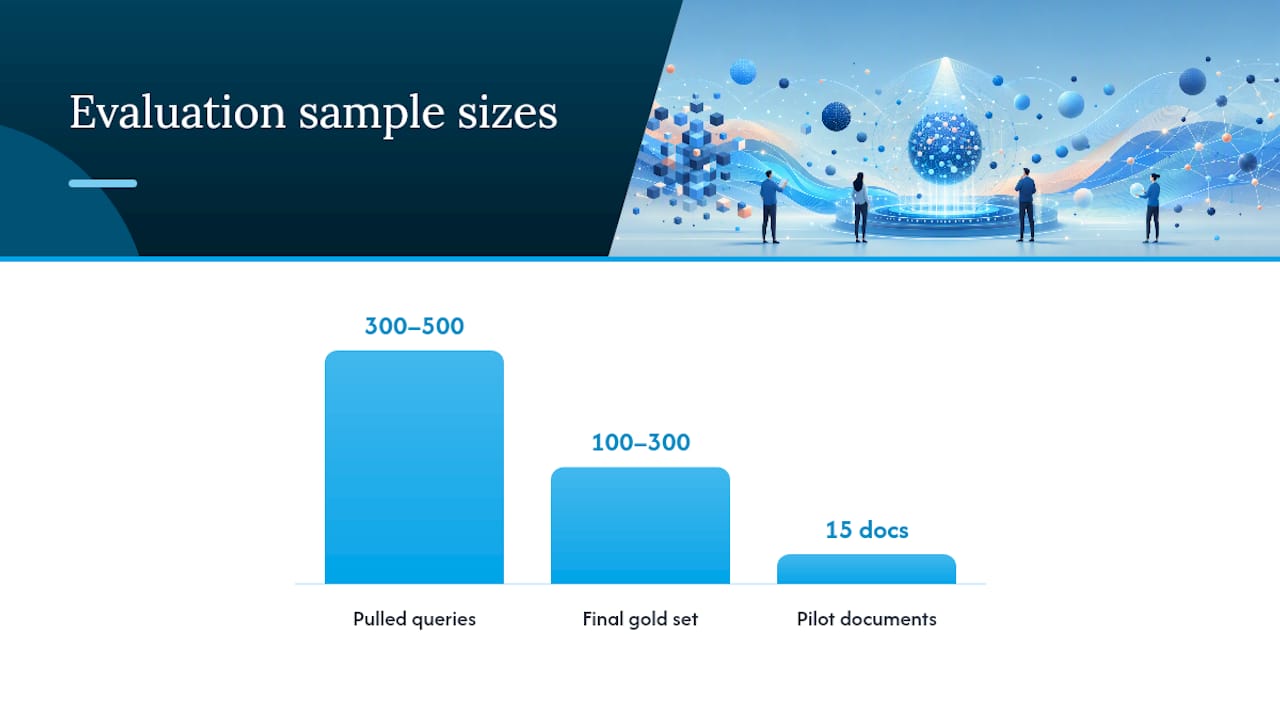
Start with 100 to 300 queries drawn from real usage patterns, not queries you invent while sitting at your desk. If you have support tickets, search logs, or a helpdesk transcript history, mine it. Include the awkward cases deliberately: long-tail questions phrased unusually, ambiguous queries that could match two different documents, and a handful of "no answer exists" queries to check whether the model false-positives on things it shouldn't retrieve at all.
Building the set takes roughly this shape:
- Pull 300 to 500 real or realistic queries from logs, support transcripts, or domain experts who know how your users actually phrase requests.
- Manually label the correct document or chunk for each query, and mark queries where no correct answer exists in the corpus.
- Trim to your final gold set by removing duplicates and queries with disputed labels, aiming for 100 to 300 clean, agreed pairs.
- Run every embedding model candidate against the same set, using identical chunking and retrieval settings so the comparison isolates the model itself.
- Score each run on Recall@K, MRR, latency and per-query cost, and log the raw results rather than just the summary numbers.
This whole exercise can run inside an afternoon. One practical evaluation approach recommends a fifteen-document pilot with four parallel strategies (typically two or three embedding models crossed with a couple of chunking configurations), which produces decisive results at negligible API cost before you scale up to the full gold set.
The output should resemble something like this, scored against your own corpus rather than a public benchmark:
Reading a table like this is where the noise thresholds from earlier pay off. A 2-point Recall@K gap between two rows tells you almost nothing. Interpret every result against your own SLA and budget, not against what looks impressive in isolation.
Turning benchmark results into a production deployment
A gold-set winner is not automatically a deployment plan. Embedding model choice is one of the more expensive architecture decisions you'll make in a RAG system, because reversing it means re-embedding your entire corpus.
Indexing cost and query cost scale differently, and conflating them causes budget surprises. Indexing cost is largely a function of corpus size and happens once, or periodically as documents update. Query cost scales with traffic and never stops. A model that looks cheap on your indexing bill can still be expensive in production if your query volume is high, so model both separately before committing.
Dimensionality drives your storage and search cost directly, which is why Matryoshka truncation is worth building into your evaluation from the start. If your gold set shows only marginal Recall@K loss when you truncate from 3,072 to 512 dimensions, that's a straightforward win on infrastructure spend without a re-embedding cycle.
Migrate with a shadow index, not a hard cutover. The safest pattern runs the new embedding model in parallel with the existing one: dual-write new documents into both indexes, dual-read query results for comparison, and only promote the new index once its live metrics match or beat your gold-set results over a representative traffic sample. Keep rollback criteria defined before you start, not improvised after something breaks.
- Define a rollback threshold (a specific Recall@K or latency figure) before the shadow index goes live.
- Run the shadow index against real traffic for at least a week to catch query patterns your gold set missed.
- Re-embed incrementally where possible; reserve full corpus re-embeds for major model version changes.
- Watch for embedding drift as your corpus grows into domains your gold set didn't originally cover.
Migration planning and lifecycle cost are frequently underestimated at the point of model selection. Practitioner guidance on embedding lifecycle management treats the choice as a long-term commitment precisely because re-embedding a large corpus is not a trivial afternoon task once you're past a pilot.
Pro Tip: Set a refresh cadence before launch, not after drift shows up in support tickets. A quarterly recall check against a small holdout of new queries will catch domain drift long before users start noticing worse answers.
A decision workflow you can run this week
Turning all of the above into something repeatable means treating embedding model selection as a staged process with clear gates, not a single meeting where someone picks a name off a leaderboard.
- Build a shortlist of three to five candidates from MTEB, MMTEB or RTEB, weighted towards your domain and language rather than the aggregate score alone.
- Run your gold-set benchmark across the shortlist, scoring Recall@K, MRR, latency and cost per query under realistic batch conditions.
- Apply the noise thresholds: treat gaps under 2 points as noise, 5 points as meaningful, and 10 points or more as decisive enough to settle the choice outright.
- Decide on fine-tuning only if the best general-purpose candidate misses your Recall@K target by a wide margin and your domain vocabulary is genuinely unusual (specialist legal, medical or multilingual corpora are the usual triggers).
- Build the shadow index, validate it against live traffic, and document rollback criteria before cutover.
Before shipping, check off the essentials:
- Gold set covers at least 100 representative queries, including ambiguous and no-answer cases.
- Latency and cost figures were measured at production batch sizes, not single-query tests.
- Dimensionality has been tested against Matryoshka truncation where the provider supports it.
- Shadow index has run against real traffic long enough to surface edge cases.
- Refresh cadence and drift monitoring are documented, not left as a "we'll deal with it later" item.
Skipping the shadow-index step is the single most common cause of embarrassing production incidents after a model migration. It costs a week of parallel running and saves you from discovering a blind spot after your users already have.
A practical view from Real-studios
Choosing an embedding model is rarely the hard part. Proving the choice holds up on real traffic is where most projects stall.
Retrieval quality on a leaderboard and retrieval quality on a client's actual document set are two different questions. We've found the gold-set stage is where teams either build confidence in their RAG system or discover it was never going to work with their existing chunking approach.
In delivered projects, Real-studios applies the same gold-set and migration workflow described above: shortlist against public leaderboards, validate on the client's own documents, then build the shadow index before anything goes live. This discipline matters just as much for Generative Engine Optimisation work, where the underlying retrieval layer determines whether an AI engine cites your business accurately or not at all.
Why the leaderboard obsession is the wrong starting instinct
The conventional advice treats embedding model choice like picking a phone off a spec sheet: find the highest score, ship it. That instinct is backwards. The top of most public leaderboards is bunched together within a point or two, which means you're often choosing between statistically identical options while ignoring the one variable that actually differs: how each model handles your documents.
What's underrated is chunking. Teams spend weeks debating which embedding model to use and an afternoon deciding how to chunk their documents, when the data suggests the two decisions are entangled. A mediocre model with well-tuned semantic chunking at 16 to 32 tokens will often beat a leaderboard leader paired with lazy fixed-size chunks.
If you take one thing from this: build the gold set before you fall in love with a model. Everything else, including the expensive fine-tuning conversation, only makes sense once you know what your own documents actually need.
Get your RAG system built on a validated foundation
Running a gold-set benchmark tells you which embedding model performs best. Turning that result into a production system, with the shadow index, monitoring and migration plan intact, is a separate piece of work most in-house teams don't have spare capacity for. Real-studios builds that layer directly: custom RAG systems, vector database integrations, and the embedding lifecycle management that keeps retrieval quality stable as your corpus grows. If your team has narrowed the field to a shortlist and needs the validation, deployment and monitoring built properly the first time, Real-studios's integration services cover exactly that handover from benchmark to production. For teams still assembling the full agent or automation around the retrieval layer, the full service range sets out how a project typically scopes and runs. Get in touch to discuss your corpus, your latency requirements and a realistic timeline for a validated pilot.
Frequently asked questions
What is the single biggest mistake teams make in embedding model choice? Picking a model purely on aggregate MTEB rank without validating on an in-domain gold set. Leaderboard gaps at the top are frequently noise, and a model that wins on paper can underperform badly on your specific documents.
How many queries do I need in a gold set before the results are trustworthy? Somewhere between 100 and 300 labelled queries is usually enough to expose a meaningful Recall@K or MRR gap between candidates, provided the set includes ambiguous and no-answer cases rather than only easy questions.
Does a higher embedding dimension always mean better retrieval quality? Not reliably, and it always costs more in storage and search time. Matryoshka-trained models let you truncate to a smaller dimension and measure the actual quality loss on your own data before committing to a size.
Should I fine-tune an embedding model or use one off the shelf? Use an off-the-shelf model first and only fine-tune if your gold-set results miss your Recall@K target by a wide margin, typically because your domain vocabulary (legal, medical, or a specific technical field) is genuinely unusual.
How do chunking strategy and embedding model choice interact? They're not independent decisions. Semantic chunking tends to outperform fixed-size chunking at small chunk sizes, but retrieval quality drops sharply below roughly 16 tokens per chunk and levels off above 32, so the same model can look strong or weak depending purely on chunk configuration.
Sources
- ArXiv — Practical benchmarking study of embedding models (T3EM, mE5-L, etc.)
- Hugging Face — Matryoshka representation learning explainer
- Decompressed — How to actually choose the best embedding model for your RAG