Data residency for AI: rules, risks and how to comply
Data residency for AI means controlling exactly where your prompts, training data, model outputs and inference processing physically occur, so they align with GDPR, the EU AI Act and the reach of the U.S. CLOUD Act. The recommended approach is not a single setting. Treat residency as a layered programme combining region-aware pipelines, contractual auditability and sovereign options where the risk demands it.
Concern about this has moved fast: enterprises citing LLM residency as a central compliance issue rose from around 33% in 2023 to roughly 78% by 2026, according to an enterprise LLM compliance guide. A practical starting point:
- Map every AI touchpoint where data leaves its home region, including inference, not just storage.
- Enforce residency technically through an AI gateway rather than relying on developer discipline.
- Choose sovereign cloud or on-premise inference only where regulated data genuinely requires it.
Key Takeaways
Effective data residency for AI requires region-aware pipelines, gateway-level enforcement and auditable logs covering storage, inference and outputs alike, not just one contractual clause.
| Point | Details |
|---|---|
| Residency is multi-touch | Storage, inference, training, outputs and logs each carry separate residency risk and need separate checks. |
| Inference residency is not automatic | Storage-at-rest guarantees don't cover where the model actually executes; test that separately. |
| Contracts alone aren't sovereignty | A US-incorporated vendor stays exposed to the CLOUD Act even with EU-based servers. |
| Enforce technically, not manually | An API gateway that blocks and logs non-compliant calls scales better than developer discipline. |
| Real-studios builds the pipeline | Real-studios delivers region-aware integrations and automations that turn residency policy into an enforced system. |
Table of Contents
- What does data residency for AI actually cover?
- Regulatory and legal risks you need to assess
- Technical architecture patterns for AI residency
- What vendors actually promise on residency, and what they don't
- Procurement checklist: questions and contract clauses to demand
- How long a residency project takes and what drives cost
- A practical implementation checklist for production AI pipelines
- Migrating legacy data into residency-compliant environments
- Integrating residency controls into existing AI models and pipelines
- Managing risk from AI-generated outputs, not just inputs
- Training teams to make residency policy stick
- Frequently asked questions
- Sources
What does data residency for AI actually cover?
Data residency, data sovereignty and data localisation get used interchangeably, and that's a mistake that causes real compliance gaps. Data residency refers to the physical location where data sits at rest, a definition IBM frames around security posture and regulatory obligation. Data sovereignty goes further: it's about which country's laws actually govern that data, regardless of where the servers sit. Data localisation is the strictest form, a legal requirement that certain data never leaves a jurisdiction at all. Inference residency is AI-specific: it governs where the GPU computation happens when a model processes your prompt, which can differ entirely from where the data is stored.
AI creates far more residency touchpoints than a typical database ever did. Each one carries its own risk profile:
- Prompts and completions — often the highest risk, since they can contain live customer or patient data.
- Embeddings — vector representations that can leak sensitive semantic content if mishandled.
- Model weights — lower direct risk, but fine-tuned weights can memorise training data.
- Outputs — generated content that may inherit compliance obligations from its inputs.
- Logs and telemetry — frequently overlooked, yet regulators increasingly treat them as personal data in scope.
Regulators tend to focus scrutiny on prompts, embeddings and logs, precisely the layers vendors are most likely to process outside your chosen region by default.
Regulatory and legal risks you need to assess
The three risks that reshape vendor and architecture decisions fastest are cross-border transfer rules under GDPR, direct obligations under the EU AI Act, and third-country access exposure under the U.S. CLOUD Act. Get these wrong and the exposure isn't theoretical. It's fines, contract termination clauses, and audit failures.
GDPR governs any transfer of personal data outside the UK or EEA, and Standard Contractual Clauses (SCCs) are the usual mechanism, but SCCs are a legal wrapper, not a technical guarantee. As Didomi's guidance on UK GDPR and cloud points out, a US-incorporated AI vendor remains reachable under the CLOUD Act even when its EU data centre keeps your data physically in Frankfurt or Dublin. Contractual residency and legal sovereignty are not the same thing.
For enterprises, the practical implications stack up quickly:
- Data Protection Impact Assessments (DPIAs) become mandatory wherever AI processes personal data at scale.
- Audit evidence must show where processing happened, not just where data was stored.
- Penalties under GDPR can reach 4% of global turnover, and the EU AI Act adds separate obligations for high-risk AI systems with its own phased compliance timeline.
Regional regimes add further layers. China's Cybersecurity Law and Personal Information Protection Law (PIPL) mandate localisation for a broad category of data. India's Digital Personal Data Protection Act (DPDP) restricts cross-border transfer without government-approved safeguards. Neither map cleanly onto EU-style SCCs, so a residency programme built only around GDPR will fail the moment you touch either market.
Technical architecture patterns for AI residency
Match the architecture to data sensitivity, not to vendor convenience. Non-sensitive workloads run fine on standard public cloud. Regulated data (health records, financial identifiers, government contracts) generally needs sovereign cloud or on-premise processing. Anything classed as critical, national security-adjacent, or subject to strict localisation law needs on-premise deployment with customer-held encryption keys.
Five patterns cover most enterprise scenarios:
- Public cloud, region-pinned — cheapest and fastest to deploy; sovereignty risk remains if the provider is US-incorporated.
- Sovereign cloud — a provider legally and operationally isolated from foreign jurisdiction reach; higher cost, stronger legal footing.
- On-premise inference — maximum control, highest operational overhead, best for the most sensitive workloads.
- Hybrid — non-sensitive inference in public cloud, regulated inference on-premise or sovereign; complex to orchestrate but cost-efficient.
- Gateway-enforced routing — a proxy layer that inspects and routes every AI call by data classification before it reaches any model.
| Approach | Latency | Cost | Sovereignty strength | Management overhead |
|---|---|---|---|---|
| Public cloud, region-pinned | Low | Low | Weak to moderate | Low |
| Sovereign cloud | Moderate | High | Strong | Moderate |
| On-premise / HYOK | Higher | Highest | Strongest | High |
| Hybrid (tiered) | Variable | Moderate | Depends on tier | High |
The distinction between storage residency and inference residency matters more than most procurement teams realise. OpenAI's own documentation separates the two explicitly: data residency keeps in-scope content at rest in a chosen region, while inference residency additionally guarantees the GPU execution itself runs in-region, and it only works when data residency is already enabled for that region. Storing data correctly and processing it correctly are two separate guarantees, and vendors sell them separately.
Pro Tip: Enforce residency rules at the API gateway, not in application code. A gateway can block, redirect or log every call by data classification before it ever reaches a model, which scales far better than trusting every developer to remember the rules.
What vendors actually promise on residency, and what they don't
Expect major AI vendors to offer storage-at-rest residency in specific regions, with inference residency as a narrower, often enterprise-tier add-on. Anthropic's Claude Platform documentation and OpenAI's enterprise offerings both distinguish between where content sits and where the model actually runs, and IBM's watsonx stack positions itself around configurable regional deployment for exactly this reason.
What vendors routinely exclude from residency guarantees is where the real exposure hides:
- System telemetry, error logs and abuse-monitoring data, which can be processed globally regardless of content residency settings.
- Authentication and account metadata, typically handled by a separate identity system outside the residency boundary.
- Request routing and load-balancing infrastructure, which may briefly touch multiple regions even with residency enabled.
- Caching layers, which can retain fragments of prompts or outputs longer than the stated retention window.
During procurement, test specific, checkable claims rather than accepting marketing language. Ask for evidence of in-region GPU execution, not just in-region storage. Ask whether backups and disaster-recovery replicas stay in-region or fail over elsewhere. Confirm whether zero-data-retention settings are contractually guaranteed or simply a configurable default. Vendors separate these guarantees deliberately, so test each one independently rather than assuming one setting covers all of them.
Procurement checklist: questions and contract clauses to demand
Before signing, put these questions directly to any AI vendor:
- Where does inference actually execute, and is that contractually guaranteed or just a default setting?
- Which data types are in scope for residency, and which (logs, telemetry, backups) are explicitly excluded?
- Where are backups, replicas and disaster-recovery copies stored?
- Who holds the encryption keys, and can we hold them ourselves (BYOK or HYOK)?
- What audit logs are available, and can we access them independently of the vendor's own reporting?
Contract language should go beyond the standard DPA template. Insist on explicit locality guarantees naming the region, not just "the EU" as a category. Demand audit rights that let you or a third party verify claims, not just a self-reported compliance statement. Require SCCs or equivalent Data Processing Terms that name the specific transfer mechanism used, and push for BYOK or HYOK clauses wherever the data classification justifies it.
Trust signals worth checking before you check anything else:
- ISO 27001 and SOC 2 certification, current and covering the specific service you're buying, not just the parent company.
- Independent third-party audit reports, not vendor self-assessments.
- A dedicated EU-incorporated (or UK-incorporated) legal entity handling the contract, which materially affects CLOUD Act exposure.
- Documented inference residency, not just storage residency, in the product documentation itself.
How long a residency project takes and what drives cost
Most AI residency programmes run through five phases: discovery (two to four weeks), architecture design (three to six weeks), pilot (four to eight weeks), migration (variable, often the longest phase), then ongoing operation with continuous audit.
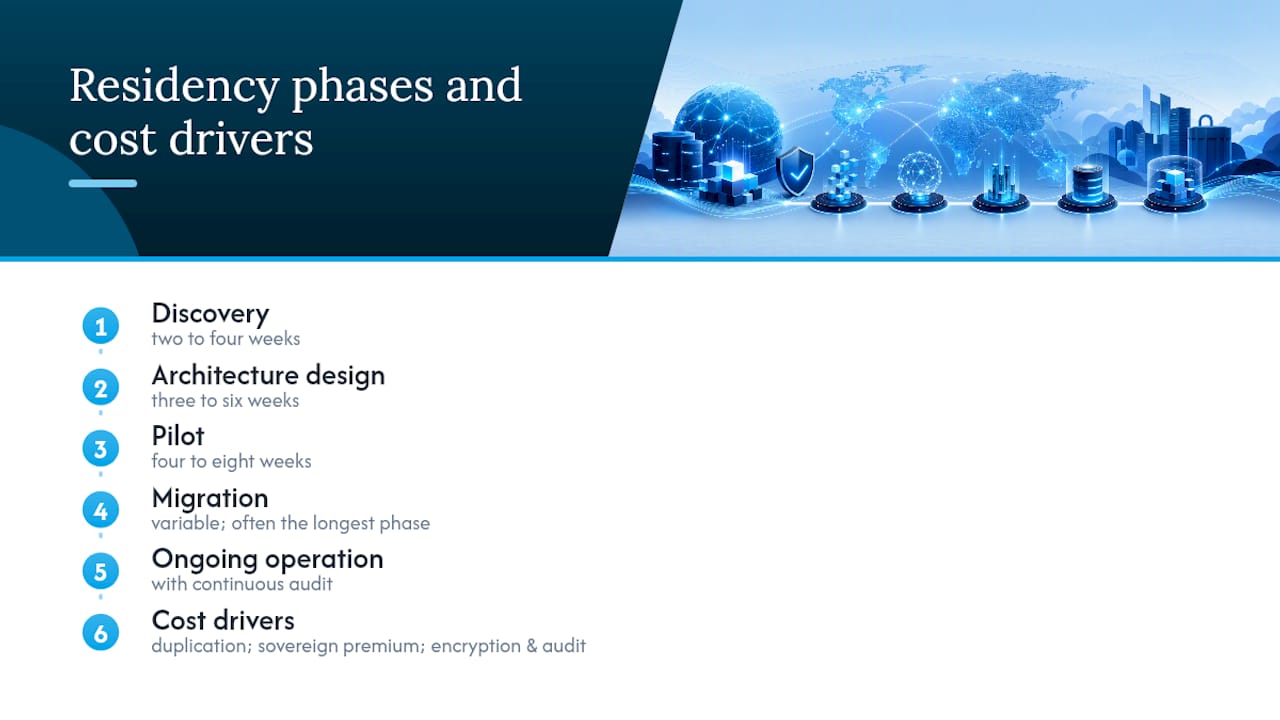
Cost is driven less by the technology and more by duplication. Running compute in two regions instead of one roughly doubles that infrastructure line. Sovereign cloud carries a premium over standard public cloud, Gartner's 2026 technology trends flag sovereignty as a top driver of procurement and architecture decisions specifically because of this cost tension. Encryption and key management add ongoing operational overhead, and audit automation is an upfront cost that pays back by replacing expensive manual review cycles.
To control spend, tier your data honestly. Keep genuinely non-sensitive workloads on standard public cloud rather than over-engineering everywhere, and reserve BYOK for the data that truly needs it.
A practical implementation checklist for production AI pipelines
Five steps take you from policy to enforcement:
- Data map — catalogue every dataset feeding your AI systems and where it currently lives.
- Classification — tag each dataset by sensitivity and regulatory scope.
- Gateway enforcement — route every AI call through a policy layer that blocks non-compliant paths automatically.
- Regional pipelines — build ingestion, embedding and inference paths that stay within the required region end to end.
- Continuous audit — log every processing event with region, timestamp and purpose.
For a retrieval-augmented generation (RAG) pipeline specifically, each stage needs its own residency check: document ingestion, embedding storage in the vector database, retrieval at query time, and the final inference call. Assuming one residency setting covers all four is the most common architectural mistake teams make.
Pro Tip: Manual developer checks are not a control. The ICO's guidance on international transfers explicitly warns that automated audit trails are the reliable path; manual review simply doesn't scale to the volume of calls a production AI system generates.
Migrating legacy data into residency-compliant environments
Legacy data is where most residency programmes stall, because historical datasets were rarely tagged with jurisdiction or sensitivity when they were created. The first task isn't migration, it's discovery: locating every dataset that currently feeds an AI pipeline and establishing where it actually sits today, which is often different from where the original system documentation claims.
Once mapped, classify before you move. Untagged legacy data gets migrated by default assumption rather than by rule, which recreates the same compliance gap in a new location. A practical approach tiers legacy datasets into three buckets: data safe to leave in place, data that must move to a compliant environment before any AI system can touch it, and data that should be archived or deleted rather than migrated at all, since old records with no active use case are pure liability once an AI pipeline can query them.
Migration itself works best in stages rather than a single cutover. Move non-sensitive legacy data first to prove the pipeline, then move regulated categories once the gateway and audit logging are confirmed working end to end. Running both environments in parallel for a defined window, rather than a hard switch, gives you a rollback path if the new environment fails an early audit. Encrypt data in transit during migration and re-key it in the destination environment rather than carrying old keys forward, since legacy key material is frequently the weakest link in an otherwise compliant new architecture. Document every migration step; auditors will ask for evidence of the transition, not just proof of the current end state.
Integrating residency controls into existing AI models and pipelines
Retrofitting residency controls into a pipeline that was never designed with them is harder than building one from scratch, and most enterprises are doing exactly that retrofit right now. The first friction point is usually the model itself: a fine-tuned model trained on mixed-jurisdiction data can't easily be "un-trained" to remove data from a specific region, which means some legacy models may need to be retired and retrained rather than patched.
Embedding stores create a second friction point. Vector databases built before residency was a requirement often replicate embeddings across regions for latency reasons, and that replication has to be unwound carefully to avoid breaking retrieval performance. A developer community guide on regional compliance patterns notes that API inference, fine-tuning, embeddings and observability each create separate residency footprints, which means a single infrastructure change rarely fixes the whole pipeline at once.
Observability tooling is the piece most teams forget. Logging and monitoring platforms often route telemetry to a central global instance by default, and that telemetry can include fragments of prompts or outputs. Fixing this usually means deploying region-specific observability stacks rather than a single global one, which adds operational complexity but closes a gap that otherwise undermines every other control you've put in place.
Managing risk from AI-generated outputs, not just inputs
Residency programmes tend to focus heavily on inputs, prompts, training data, embeddings, and pay far less attention to what the model produces. That's a gap, because outputs can inherit or even amplify the compliance exposure of their inputs, particularly when a model summarises, restructures or translates regulated content.
A generated output containing personal data extracted from a regulated input carries the same residency obligation as the original record, even though it's technically new content. Treat AI outputs as a data category in their own right for residency purposes, tagged and logged the same way inputs are, rather than assuming compliance stops once the input side is handled.

There's a second risk specific to generated content: model outputs can be wrong, and a residency-compliant pipeline that produces an inaccurate or fabricated answer about a regulated matter is still a governance failure, just a different kind. Logging outputs alongside the inputs and prompts that produced them gives you the audit trail to investigate both problems, jurisdictional exposure and factual accuracy, from the same evidence base.
Practical risk controls worth building in from the start include output classification (tagging generated content with the same sensitivity labels as its source data), retention limits on generated content that mirror the retention rules of its inputs, and a review process for outputs used in regulated decisions, such as credit, hiring or medical contexts, where an ungoverned AI output creates liability regardless of where it was generated.
Training teams to make residency policy stick
A residency architecture only works if the people using AI systems day to day understand why the rules exist and where the boundaries sit. The most common failure isn't a technical gap, it's an employee pasting regulated customer data into a general-purpose chat tool that has no residency guarantees at all, simply because nobody explained the difference between that tool and the sanctioned, region-pinned system.
Effective training for this is specific, not generic data-protection awareness. Staff need to know which AI tools are approved for which data categories, what happens technically when they submit a prompt (where does it go, who can see it, how long is it kept), and who to ask when a new use case doesn't obviously fit an existing category. Generic annual compliance training rarely achieves this. Short, role-specific sessions tied to the actual tools people use in their daily work land far better.
Change management matters just as much as training content. Rolling out a new gateway or region-pinned pipeline without explaining why it exists invites workarounds, and workarounds are exactly what defeats a technical control. Involve the teams most affected, customer support, sales operations, whoever handles the most sensitive data, in testing the new pipeline before full rollout, so friction gets surfaced and fixed rather than routed around. Assign clear ownership for policy updates too; regulation shifts (as the EU AI Act's phased obligations demonstrate) and a residency policy written once and never revisited becomes obsolete within a year.
Where most implementations quietly fail
The recurring mistake isn't picking the wrong region. It's treating a signed DPA as the finish line while inference, telemetry and legacy embeddings keep leaking across borders unchecked. Real-studios runs discovery and pilot engagements built around exactly this gap.
Build a residency-aware AI pipeline with Real-studios
The alternatives most enterprises try first, generic compliance consultants or a vendor's own default settings, either stop at contract language or assume storage residency covers inference too. Real-studios closes that gap by building the actual pipeline: region-aware retrieval-augmented generation systems, gateway-enforced routing, and audit logging that satisfies a real audit rather than a checkbox. Service Integrations connects your existing vendor APIs and enterprise systems into a residency-controlled architecture from day one, rather than retrofitting controls after the fact.
A typical engagement runs through discovery, architecture design, a scoped pilot, then handover with ongoing support, so your team owns the system once it's live. Service Automations handles the operational layer, turning manual residency checks into enforced, logged workflows. If you're facing a residency gap in an existing AI deployment, get in touch for a tailored assessment of where your pipeline currently exposes you.
Frequently asked questions
What is the difference between data residency and data sovereignty in AI? Data residency is about physical location; data sovereignty is about which country's laws govern the data regardless of where it sits. A US-incorporated vendor storing data in the EU still falls under U.S. CLOUD Act jurisdiction, so residency alone doesn't guarantee sovereignty.
Where is AI data stored when I use a cloud-based model? It depends on the vendor's residency configuration. Most enterprise AI providers let you select a storage region, but inference (the actual processing) may still occur elsewhere unless inference residency is separately enabled and supported for that region.
Does GDPR require AI data to stay in the EU? GDPR doesn't mandate EU-only storage, but it does require a valid transfer mechanism, typically SCCs, for any personal data leaving the EEA, along with documented risk assessment through a DPIA for AI processing at scale.
What is inference residency and why does it matter? Inference residency guarantees that the GPU computation processing your data happens within a specified region, not just that the data is stored there. It matters because prompts and outputs pass through inference in real time, making it the point where cross-border exposure most commonly occurs.
How long does implementing AI data residency typically take? A full programme, from discovery through pilot to production migration, generally spans several months, with discovery and design taking a few weeks each and migration timelines varying widely depending on legacy data volume and complexity.
This article is general information, not a substitute for advice from a qualified lawyer. Consult a qualified legal professional about your own circumstances before acting on anything here.
Sources
- Data residency and inference residency for ChatGPT | OpenAI Help Center
- A brief guide to international transfers | ICO