Customer service AI: a practical guide for UK decision-makers

Customer service AI uses machine learning, NLP and generative models to automate routine contacts, augment agents and deliver personalised support at scale. The immediate next step: select one high-impact pilot use case, secure your CRM and knowledge-base integrations, then measure progress against two or three KPIs from day one.
The core components you will encounter in any serious deployment:
- Natural language processing (NLP) — interprets customer intent from text and speech
- Machine learning (ML) — classifies, routes and improves predictions over time
- Generative models and retrieval-augmented generation (RAG) — produce accurate, grounded responses from your own knowledge base
- Sentiment analysis — detects frustration or urgency in real time to trigger escalation
- Intelligent routing — matches contacts to the right agent or automated flow based on intent and history
Gartner research found that 85% of customer service leaders planned to explore or pilot customer-facing conversational generative AI in 2025. UK deployments must also satisfy the UK GDPR framework, which governs how personal data is processed in automated systems. Real-studios, trading as AIthatworks, is a Manchester-based consultancy that builds custom AI agents, automations and integrations for UK businesses across all of these capability areas.
Table of Contents
- What does customer service AI actually include?
- What are the most valuable AI use cases in customer service today?
- What is the business case for customer service AI?
- What risks and compliance issues should UK teams anticipate?
- How do you implement customer service AI in a UK business?
- How Real-studios helps UK businesses adopt customer service AI
- How do you measure ROI on customer service AI?
- How do AI use cases differ across UK sectors?
- What near-term trends should UK teams watch?
- Key takeaways
- What we observe in UK deployments
- Real-studios builds customer service AI for UK businesses
- Useful sources
What does customer service AI actually include?
AI in customer service refers to intelligent technology that automates repetitive tasks, routes requests and equips agents with real-time context and recommendations. That definition covers a wide stack, so it helps to map each technology to a practical function before procurement conversations begin.
Core technologies and what they do
Natural language processing converts unstructured text or speech into structured intent signals. In practice, it is what allows a chatbot to understand "I want to change my delivery address" rather than requiring a customer to press a menu option.

Machine learning sits behind classification, routing and continuous improvement. Every resolved ticket becomes a training signal that sharpens the model's next prediction.
Generative models and RAG are the most significant recent addition. A generative model alone can hallucinate; paired with RAG, it retrieves verified content from your knowledge base before composing a response, which keeps answers grounded and auditable. This is the architecture that makes AI-generated responses safe enough for customer-facing deployment.
Speech-to-text and text-to-speech power voice channels, converting call audio into transcripts for analysis and generating natural-sounding spoken responses. Modern models handle a range of accents and languages, which matters for UK contact centres serving diverse customer bases.
Sentiment analysis monitors tone in real time. A spike in negative sentiment mid-conversation can automatically flag the interaction for supervisor review or trigger a warm handover to a human agent.
Knowledge retrieval and real-time agent assist surface the right article, policy or procedure to an agent while they are still on the call or chat, cutting average handling time without removing the human from the loop.
Automation levels: what each requires
| Level | Description | Typical requirements |
|---|---|---|
| Assist | AI surfaces suggestions; agent decides | CRM integration, knowledge base, agent desktop plugin |
| Augment | AI handles defined sub-tasks (summarisation, classification); agent owns the conversation | Structured knowledge base, transcript ingestion, workflow APIs |
| Autonomous | AI resolves end-to-end without agent involvement | High-quality training data, RAG with vetted sources, robust escalation logic, consent management |
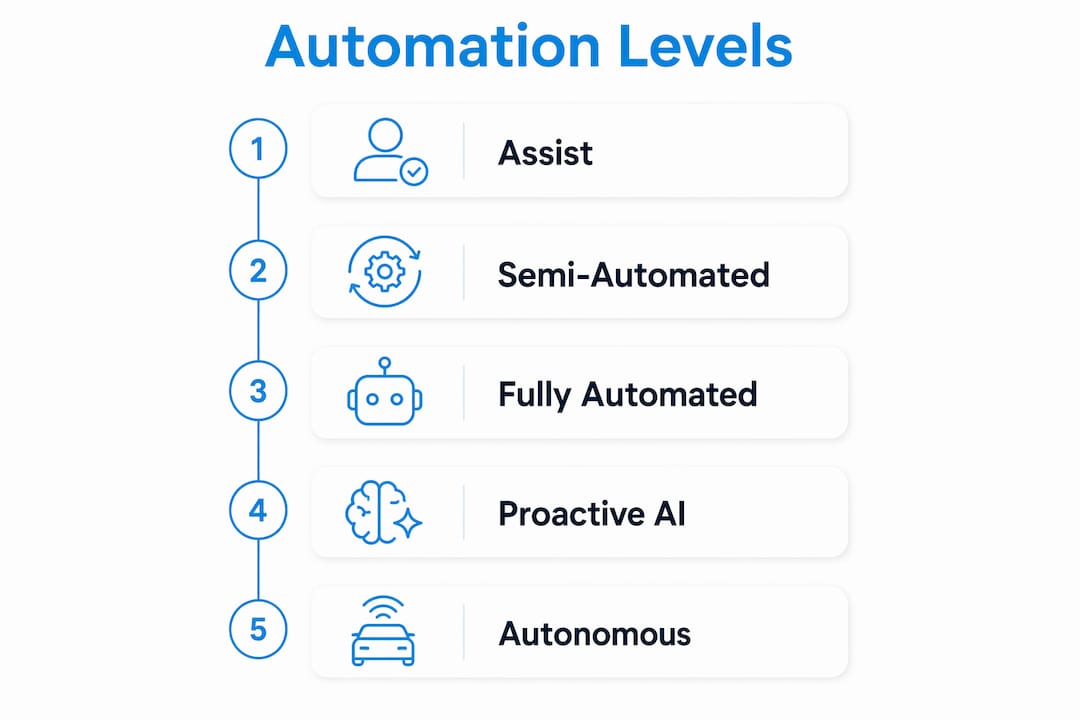
Infrastructure needs grow with each level. At minimum, any deployment requires a clean knowledge base, CRM API access, secure transcript handling and a consent management layer that satisfies UK GDPR obligations.
Pro Tip: Start at the "assist" level for your first pilot. It delivers measurable value quickly, carries the lowest risk of customer-facing errors, and generates the interaction data you need to build confidence before moving to autonomous flows.
What are the most valuable AI use cases in customer service today?
Chatbots remain the most widely adopted AI application in customer service because they operate 24/7, handle many simultaneous queries and resolve common questions instantly. Beyond chatbots, the use-case map is broader than most procurement briefs acknowledge.
Use cases and channel coverage
| Use case | Chat | Voice | Social/Messaging | Expected outcome | |
|---|---|---|---|---|---|
| Chatbot / virtual assistant | ✓ | ✓ | — | ✓ | 24/7 resolution of FAQs; human handover for complex queries |
| Agent assist (real-time suggestions) | ✓ | ✓ | ✓ | ✓ | Reduced AHT; consistent policy adherence |
| Automated summarisation and wrap-up | ✓ | ✓ | ✓ | — | Faster after-call work; cleaner CRM records |
| Intelligent and behavioural routing | ✓ | ✓ | ✓ | ✓ | Higher first contact resolution; reduced misrouting |
| Knowledge retrieval for self-service | ✓ | — | ✓ | ✓ | Deflection of tier-1 contacts; lower cost per contact |
| Automated follow-ups and case classification | ✓ | — | ✓ | ✓ | Reduced manual admin; faster case closure |
Key points for each use case:
- Chatbots and virtual assistants handle password resets, order status, appointment booking and policy queries well. Human handover is required when sentiment turns negative, when the query falls outside the knowledge base, or when regulatory obligations demand a human decision.
- Agent assist works best when the knowledge base is well-structured. Agents receive suggested responses, relevant articles and compliance prompts in real time, without leaving their desktop.
- Automated summarisation is one of the fastest wins. Generative summarisation has reduced after-call wrap-up time by 35–50% in reported deployments, freeing agents for more contacts per shift.
- Intelligent routing matches a contact to the right queue or agent based on intent, history and predicted outcome rather than a static IVR tree. Predictive behavioural routing is moving customer service from reactive to proactive engagement.
- Knowledge retrieval for self-service requires a well-maintained knowledge base. Stale or contradictory articles are the single most common cause of poor self-service CSAT.
- Automated follow-ups and case classification reduce manual admin and ensure SLA compliance without agent effort.
Multilingual capability is available across most modern platforms, and 24/7 availability is a baseline expectation for any autonomous or augmented deployment.
What is the business case for customer service AI?
The primary benefits fall into three categories: cost reduction, speed improvement and customer experience uplift. Near-term gains (three to six months) tend to be operational; medium-term gains (six to eighteen months) compound as models improve and adoption widens.
Cost per contact falls when AI deflects tier-1 queries or reduces the time agents spend on each interaction. The lever is deflection rate multiplied by the volume of contacts and the average cost per human-handled contact.
Average handling time (AHT) drops through agent assist and automated summarisation. Generative summarisation alone has cut after-call work by 35–50% in live deployments, a figure that translates directly into agent capacity.
CSAT and NPS tend to improve when resolution is faster and more consistent. The gains are most visible in channels where customers previously waited in queue or received inconsistent answers.
Agent productivity and retention are often underweighted in business cases. Removing repetitive wrap-up work and giving agents better information in the moment reduces cognitive load, which correlates with lower attrition.
Compliance consistency is a structural benefit. AI-generated responses drawn from a vetted knowledge base apply policy uniformly, reducing the variance that creates regulatory exposure.
Statistic to model: If your contact centre handles 50,000 tier-1 contacts per month at £8 per contact, a 30% deflection rate saves £120,000 per month before project costs. Adjust the deflection rate and cost-per-contact figure to your own baseline.
Typical UK deployment costs vary by scope, integration complexity and the number of channels. A focused pilot covering one channel and one use case is achievable within a defined project budget; full omnichannel deployment with custom RAG and CRM integration is a larger programme. Project-based pricing, as offered by Real-studios, gives finance teams a defined cost envelope rather than an open-ended licence commitment.
What risks and compliance issues should UK teams anticipate?
Every AI deployment carries risks that procurement and legal teams need to evaluate before sign-off. The list is manageable, but ignoring any item creates downstream liability.

Hallucinations occur when a generative model produces plausible but incorrect output. RAG with a vetted, version-controlled knowledge base is the primary mitigation. Human-in-the-loop review for any response outside a defined confidence threshold adds a second layer.
UK GDPR requires lawful basis for processing personal data, transparency with customers that they are interacting with an automated system, and data minimisation. Transcripts, conversation logs and any PII used to train or fine-tune models must be handled under a compliant data processing agreement. Data residency within the UK or EEA is a common procurement requirement.
FCA considerations apply to any financial services deployment. Automated responses that constitute financial advice, or that influence a regulated product decision, require human oversight and may need to satisfy Consumer Duty obligations. Legal and compliance sign-off is non-negotiable before go-live in this sector.
Bias and fairness can emerge from training data that over-represents certain customer demographics. Regular bias audits and diverse test sets are part of responsible governance.
Model drift happens when the real-world distribution of queries shifts away from the training data. Scheduled retraining and performance monitoring cadences prevent silent degradation.
Over-automation and poor handover is the most common cause of CSAT damage in early deployments. A customer who cannot reach a human when they need one will not forgive the experience. Clear escalation triggers, warm handover protocols and a visible "speak to a person" option are not optional extras.
Pro Tip: For your first pilot, restrict generative outputs to retrieval-heavy workflows where every response is grounded in a specific knowledge-base article. Keep free-form generation behind an agent review step until you have sufficient data on accuracy and customer acceptance.
This article provides general information only and is not legal or compliance advice. Confirm your specific obligations with a qualified legal professional and review the ICO's guidance on automated decision-making for your use case.
How do you implement customer service AI in a UK business?
A phased approach reduces risk and builds internal confidence. The following roadmap applies to most UK deployments, from a focused pilot to full omnichannel scale.
Phased implementation roadmap
-
Discovery and use-case selection (weeks 1–4): Map your current contact volumes by category, identify the top three to five query types by volume and resolution complexity, and select the single use case with the highest deflection potential and the lowest data risk. Define two or three KPIs before any build begins.
-
Pilot design and success metrics (weeks 3–6): Scope the pilot to one channel and one use case. Define what "success" looks like numerically (e.g. 25% deflection rate, CSAT maintained above baseline, AHT reduced by 15%). Agree a minimum sample size for statistical validity before drawing conclusions.
-
Integration and data engineering (weeks 4–10): Connect your CRM, ticketing system and knowledge base via APIs. Ingest historical transcripts to inform intent classification. Implement consent management and logging from day one. This phase is where most pilots stall; under-resourced integration work is the most common cause of delay.
-
Governance and monitoring (ongoing from week 8): Stand up a weekly pilot dashboard covering your agreed KPIs. Assign a named owner for model performance and a clear escalation path for anomalies. Document your audit trail for UK GDPR compliance.
-
Scale and optimisation (months 4–12+): Expand to additional channels or use cases once the pilot KPIs are met. Introduce more complex automation levels (augment → autonomous) as data quality and confidence improve. Run quarterly bias audits and schedule knowledge-base reviews.
Vendor selection criteria
- CRM and ticketing integration capability (pre-built connectors vs. custom API work)
- Omnichannel support across voice, chat, email and social
- Data residency and security certifications (UK/EEA hosting, ISO 27001, SOC 2)
- SLA terms and escalation support
- Ability to customise RAG connectors and knowledge-base pipelines
- Post-launch optimisation and ongoing support model
Technical readiness checklist
- CRM APIs documented and accessible
- Knowledge base audited, deduplicated and version-controlled
- Transcript ingestion pipeline defined and tested
- Consent management layer in place
- Logging and observability tooling configured
- Data processing agreements signed with all vendors
Pro Tip: Treat knowledge-base quality as a prerequisite, not an afterthought. A well-structured, regularly reviewed knowledge base is the single biggest determinant of AI response accuracy. Allocate dedicated resource to this before the build starts.
How Real-studios helps UK businesses adopt customer service AI
Real-studios, operating as AIthatworks, is a Manchester-based AI consultancy that builds custom AI agents, automations and integrations for UK businesses. Their work covers the full stack relevant to customer service AI: RAG-based chat and email agents, voice agents, workflow automations, CRM and ticketing integrations, and Generative Engine Optimisation (GEO) to maintain visibility as customers increasingly discover businesses through AI-powered search.
The engagement model is project-based. Clients receive a defined scope, a fixed delivery timeline and post-launch support, rather than an open-ended subscription. Real-studios offers MVP-style delivery to accelerate time-to-value, with iterative optimisation built into the engagement rather than treated as a separate retainer.
Relevant capabilities for customer service deployments:
- Custom RAG agents that retrieve answers from your own knowledge base, reducing hallucination risk
- Voice, chat and email agents designed to handle customer enquiries naturally across channels
- Workflow automations for after-call summarisation, case classification and follow-up
- CRM and ticketing system integrations to maintain conversation context across channels
- GEO services to ensure your business is surfaced accurately in AI-generated search responses
Real-studios works with UK businesses across sectors including finance, retail and professional services. Discovery calls are scoped to assess integration readiness, identify the highest-value pilot use case and outline a delivery plan with clear milestones.
How do you measure ROI on customer service AI?
Measurement starts before the pilot goes live. Agreeing baseline figures for each KPI before deployment is the only way to produce a credible before-and-after comparison.
Primary KPIs to track
- CSAT / NPS: customer satisfaction score and net promoter score, measured consistently across AI-handled and human-handled contacts
- First contact resolution (FCR): percentage of contacts resolved without a follow-up or escalation
- Average handling time (AHT): total time per contact including after-call work
- Deflection rate: percentage of contacts resolved by AI without human involvement
- Cost per contact: total contact centre cost divided by total contacts handled
- Agent utilisation: percentage of available agent time spent on active contacts
- After-call work time: time spent on wrap-up, summarisation and CRM updates post-contact
A simple ROI model
Take your current monthly contact volume, your current cost per contact and your current AHT. Apply your target deflection rate and AHT reduction to calculate monthly savings. Subtract the project cost amortised over twelve months. The result is your twelve-month net benefit.
Statistic to model: Generative summarisation has reduced after-call wrap-up time by 35–50% in reported deployments. For a team of 50 agents each handling 80 contacts per day, a 35% reduction in wrap-up time frees a material portion of daily capacity without adding headcount.
For CSAT measurement during a pilot, ensure your sample size is large enough to detect a meaningful change. A pilot running for two weeks on a low-volume channel will not produce statistically valid CSAT data. Plan for a minimum of four to six weeks and a minimum contact volume agreed with your analytics team before the pilot begins.
Reporting cadence: weekly dashboards for pilot KPIs, monthly steering reviews for trend analysis, quarterly governance reviews covering bias audits and knowledge-base health.
How do AI use cases differ across UK sectors?
Sector context shapes both the use cases that deliver the most value and the compliance constraints that govern deployment.
Financial services: The highest-value use cases are account enquiry automation, fraud alert triage and mortgage or insurance product FAQs. FCA Consumer Duty obligations require that automated responses do not mislead customers or substitute for regulated advice. Any AI system that influences a product recommendation must have human oversight and a documented audit trail. Integration points typically include core banking or policy administration systems, CRM and a compliance logging layer. Legal and compliance sign-off before go-live is standard.
Retail and e-commerce: Order tracking, returns processing and product availability queries are high-volume, low-complexity contacts that deflect well. Personalisation through purchase history integration can lift CSAT on proactive notifications. Seasonal volume spikes make 24/7 autonomous handling particularly valuable. The main constraint is integration with order management and logistics APIs, which vary in quality across retail tech stacks.
Telecoms: Fault reporting, billing queries and service upgrade conversations are the dominant use cases. Telecoms contact centres often have high volumes and thin margins, making cost-per-contact reduction the primary driver. Voice AI is particularly relevant given the channel mix. Ofcom's accessibility requirements mean that any automated voice system must offer a clear path to a human agent.
Public sector: Self-service for benefits enquiries, appointment booking and document requests can reduce pressure on frontline staff. Accessibility obligations under the Equality Act 2010 require that automated systems are usable by people with disabilities, including those using assistive technology. Data residency requirements are typically stricter, with UK-only hosting often mandated. Procurement follows public sector frameworks, which affects vendor selection and contracting timelines.
What near-term trends should UK teams watch?
The following developments will affect procurement and roadmap decisions over the next twelve to twenty-four months.
- Predictive behavioural routing is moving from pilot to production in larger contact centres. Systems that route based on predicted customer outcome rather than stated intent will become a standard expectation.
- RAG evaluation and provenance is maturing. Expect vendor RFPs to include questions about retrieval accuracy, citation tracing and knowledge-base versioning as buyers become more sophisticated.
- Omnichannel context continuity remains an unsolved problem for many deployments. Customers who switch from chat to voice expect the agent to know their history. Systems that cannot maintain conversation state across channels damage CSAT in ways that are difficult to recover from.
- Real-time voice analytics is expanding beyond quality assurance into live coaching and compliance monitoring. Expect this to become a standard feature in enterprise contact centre platforms.
- GEO and AI search impacts are changing how customers discover businesses before they make contact. Organisations that are not surfaced accurately in AI-generated search responses will see inbound volume shift to competitors who are.
Regulatory watch items for UK teams:
- ICO guidance on automated decision-making under UK GDPR continues to evolve; monitor updates before expanding autonomous flows
- FCA Consumer Duty implementation is ongoing; financial services teams should review AI response governance annually
- Data residency requirements may tighten as the UK's post-Brexit data adequacy position develops
Pro Tip: Design for modularity from the start. Use standard API contracts between your AI layer and your CRM, ticketing and knowledge-base systems. This makes it straightforward to swap a model or a vendor component without rebuilding the entire integration.
Key takeaways
Customer service AI delivers measurable value fastest when you start with a single, well-scoped pilot, secure your integrations before build, and measure against agreed KPIs from day one.
| Point | Details |
|---|---|
| Start with one pilot use case | Select the highest-volume, lowest-complexity query type and build from there. |
| Secure integrations first | CRM, knowledge base and transcript pipelines must be in place before any AI layer goes live. |
| Measure before you deploy | Agree baseline CSAT, FCR and AHT figures before the pilot starts to produce valid comparisons. |
| Generative summarisation is the fastest win | Reported deployments show 35–50% reductions in after-call wrap-up time, freeing agent capacity quickly. |
| Real-studios as implementation partner | Real-studios builds custom RAG agents, automations and integrations for UK businesses on a project-based model with post-launch support. |
What we observe in UK deployments
The gap between a successful customer service AI deployment and a stalled one is rarely the model. It is almost always the knowledge base and the integrations.
Businesses arrive at discovery calls with an expectation that the AI will "learn" from their existing documents. In practice, most knowledge bases are a mix of outdated PDFs, contradictory policy versions and articles written for internal staff rather than customer-facing responses. The retrieval layer can only be as accurate as the content it retrieves from. Fixing this before the build starts is not glamorous work, but it is the single highest-leverage activity in any deployment.
The second pattern is underestimating integration complexity. CRM APIs are rarely as clean as vendor documentation suggests. Ticketing systems have custom fields, non-standard statuses and legacy data structures that require careful mapping. Teams that allocate two weeks for integration and discover it takes eight are not unusual. Build in contingency.
On team enablement: agents who understand what the AI is doing and why tend to adopt it faster and use it more effectively. A short internal briefing covering how the assist layer works, what it will and will not do, and how to override or escalate is worth more than a lengthy training programme. The goal is confidence, not certification.
The roadmap in this article reflects patterns observed across UK deployments in financial services, retail and professional services. The phases are not arbitrary; they reflect where projects typically encounter friction and where early investment pays the highest return.
Real-studios builds customer service AI for UK businesses
UK businesses that want faster resolution times, lower cost per contact and agents freed from repetitive wrap-up work have a practical route to all three. Real-studios designs and builds custom AI agents, automations and integrations scoped to your existing systems and contact volumes, without open-ended licence commitments.
Engagements are project-based: a defined scope, a delivery timeline and post-launch optimisation included. Whether you need a focused service automation for a single query type or a full omnichannel agent covering chat, voice and email, Real-studios scopes the work to match your readiness and your budget. The ai-studio capability supports rapid prototyping of agent workflows before full deployment, reducing the risk of committing to a build that does not fit your use case.
To discuss your contact centre's highest-value pilot opportunity, request a discovery call via real-studios.com. The call covers integration readiness, use-case prioritisation and a proposed delivery outline, with no obligation to proceed.
Useful sources
- AI in customer service: benefits, uses and best practices — industry overview of AI applications in customer service, including agent assist and automation
- What is an AI contact centre? (Zoom) — overview of AI contact centre capabilities including omnichannel context, summarisation and agent assist
- Is this the year AI redefines the call centre? (CMSWire) — analysis of predictive behavioural routing and proactive engagement trends
- Real-world examples of AI in customer service (Kayako) — practical use-case examples including chatbots and virtual assistants
- Gartner: 85% of customer service leaders to pilot conversational generative AI in 2025 — Gartner survey data on adoption intentions
- Gartner: three technologies transforming customer service by 2028 — Gartner analysis of near-term technology impact on support operations
- Real-studios service automations — details on bespoke automation and AI agent development for UK businesses
- Real-studios service integrations and GEO — integration services and Generative Engine Optimisation for AI-first discovery