Contact centre AI agent: UK enterprise pilot-to-scale guide

A contact centre AI agent is software that either assists human agents in real time or handles customer interactions end-to-end without human involvement. For UK enterprise contact centres, the recommended starting point is a shadow-mode agent-assist pilot: the AI drafts responses and guidance while humans retain control, quality is measured against agreed KPIs, and automation is extended only once thresholds are consistently met.
Why this approach works in practice:
- AI agents can deflect 60–80% of repeat tickets when trained on your knowledge base and past resolved cases, reducing contact volume without replacing your team overnight.
- Agent assist reduces average handle time and training overhead while improving accuracy, giving agents better information faster.
- A phased pilot protects brand reputation and gives procurement and legal teams time to address GDPR and voice-recording obligations before full deployment.
- UK organisations that start with shadow mode and measurable QA gates consistently reach production faster than those who attempt a full autonomous deployment from day one.
Table of Contents
- What does a contact centre AI agent actually do?
- What capabilities should you look for in a contact centre AI agent?
- What business benefits and KPIs should you track?
- How does the technical architecture of a contact centre AI agent work?
- How should you plan deployment and rollout for a UK contact centre?
- What are the security and compliance requirements for UK contact centres?
- How do you evaluate and choose the right AI agent partner?
- How Real-studios delivers contact centre AI agent projects
- What are the practical next steps for UK contact centre decision-makers?
- Key takeaways
- The gap between AI agent promises and what actually determines success
- Real-studios builds contact centre AI agents that work in production
What does a contact centre AI agent actually do?
Two distinct forms exist, and conflating them is the most common procurement mistake.
Agent assist sits alongside a human representative during a live interaction. It listens to the conversation in real time, retrieves relevant knowledge-base articles, suggests the next best response, flags compliance risks, and updates the CRM record automatically. The human sends every reply. The AI reduces cognitive load and speeds up resolution.

Autonomous virtual agents handle the entire interaction without a human in the loop. The customer contacts the organisation via voice, chat, email, or messaging; the agent interprets intent using natural language understanding (NLU), retrieves the right answer from a retrieval-augmented generation (RAG) pipeline over your knowledge base, executes actions such as booking changes or refunds, and escalates to a human only when confidence falls below a defined threshold or the customer requests it.
The interaction flow for a virtual agent looks like this: the customer reaches a channel adapter (voice IVR, web chat widget, email parser, or messaging API), which passes the input to a speech-to-text (STT) engine for voice or directly to an NLU model for text. The NLU identifies intent and extracts entities, then queries the RAG layer over your knowledge base and policy documents. A dialogue manager selects the response or action, the execution layer writes to the CRM or ticketing system, and a text-to-speech (TTS) engine delivers the reply for voice. If confidence is low or the customer escalates, the system hands off to a live agent with full context.

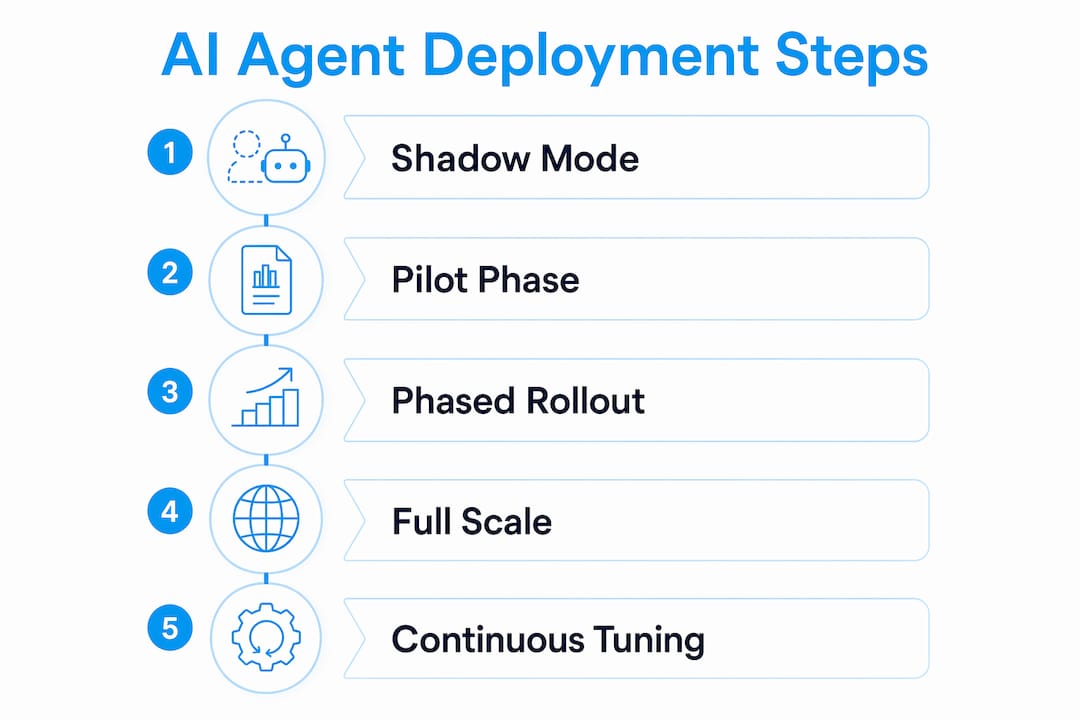
Pro Tip: Start every pilot in shadow mode. The AI drafts every reply; a human reviews and sends it; a QA scoring system records accuracy, tone, and policy compliance. Only flip to auto-reply once QA scores meet your acceptance threshold across a statistically meaningful sample. This protects brand tone and catches hallucinations before they reach customers.
What capabilities should you look for in a contact centre AI agent?
Decision-makers frequently over-index on headline features and under-examine the operational specifics. The capabilities below are the ones that determine whether a deployment succeeds at scale.
Core capability checklist
- Omnichannel support: voice, web chat, email, SMS, and messaging apps handled from a single orchestration layer, with consistent intent detection across channels.
- Real-time agent assist: in-conversation guidance, suggested replies, knowledge retrieval, and CRM auto-population delivered with sub-second latency.
- Full virtual-agent workflows: end-to-end conversation management including multi-turn dialogue, disambiguation, and graceful fallback to human agents.
- RAG over trusted knowledge bases: retrieval-augmented generation that queries your internal policy documents, product catalogues, and past resolved tickets rather than relying on base model behaviour. Training on internal documents keeps tone and policy accuracy within brand bounds.
- Intelligent routing: intent-based routing that sends contacts to the right queue, agent skill group, or automated flow without manual triage.
- Voice controls: STT/TTS with interrupt handling so the agent does not speak over callers, plus configurable hand-off triggers.
- Action execution: the ability to write to CRM records, raise tickets, process refunds, update bookings, and query order status. Modern AI agents integrate with CRM and workflow engines to complete tasks rather than only answer questions.
- Analytics and QA tooling: conversation scoring, intent coverage reporting, escalation-rate tracking, and CSAT correlation dashboards.
Capability scoring for procurement
When reviewing vendors or scoping an internal build, score each capability on a 1–3 scale across three dimensions:
- Does the vendor demonstrate this in a live environment, not just a slide deck?
- Does it integrate with your existing CRM and telephony stack without custom middleware?
- Is it configurable by your operations team, or does every change require vendor professional services?
Enterprise platforms such as Google Cloud's Contact Center AI offer multimodal agents, real-time streaming audio, and commerce integrations at scale. SMB-oriented products, by contrast, typically focus on calendar booking and lead qualification for simpler phone flows. The gap matters: an SMB receptionist product will not handle the compliance, routing complexity, or integration depth a UK enterprise contact centre requires.
What business benefits and KPIs should you track?
The metrics that matter most are the ones your board already watches: cost per contact, CSAT, and agent utilisation. AI agents affect all three, but the magnitude depends on how well the system is trained and how the pilot is scoped.
Primary benefits mapped to metrics
| Benefit | KPI | Baseline source |
|---|---|---|
| Ticket deflection | % of contacts resolved without human agent | Current helpdesk volume by category |
| Handle time reduction | Average handle time (AHT) in seconds | Current AHT by contact type |
| First-contact resolution | FCR rate (%) | Current FCR by channel |
| Agent capacity | Contacts handled per agent per hour | Current throughput data |
| Customer satisfaction | CSAT score / NPS | Current post-contact survey |
| Cost per contact | £ cost per resolved contact | FTE cost + overhead ÷ volume |
How to build a simple ROI outline
Populate these inputs before your pilot scoping call:
- Monthly contact volume eligible for automation (start with your top three repeat intent categories)
- Current average handle time for those contacts
- Cost per agent hour (fully loaded, including management and training overhead)
- Estimated deflection rate (use 60–80% for repeat tickets as a planning benchmark, then validate against your own data in shadow mode)
- Ongoing model tuning and maintenance costs from the vendor or implementation partner
The output is a monthly saving figure you can set against implementation cost to produce a payback period. Most UK enterprise pilots reach payback within six to twelve months when scoped to high-volume, low-complexity contact types.
Benchmark to set expectations: AI agents trained on a company's knowledge base and past resolutions deflect 60–80% of repeat tickets across email, chat, and helpdesk channels. Use the lower end of that range for conservative board-level projections.
How does the technical architecture of a contact centre AI agent work?
Understanding the component map helps you identify where vendor responsibility ends and your internal IT team's begins.
Component map
- Channel adapters: SIP trunk or CPaaS connector for voice; WebSocket or REST API for web chat; IMAP/SMTP or API for email; webhook integrations for WhatsApp, Teams, or SMS.
- STT/ASR: converts caller speech to text; enterprise deployments use cascaded architectures that allow best-of-breed model selection per intent and provide interrupt control so the agent does not speak over the caller.
- NLU/intent detection: classifies intent, extracts entities (account number, product name, date), and passes structured data to the dialogue manager.
- RAG/knowledge layer: retrieves relevant passages from versioned policy documents, product catalogues, and resolved-ticket archives. Effective RAG requires diligent KB curation and a continuous feedback loop that feeds resolved tickets back into the retrieval corpus.
- Dialogue manager/planner: selects the next action or response based on intent, retrieved context, and conversation history.
- Action/execution layer: writes to CRM (Salesforce, Microsoft Dynamics, ServiceNow), raises tickets, processes transactions, or queries order management systems via secure API calls.
- TTS: synthesises the response for voice channels; latency here directly affects caller experience.
- Monitoring and QA pipelines: log every turn, score responses against QA rubrics, and surface intent-coverage gaps and escalation patterns.
Integration checklist
Before committing to a vendor or build, confirm each of the following:
- CRM connector: pre-built or custom API, read/write permissions, field mapping
- Telephony: SIP trunk compatibility, CPaaS provider (Twilio, Vonage, or equivalent), DTMF fallback
- Identity and customer data: authentication method, data masking for PII in transcripts
- Knowledge base connectors: SharePoint, Confluence, Zendesk, or custom document store
- Security and compliance gates: data residency region, encryption in transit and at rest, audit logging
Performance benchmarks
| Metric | Typical enterprise figure | Notes |
|---|---|---|
| Ticket deflection rate | 60–80% (repeat contacts) | Source: trained KB + resolved tickets |
| Voice response latency | Under 200 milliseconds | Enterprise cascaded architecture |
| First audio delivery | Under 1 second from end of caller speech | Enterprise deployments |
| Escalation rate (target) | Under 20% for in-scope intents | Set in pilot acceptance criteria |
How should you plan deployment and rollout for a UK contact centre?
A phased rollout reduces risk and gives your team time to build confidence in the system before it operates autonomously.
Recommended phases and timeline
| Phase | Activity | Typical duration | Go/no-go gate |
|---|---|---|---|
| Discovery and data readiness | Map contact intents, audit KB quality, confirm integrations, draft DPIA | 3–5 weeks | KB coverage ≥ 80% of target intents |
| Shadow-mode pilot | AI drafts replies; humans send; QA scoring runs | 4–8 weeks | QA accuracy ≥ agreed threshold |
| Selective auto-reply | Auto-reply enabled for highest-confidence, lowest-risk intents | 4–6 weeks | CSAT stable; escalation rate within target |
| Expanded virtual agents | Additional intents and channels added | 6 weeks | Volume and CSAT KPIs met |
| Full scale | All target intents automated; agent assist live across remaining contacts | Ongoing | Monthly KPI review |
Implementation checklist
- Map every target intent to a KB article or policy document before the pilot starts.
- Test all CRM and telephony connectors in a staging environment; confirm service integrations cover your specific CRM and telephony stack.
- Define escalation rules and human-review gates before go-live, not after.
- Train agents and supervisors on the new workflow: what the AI does, when it escalates, and how to override it.
- Establish a QA scoring rubric that covers accuracy, tone, policy compliance, and escalation appropriateness.
- Schedule a post-launch optimisation review at weeks two, four, and eight.
What are the security and compliance requirements for UK contact centres?
UK contact centres operate under the UK GDPR (retained from EU GDPR post-Brexit), the Data Protection Act 2018, and sector-specific rules from the FCA, ICO, and CQC depending on industry. AI agents introduce specific obligations that standard software procurement does not always cover.
Compliance checklist for vendor conversations
- Controllership: confirm whether the vendor acts as a data processor or joint controller, and document this in a Data Processing Agreement (DPA).
- Lawful basis: identify the lawful basis for processing customer data through the AI agent (legitimate interests, contract performance, or consent).
- DPIA: conduct a Data Protection Impact Assessment before go-live; the ICO expects one for any high-risk processing involving automated decision-making.
- Data minimisation: confirm the system does not retain full conversation transcripts longer than operationally necessary; define retention periods in the DPA.
- Subject access: confirm the vendor can support Subject Access Requests (SARs) by providing conversation logs for a specific individual on request.
- Sensitive data: if your contact centre handles health, financial, or other special-category data, confirm the vendor's handling and isolation controls.
- Data residency: for UK organisations, confirm that all processing and storage occurs within the UK or EEA, or that appropriate transfer mechanisms (SCCs or UK IDTA) are in place.
- Voice recording consent: UK law requires that callers are informed when a call is recorded. Extend this to AI-processed transcripts; your IVR or opening message must cover both.
- Security posture: regulated verticals require SOC 2 Type II certification, ISO 27001, and contractual BAAs where health data is involved. Request these certificates before signing.
Pro Tip: Carry out the DPIA at the start of the discovery phase, not at the end. Early identification of high-risk processing points lets you redesign data flows before they are built into the architecture, which is far cheaper than retrofitting controls post-deployment.
How do you evaluate and choose the right AI agent partner?
The difference between a successful deployment and a costly failure usually comes down to the quality of the partner, not the underlying model.
Procurement checklist
- Integration breadth: does the vendor have pre-built connectors for your CRM, telephony, and ticketing systems, or will every integration require bespoke development?
- SLAs: what are the uptime, latency, and escalation-response commitments, and are they contractually binding?
- Security and compliance posture: SOC 2 Type II, ISO 27001, UK GDPR DPA, data residency options.
- Explainability: can the vendor show you why the agent gave a specific response, and can you audit the retrieval steps?
- Testing tooling: does the platform include a conversation simulator, regression testing, and intent-coverage reporting?
- Pricing model transparency: is pricing per conversation, per seat, or per API call? What happens to cost as volume scales?
- Support and managed services: is post-launch optimisation included, or billed separately?
Must-ask vendor questions
- How is our data used to train or fine-tune models? Is it isolated from other customers?
- Can you demonstrate shadow mode in a live environment with our data?
- How are escalation rules configured, and who controls them after go-live?
- What is the process for updating the knowledge base and retraining the model?
- Which QA metrics do you report, and who owns the QA process?
Red flags to watch for
- The vendor cannot demonstrate shadow mode or a phased rollout capability.
- Accuracy claims are presented without supporting QA data or a defined measurement methodology.
- Data use for model training is described vaguely or buried in terms of service.
- There is no clear escalation or human-in-the-loop policy.
- The vendor proposes a full autonomous deployment from day one with no pilot phase.
How Real-studios delivers contact centre AI agent projects
Real-studios (trading as AIthatworks) follows a structured methodology that moves from discovery to production without skipping the quality gates that protect your brand and compliance posture.
A recent anonymised engagement with a UK-based financial services contact centre illustrates the approach. The client was handling a high volume of repeat account-status and payment-query contacts across voice and web chat. Real-studios completed a knowledge-base audit, mapped the top intent categories, and built a RAG pipeline over the client's internal policy documents and resolved-ticket archive. The shadow-mode pilot ran for six weeks. By week four, QA scores for the top three intents were consistently above the agreed threshold. Auto-reply was enabled for those intents in week seven. Within three months of go-live, the client reported a material reduction in contacts reaching human agents for those intent categories, measurably lower AHT for assisted contacts, and stable CSAT scores throughout the transition.
The methodology in brief:
- Discovery: intent mapping, KB audit, integration scoping, DPIA initiation.
- RAG knowledge engineering: document ingestion, chunking strategy, retrieval testing, brand-voice alignment.
- Shadow-mode tuning: QA rubric definition, human-review workflow, threshold setting.
- Agent assist roll-out: real-time guidance deployment, CRM integration, supervisor dashboard.
- Post-launch optimisation: weekly KPI reviews, KB gap analysis, model updates.
- GEO tuning: ensuring the client's AI-generated responses are recognised and surfaced correctly in generative search environments.
What are the practical next steps for UK contact centre decision-makers?
If you are ready to scope a pilot this quarter, work through these steps in order.
- Define pilot scope and KPIs. Select two or three high-volume, low-complexity intent categories. Set target KPIs: deflection rate, AHT reduction, CSAT floor, and escalation-rate ceiling.
- Nominate data owners. Identify who owns the knowledge base, who approves policy document updates, and who has authority to sign off on QA thresholds.
- Audit your knowledge base. Map each target intent to an existing KB article. Identify gaps before the vendor conversation, not during it.
- Draft an initial DPIA. Use the ICO's template. Identify processing activities, data flows, and high-risk elements so your legal team can review before vendor selection.
- Prepare a supplier questionnaire. Use the must-ask questions from the evaluation section above. Send it to shortlisted vendors before the demo, not after.
- Request shadow-mode demonstrations. Ask every vendor to demonstrate shadow mode with a sample of your contact types, not a generic demo dataset.
- Define escalation rules. Before any pilot starts, document the conditions under which the AI must hand off to a human and who reviews those cases.
- Confirm stakeholder sign-offs. Procurement needs the DPA and security certificates. Legal needs the DPIA and lawful-basis documentation. IT needs the integration architecture. Operations needs the QA rubric and escalation rules. Get all four aligned before go-live.
A minimum viable pilot covers one channel (typically web chat), one to three intents, a shadow-mode phase of four to six weeks, and a clear go/no-go decision gate based on pre-agreed QA scores and CSAT data.
Key takeaways
A contact centre AI agent delivers measurable deflection, handle-time, and CSAT improvements when deployed in a phased shadow-mode pilot with clear KPIs, proper knowledge engineering, and UK GDPR compliance built in from the start.
| Point | Details |
|---|---|
| Start with shadow mode | Run the AI in a drafting role with human review before enabling auto-reply to protect brand tone and compliance. |
| Deflection benchmark | AI agents trained on your knowledge base can deflect 60–80% of repeat tickets; use the lower end for board projections. |
| UK compliance is non-negotiable | Complete a DPIA, confirm data residency, and address voice-recording consent before go-live, not after. |
| Evaluate on integration depth | Score vendors on CRM and telephony connector quality, shadow-mode capability, and QA tooling, not headline accuracy claims. |
| Real-studios pilot approach | Real-studios delivers discovery-to-production AI agent projects for UK contact centres, including shadow-mode tuning and post-launch optimisation. |
The gap between AI agent promises and what actually determines success
The contact centre AI market is full of vendors who lead with deflection percentages and CSAT uplifts. Those numbers are real, but they are outputs of a process, not guarantees that come with the software licence.
What actually determines whether a deployment succeeds is the quality of the knowledge base, the rigour of the shadow-mode phase, and the clarity of the escalation rules. A poorly curated KB produces confident wrong answers. A skipped shadow-mode phase means those wrong answers reach customers. Vague escalation rules mean the system holds conversations it should hand off, and customers notice.
The organisations that get the most from AI agents are the ones that treat the pilot as a genuine learning exercise rather than a procurement box to tick. They assign a knowledge-base owner, they review QA scores weekly, and they are willing to delay auto-reply by two weeks if the data says the system is not ready. That discipline is not a constraint on speed. It is what makes the eventual scale-up credible to the board, to regulators, and to the customers on the other end of the conversation.
Real-studios builds contact centre AI agents that work in production
UK contact centres that want measurable results from AI agents, not just a proof of concept, need a partner who handles the full stack: knowledge engineering, CRM and telephony integration, shadow-mode tuning, and post-launch optimisation.
Real-studios (AIthatworks) delivers exactly that. Based in Manchester, the consultancy builds bespoke AI agents for UK businesses, covering voice, chat, and email channels with RAG pipelines trained on your internal documents and brand voice. Every engagement starts with a scoped discovery phase and moves through a structured shadow-mode pilot before any autonomous deployment goes live.
The Service Automations offering covers the full agent build and deployment cycle. For teams that want a time-boxed pilot to validate use cases and KPIs before committing to full scale, the Service MVP engagement is the right starting point. Both include a KPI dashboard and a post-launch optimisation review.
Book a pilot scoping call with Real-studios to define your target intents, confirm your integration requirements, and get a realistic timeline for your first shadow-mode deployment.