Get Cited in AI Answers: Evidence First GEO for Content Teams
AI answers usually cite short, self-contained passages placed early in a page. CXL's 100-page study found 55% of AI Overview citations came from the first 30% of the content, with the 10 to 20% zone alone producing the most snippets. The single highest-leverage fix: move your core answer, a named entity, and one sourced statistic into the first 150 to 200 words, then structure every H2 as a self-contained answer capsule.
TL;DR:
- Moving your core answer and key statistics into the first 150 to 200 words significantly increases the likelihood of AI citations, as early content is favored.
- Structuring each heading as a self-contained answer capsule with clear, standalone answers boosts citation potential across AI engines.
- Ensuring content is server-side rendered or served as static HTML improves machine accessibility and extraction for retrieval-augmented AI systems.
- Regularly updating and verifying schema markup, schema.org validation, and establishing a review schedule helps maintain content relevance and citation share over time.
- Cross-platform testing of queries across multiple AI engines reveals platform-specific citation gaps, emphasizing the need for tailored optimization.
Table of Contents
- Where AI engines pull citations from and the 'ski ramp' evidence
- The six page-level drivers that determine citation likelihood
- Prioritised checklist: what to fix now, in 90 days, and over the year
- How do you measure AI citation visibility?
- What mistakes reduce your chance of being cited?
- What does it mean to be cited in AI answers?
- How do AI systems select and generate citations?
- What are the legal and ethical considerations around AI citations?
- How do AI citations affect website traffic and SEO?
- What do strong AI citations actually look like?
- What does a practical GEO diagnostic actually involve?
- Where to go for deeper study
- The gap between citation advice and citation reality
- Sources
Where AI engines pull citations from and the 'ski ramp' evidence
The pattern has a shape, and it looks like a ski ramp. CXL's analysis of 100 AI Overview citations plotted where in a page each cited passage sat, broken into ten-percentage-point bands from the top of the content to the bottom. The result wasn't a gentle slope. It was a steep drop-off after the first third of the page, followed by a long, low tail.
The distribution tells the real story:
- 0 to 10% of the page: 21 citations
- 10 to 20%: 27 citations, the single richest band
- 20 to 30%: 7 citations
- 30 to 40%: 9 citations
- 40 to 60%: 15 citations
- 60 to 80%: 11 citations
- 80 to 100%: 10 citations
It usually corresponds to the first substantive paragraph after a title and any throat-clearing, which is exactly why a tight, jargon-free lede matters more than a clever headline.
This isn't a Google-only quirk. Separate analysis of ChatGPT citation patterns found a closely aligned figure: a large share of citations come from the first third of a document. This shows a common pattern across AI engines favoring early content. That's not coincidence. It reflects how retrieval-augmented systems chunk a page before an AI model ever sees it.
Here's the mechanism worth understanding. Large language models don't read your page top to bottom the way a person does. They (or the crawler and indexing layer feeding them) break content into passages, often a few hundred words each, and score those chunks for relevance to a query. A chunk sitting inside a wall of scene-setting narrative competes against a chunk that opens with a plain-stated fact. The fact-first chunk wins more often, because it's easier to lift cleanly and quote without additional editing.
The practical consequence for content layout is straightforward: your structure creates an extraction bias whether you plan for it or not. If your strongest statistic, your clearest definition, or your most defensible claim sits in paragraph nine, you're asking the retrieval layer to do extra work to find it, so you should learn how to optimize your website like a pro to ensure better AI extraction. Most of the time, it won't bother. It'll cite the competitor whose paragraph two said the same thing more plainly.
This is also why generic "comprehensive guide" openings hurt more than they help.
The six page-level drivers that determine citation likelihood
DerivateX's analysis of URL-level signals identifies six factors that predict whether a given page gets picked up by a large language model. Each one comes with a diagnostic question you can run today, and a fix you can assign this week.
- Page type alignment. Ask: does your title and URL slug actually look like the page type the query implies? A listicle title answering a "how to" query, or a product page trying to answer a definitional query, both confuse the retrieval layer. Fix: rework the title and slug to match the query's intent, and build a dedicated page for high-volume question intents rather than folding them into unrelated content.
- Content position and chunking. Ask: is your answer front-loaded, and does each H2 function as a standalone answer capsule? Fix: move your key stats and the direct answer into the first 150 to 200 words, and rewrite each subheading so the paragraph beneath it makes sense with zero surrounding context.
- Claim density and entity clarity. Ask: are your facts attributed to named sources, and are your figures specific rather than vague? Fix: replace "many businesses report improvements" with a named study, a named organisation, and a concrete figure, stated early rather than buried in a footnote.
- Technical parsability. Ask: can a crawler bot actually fetch and render your content without executing JavaScript first? Fix: server-side render critical content or serve static HTML, publish an llms.txt file signalling which content is available for machine consumption, and check your server logs for GPTBot and PerplexityBot hits to confirm they're reaching the page at all.
- Topical authority and corroboration. Ask: does your brand or your claim appear anywhere else that an AI system might cross-reference? Fix: pursue contributed pieces on relevant publications, participate in communities where your topic gets discussed, and secure earned mentions rather than relying on owned content alone.
- Freshness. Ask: is there a visible, accurate date, and does the content reflect the current state of the topic? Fix: add a clear "last updated" marker and set an actual review schedule for pages where facts change, rather than a cosmetic date stamp that never moves.
Page type alignment and chunking are usually the fastest wins because they're entirely within an editorial team's control. Topical authority and corroboration move slower, because they depend on how other domains talk about you, not just what you publish. Both matter for citation share, but they operate on different clocks.
Prioritised checklist: what to fix now, in 90 days, and over the year
Not every fix pays off on the same timeline. Sequencing matters, because teams that try to do everything at once usually finish nothing.
Fast wins (0 to 30 days):
- Publish an llms.txt file and audit server logs for GPTBot and PerplexityBot activity to confirm crawlers can reach your pages.
- Move to server-side rendering, or serve a static HTML fallback, for any page currently dependent on client-side JavaScript for its core content.
- Rewrite the lede on your five highest-traffic informational pages so the direct answer appears in the first 150 to 200 words.
- Rework H2s into answer capsules: a question-style heading followed immediately by a two- or three-sentence direct answer.
Editorial work (30 to 90 days):
- Add FAQPage, Article, and Author schema markup, and validate every implementation against validator.schema.org.
- Bring named expert quotes and sourced statistics into the top 30% of each priority page, with attribution stated plainly rather than implied.
- Convert dense paragraphs of comparative data into tables, since Authoricy's benchmark work links structural readiness, including tables and short answer sections, to stronger citation rates.
Reputation work (3 to 12 months):
- Pursue corroborating mentions on third-party sites, industry roundups, and relevant communities, since AI systems weigh cross-referenced claims more heavily than isolated ones.
- Publish original research or first-party data your competitors can't replicate, which tends to earn citations precisely because there's no alternative source to cite instead.
- Build a presence on the platforms AI systems already draw from heavily, including community sites, video platforms, and industry-recognised lists.
To triage which pages to fix first, ask three questions of each candidate: does it already rank for a question-style query, does the current lede bury the answer past paragraph three, and does the topic carry commercial or reputational weight for your business? Pages that clear all three go to the top of the list.
How do you measure AI citation visibility?
Citation rate, the share of relevant AI answers that name your domain, is the core metric, but it's rarely available as a clean dashboard number. Most teams approximate it through a mix of direct testing and inferred signals.
- Manual prompting and screenshots. Run your target queries through ChatGPT, Perplexity, and Gemini directly, and log whether your domain appears, in what position, and alongside which competitors.
- AI share of voice. Track how often your brand appears relative to competitors across a fixed set of queries, checked on a consistent schedule rather than once.
- Platform distribution. Log results separately for each engine. A page cited heavily by Perplexity but never by Gemini tells you something specific about how that platform sources answers.
- AI-referred sessions. Segment referral traffic in your analytics platform for AI chat and search engines, since this traffic pattern often shows a different on-site behaviour than traditional organic clicks.
- Server log analysis. Cross-reference GPTBot and PerplexityBot hit frequency against your citation testing to see whether visibility problems are technical (bots aren't fetching the page) or editorial (bots fetch it but don't cite it).
Tools purpose-built for this tracking are still maturing; Semrush's AI visibility tooling and similar platform-level trackers are worth pairing with manual prompting rather than trusting either method alone. Expect technical fixes, like server-side rendering or llms.txt deployment, to show measurable movement within 30 to 90 days. Reputation-level moves, like earned mentions and original research, tend to compound over 3 to 12 months rather than showing quick jumps.
What mistakes reduce your chance of being cited?
The most damaging pattern is a long narrative lede with no extractable opening. Readers might tolerate three paragraphs of scene-setting before the answer; a retrieval system generally won't wait that long.
- Burying the direct answer beneath history, context, or a "let's start with the basics" preamble.
- Blocking crawlers via robots.txt or relying entirely on JavaScript rendering that bots can't execute.
- Using vague, unattributed claims instead of named entities and specific, sourced figures.
- Assuming a fix that works for Google's AI Overviews will automatically transfer to ChatGPT, Perplexity, or Gemini, without testing each platform separately.
Pro Tip: Test the same query across at least three engines before declaring a page "optimised." A page can dominate Perplexity citations while being invisible to Gemini, because each platform weights freshness, corroboration, and chunk structure differently.
What does it mean to be cited in AI answers?
Being cited in AI answers means an AI system, whether that's Google's AI Overviews, ChatGPT, Perplexity, or Gemini, names your domain or links to your page as the source behind a claim in its generated response. It's the AI-era equivalent of a featured snippet, except the "snippet" is often invisible until a user clicks through to see sources.
The stakes are rising quickly. As more searches resolve inside an AI answer without a traditional list of blue links, citation becomes the main route by which a brand gets seen at all for that query. A page that used to rank second on Google and still capture clicks might now get zero visibility if it's never named as a source, even while its content technically informed the answer given.
This matters differently depending on the query type. For a purely informational question, being cited puts your brand name in front of the user directly inside the answer, sometimes with no click required. For a commercial or comparison query, a citation is often the deciding factor in whether a user visits your site at all among several options the AI mentions.
How do AI systems select and generate citations?
Retrieval-augmented generation, the underlying architecture behind most cited AI answers, works in two stages. First, the system retrieves a set of relevant passages from indexed content, often chunked into a few hundred words each. Second, a language model synthesises those passages into a natural-language answer, choosing which sources to cite based on relevance and, increasingly, on how cleanly a passage can be quoted.
That second stage rewards passages that stand alone. A sentence that depends on three preceding sentences for context is harder for the model to extract cleanly, so it tends to lose out to a competing passage that states a fact with no dependency on surrounding text. This is also why DerivateX's chunk-structure factor matters so much: the retrieval layer scores chunks, not whole pages, so a page's average quality matters less than its best individual chunk.
What are the legal and ethical considerations around AI citations?
Attribution norms are still unsettled. Most AI engines cite a source URL, but few consistently preserve the nuance, caveats, or scope of the original claim, which creates a real risk of your content being misrepresented even while technically "cited."
There's also a live tension over whether AI-generated summaries reduce the incentive for publishers to produce original research at all, since the value of that research gets extracted into an answer that may never send a click back to the source. Ethically, this pushes content teams towards publishing claims that are specific enough to be hard to paraphrase inaccurately, and towards checking, where platforms allow it, how their content is being represented once cited.
How do AI citations affect website traffic and SEO?
A citation doesn't behave like a traditional backlink or a ranking position. It can generate brand exposure with zero click-through, since many users read the AI-generated answer and never visit the underlying page. This shifts the value proposition of visibility away from pure traffic and towards impression-based brand presence, similar to how a mention on television or radio builds recognition without any traceable click.
Where citations do drive traffic, that referral segment often behaves differently: sessions arriving from an AI answer tend to reflect users who already have partial context, which can affect time on page and conversion patterns compared with cold organic search traffic. Tracking that segment separately in analytics is the only reliable way to understand its actual value to your business.
What do strong AI citations actually look like?
The clearest pattern in well-cited content is structural, not topical. Pages that get cited repeatedly tend to share a shape: a direct answer within the first few sentences, a named statistic with attribution close to it, and subheadings phrased as the questions users actually type.
Authoricy's benchmark work found structural readiness, including short answer sections, tables, and FAQ schema, correlated strongly with citation frequency. That lines up with a separate observation worth building into your own content: FAQ blocks function almost like mini-articles, because each question-and-answer pair is self-contained enough to be lifted and cited even when it sits lower on the page, well past the ski-ramp zone where most citations cluster. A well-built FAQ section can outperform its position on the page precisely because it doesn't depend on anything above it for context.
What does a practical GEO diagnostic actually involve?
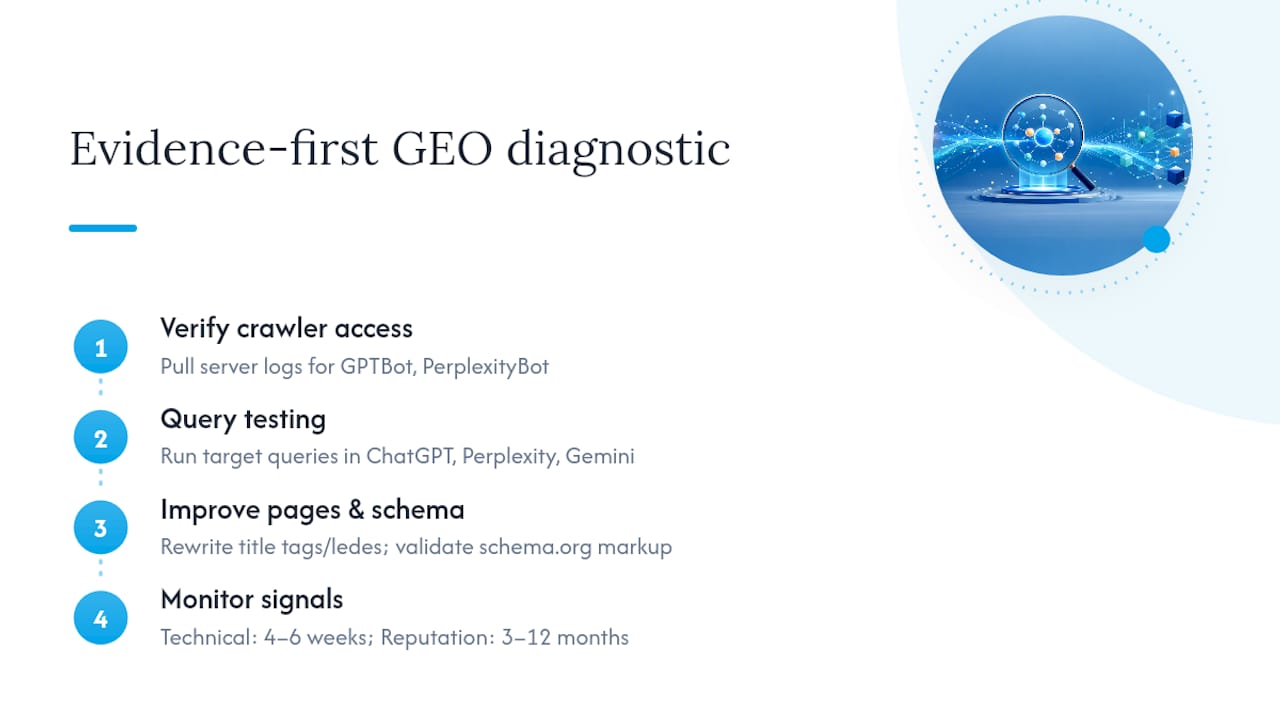
A proper diagnostic starts with the unglamorous work: pulling server logs to confirm GPTBot and PerplexityBot are actually reaching your priority pages, then running the same set of target queries through ChatGPT, Perplexity, and Gemini to record whether you're cited, and where.
From there, the workflow moves to editorial: rewriting title tags and ledes on pages that rank but don't get cited, and checking schema implementation against validator.schema.org to catch markup errors that silently block machine readability. Expect technical fixes to show measurable signal within four to six weeks; earned mentions and reputation-level work take considerably longer to compound, often three to twelve months before they show up clearly in citation testing.
This is the kind of structured, evidence-first process Real-studios runs for clients pursuing Generative Engine Optimisation, treating AI visibility as a measurable discipline rather than a guess. Building the diagnostic muscle in-house, with a named author, clear organisational credentials, and a documented review cadence, is one of the underrated trust signals that AI systems and human readers both respond to.
Where to go for deeper study
For the full breakdown of citation distribution across a page, read CXL's 100-page study, the primary source behind the statistics used throughout this piece. For the six-factor URL-level framework and diagnostic questions used in the checklist above, see DerivateX's analysis. For structural benchmarks on tables, FAQ schema, and answer capsules, Authoricy's B2B guide is worth bookmarking. To validate your own schema markup, run it through validator.schema.org before publishing.
The gap between citation advice and citation reality
Most content teams treat AI citation as a content problem when it's really a structural one first and a reputation problem second. You can write a technically brilliant paragraph and still lose the citation to a competitor who said something less impressive but said it in a cleaner, more extractable shape. That's uncomfortable for anyone who takes writing seriously, but it's the reality of how retrieval systems chunk and score content.
The bigger misconception is thinking optimisation for one AI engine transfers automatically to the rest. It doesn't. A page perfectly tuned for Google's AI Overviews can sit invisible in Perplexity results, because each platform weighs freshness, corroboration, and technical parsability differently. Teams that test across ChatGPT, Perplexity, and Gemini separately, rather than assuming one win generalises, consistently find gaps they'd otherwise have missed entirely.
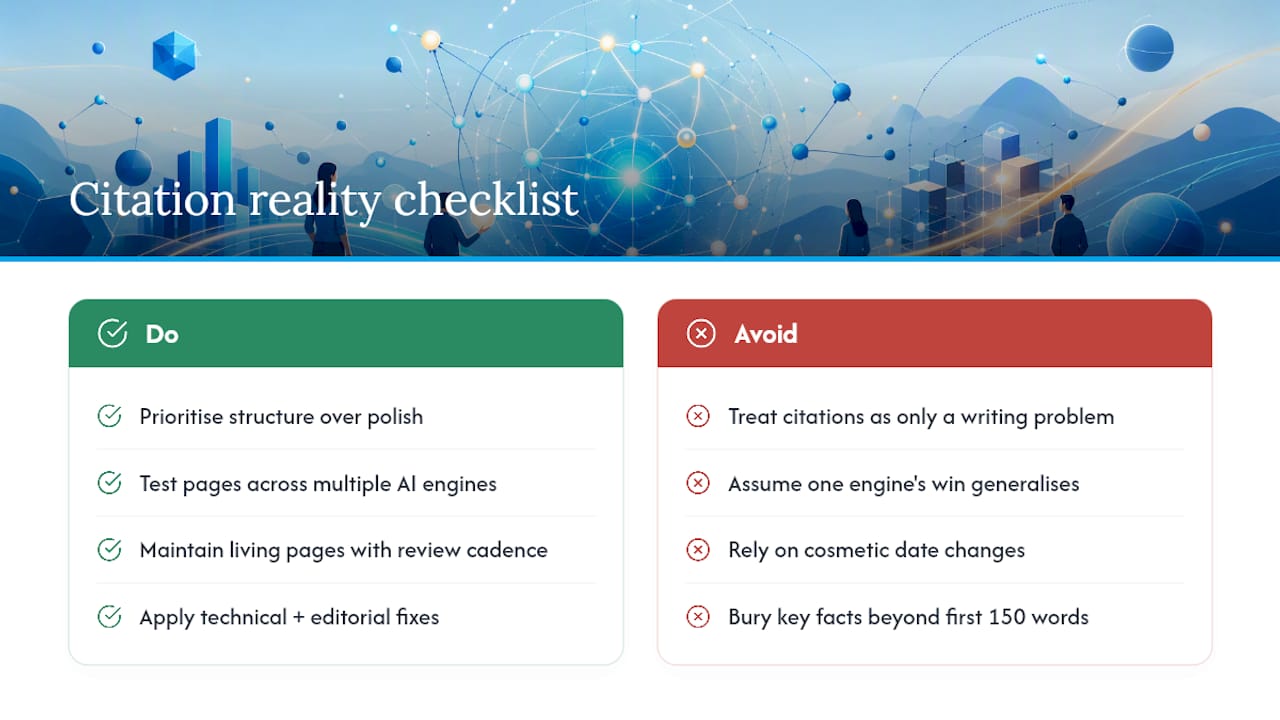
The other underestimated factor is speed of decay. Freshness isn't a one-time fix. A page that earned citations six months ago on the strength of a statistic can lose that citation the moment a newer, better-sourced page enters the index. Treating your highest-value pages as living documents, with a genuine review cadence rather than a cosmetic date change, is the difference between sustained citation share and a brief spike that fades.
If there's one thing worth internalising from the evidence, it's this: structure beats polish. A plainly stated fact in the first 150 words will out-cite a beautifully written paragraph buried on page two of your content, every time the retrieval layer has to choose between them.
— Oded
Ready to put this into practice? Specialist consultancies build Generative Engine Optimisation into their AI consultancy work for businesses, combining technical fixes like server-side rendering and schema validation with the editorial restructuring that makes content genuinely citable. Explore Real-studios' automation and GEO services to see how a structured diagnostic and implementation sprint could apply to your own priority pages.
Sources
- Where Google AI Overviews Cite From: A 100-Page Study
- LLM Citation Factors: 6 URL-Level Signals That Decide
- AI Citation Optimization: B2B Guide | Authoricy