Build vs buy AI: a pragmatic framework for UK leaders
For most UK businesses, the right answer to the build vs buy AI question is neither pure build nor pure buy. It is a hybrid: purchase the commodity infrastructure and foundation models, then build the workflows and agents that encode your competitive advantage. That single principle, supported by MIT Sloan's guidance on AI strategy, resolves the majority of procurement debates before they become expensive.
The 60-second decision path:
- Lean towards buy if the capability is generic (scheduling, summarisation, document parsing), your timeline is under three months, or you have no ML or AI engineering resource in-house.
- Lean towards build if the workflow touches proprietary data, encodes specialist business logic, or would hand a competitor a direct window into your processes if outsourced.
- Default to hybrid in every other case: buy the platform or foundation layer, build the differentiating agent or integration on top.
The core trade-offs in brief:
- Cost: off-the-shelf licences carry lower upfront cost but accumulate over time; bespoke builds carry higher initial spend with lower marginal cost at scale.
- Time to value: buying typically delivers working capability in weeks; building typically takes months.
- Strategic moat: only bespoke builds encode proprietary logic that competitors cannot replicate by purchasing the same product.
- Compliance: building gives you full data residency control; buying requires rigorous vendor due diligence under UK GDPR.
- Talent: the constraint most teams underestimate.
Pro Tip: The single most overlooked cost in a build decision is not cloud infrastructure — it is the ongoing salary, management overhead, and retention risk of the engineers who will own the system after launch. Price that before you price the compute.
Table of Contents
- How do you score a build vs buy AI decision in 60 seconds?
- Why has the build vs buy AI question shifted so dramatically?
- What does a practical 6-step build vs buy framework look like?
- When does building a bespoke AI solution make sense?
- When does buying an off-the-shelf AI product make sense?
- What do practical hybrid AI architectures look like?
- How do you estimate cost and timeline for build vs buy AI?
- How does Real-studios run the build vs buy decision process for UK businesses?
- Key takeaways
- The assumption that costs teams most
- Real-studios runs your build vs buy decision workshop
- Useful sources and further reading
How do you score a build vs buy AI decision in 60 seconds?
The checklist below maps directly to a build, buy, or hybrid outcome. Score each question, total the points, and read off the recommendation.
The scoring checklist
- Is this capability core to your competitive advantage? Yes = 3 pts. Partially = 1 pt. No = 0 pts.
- Does the workflow involve sensitive, proprietary, or regulated data? Yes = 3 pts. Partially = 1 pt. No = 0 pts.
- Do you need deep integration with bespoke internal systems? Yes = 2 pts. Standard APIs only = 1 pt. No = 0 pts.
- Do you have (or can you hire) the engineering talent to build and maintain this? Yes = 2 pts. Possibly = 1 pt. No = 0 pts.
- Is the expected usage volume high enough to justify build economics over a 3-year horizon? Yes = 2 pts. Uncertain = 1 pt. No = 0 pts.
Weighting rationale
Strategic moat and data sensitivity carry the highest weight (3 pts each) because they are the two factors that, according to SVPG's build vs buy framework, most reliably justify the cost and risk of a bespoke build. Integration depth and talent follow. Volume is a tiebreaker.
Pro Tip: Before you commit to a build score, test your talent assumption with one concrete question: "Who will own this system in 18 months, and are they already employed here?" If the answer is uncertain, reduce your talent score by one point.
Example: A UK professional services firm scores 3 (competitive moat) + 3 (client data sensitivity) + 2 (bespoke CRM integration) + 1 (talent: one senior engineer available) + 1 (volume: uncertain) = 10. Decision: build, with a managed partner to reduce delivery risk.
Why has the build vs buy AI question shifted so dramatically?
The economics of this decision changed faster than most procurement frameworks have caught up with. Three forces drove the shift.
Infrastructure costs fell sharply. Managed model APIs, cloud-hosted vector databases, and low-code orchestration tools such as LangChain and n8n mean a capable AI agent can be assembled without a dedicated MLOps team. Building AI agents has become materially cheaper, altering the calculus for UK SMEs that previously had no realistic build option.
The vendor market expanded rapidly. Gartner projects worldwide AI spending will continue to grow significantly., and that scale of investment has produced a proliferating catalogue of commercial AI products across every business function. The Statista AI market outlook confirms the market is growing at pace, which means the vendor options available to a UK buyer today are materially broader than they were two years ago.
UK adoption patterns confirm a buying preference. According to GOV.UK AI adoption research, 65% of UK organisations planned to implement off-the-shelf AI applications and 59% planned to embed AI into existing tools. Those figures reflect a rational response to the market: for most functions, a well-chosen commercial product delivers faster value than a bespoke build.
Market signal: According to GOV.UK AI adoption research, 65% of UK organisations planned to implement off-the-shelf AI applications and 59% planned to embed AI into existing tools — confirming that buying and embedding, rather than building from scratch, is the dominant deployment pattern.
What changed the hybrid argument is the combination of cheaper build tooling and richer vendor options. You can now buy a capable foundation and build a differentiated layer on top at a cost that was not viable three years ago.
What does a practical 6-step build vs buy framework look like?
Run this as a half-day or full-day workshop with your technical lead, a business owner, and a finance representative. Each step produces a concrete artefact.
-
Discovery: clarify the outcome. Define the business problem in one sentence, name the users, and agree on two or three measurable success metrics. Interview prompt: "What does success look like in six months, and how will we measure it?"
-
Workflow map: commodity vs proprietary. Draw the end-to-end workflow. Label each step as either commodity (available off-the-shelf) or proprietary (encodes your business logic or data). The proprietary steps are your build candidates. For guidance on managing the delivery workflow once you have decided, AI project management tools for B2B teams offers a practical overview of tooling options.
-
Data and compliance review. Identify every data source the AI will touch. Flag personal data, commercially sensitive data, and any data with residency requirements. This step often resolves the build vs buy question on its own: if the data cannot leave your environment, buying a cloud-hosted SaaS product may not be viable without contractual data residency guarantees.
-
Capability and talent check. List the skills required to build and operate the system: prompt engineering, API integration, model fine-tuning, monitoring, and incident response. Map those against your current team. Gaps that cannot be filled within your hiring timeline are a strong signal to buy or partner.
-
TCO estimation. Compare total cost of ownership across a 3-year horizon for each option. Use the table below as a starting template.
-
Pilot and decide. Run a time-boxed pilot (typically 4–8 weeks) against your success metrics from Step 1. Define exit criteria before you start: if the pilot does not hit metric X by week Y, you stop and reassess.
Workshop TCO comparison template
| Dimension | Off-the-shelf buy | Bespoke build | Hybrid |
|---|---|---|---|
| Initial development cost | Low (licence fee) | High (engineering time) | Medium (platform + build) |
| Ongoing licence / hosting | Recurring per seat or usage | Low marginal cost at scale | Partial licence + hosting |
| Maintenance and updates | Vendor-managed | Internal team required | Split responsibility |
| Compliance and audit | Vendor certifications required | Full internal control | Shared, by layer |
| Talent dependency | Low | High | Medium |
| Exit cost | Moderate (data export, migration) | Low | Medium |
| Time to first value | Weeks | Months | 4–8 weeks for pilot |
Pilot checklist:
- Success metrics defined and agreed before start
- Data access confirmed and GDPR-compliant
- Rollback plan documented
- Stakeholder review scheduled at week 4
- Exit criteria written down and signed off
The MIT Sloan buy/boost/build spectrum is a useful reference for framing the options at Step 2 of this workshop, particularly for teams that have not yet encountered the "boost" (customise an existing product) as a distinct middle path.
When does building a bespoke AI solution make sense?
Build when the capability is genuinely strategic and the talent exists to sustain it. The signals below are evidence you can check, not abstract principles.
- The workflow encodes a competitive moat — If a competitor could replicate your capability by purchasing the same off-the-shelf product, it is not a moat. If it requires your proprietary data, your domain logic, or your operational history, it may be. As SVPG's framework puts it: buy commoditised layers, build where the capability creates a durable competitive advantage.
Use-case example: A UK logistics firm with proprietary routing data and a high daily transaction volume builds a custom dispatch-optimisation agent. No off-the-shelf product can ingest their legacy data format or replicate their pricing logic. The build pays back within two years and the competitor cannot replicate it by buying the same tool.
Pro Tip: Before committing to a full build, run a two-week internal proof-of-concept using open-source tooling and synthetic data. If your team cannot produce a working prototype in that window, the talent gap is real and a managed partner or hybrid approach is the lower-risk path.
When does buying an off-the-shelf AI product make sense?
Buying is the rational choice when the function is generic, the timeline is short, or the internal capability to build and maintain simply does not exist. The GOV.UK AI adoption research confirms this is the dominant pattern: 65% of UK organisations planned to implement off-the-shelf AI applications and 59% planned to embed AI into existing tools.
Buy signals:
- The function is commodity: document summarisation, meeting transcription, CRM enrichment, or standard customer service deflection.
- You need working capability within 8–12 weeks.
- Integration requirements are standard (REST APIs, webhooks, common SaaS connectors).
- The data involved is not sensitive or can be anonymised before processing.
- No ML or AI engineering resource exists in-house and hiring is not planned.
Vendor evaluation checklist
Before signing a contract, get written answers to these questions:
- Where is data processed and stored? Does the vendor offer UK or EU data residency?
- What certifications does the vendor hold? (ISO 27001, SOC 2 Type II, Cyber Essentials Plus)
- Who are the sub-processors, and are they listed in the Data Processing Agreement?
- Does the vendor use your data to train or fine-tune models?
- What are the SLAs for uptime and incident response?
- Can you export your data in a portable format, and what does migration out look like?
- What is the contract notice period and what happens to your data on termination?
Risks when buying and how to mitigate them:
- Vendor lock-in: negotiate data portability clauses and test the export process before you go live, not after.
- Hidden TCO: per-seat or per-API-call pricing models can scale unexpectedly. Model your usage at 2x and 5x current volume before signing.
- Compliance drift: vendors update their sub-processors and data practices. Build a quarterly review into your contract management process.
What do practical hybrid AI architectures look like?
The hybrid approach is not a compromise. It is the architecture that most enterprise AI practitioners now recommend, and it maps directly to the SVPG principle of buying the foundation and building the differentiator.
Pattern 1: buy foundation services, build customer-facing logic. Purchase managed model APIs (OpenAI, Anthropic, or Azure OpenAI Service), cloud hosting, and a vector database. Build the RAG pipeline, the prompt logic, and the customer-facing agent on top. You control the differentiation; the vendor manages the infrastructure.
Pattern 2: buy the productivity layer, build vertical workflow agents. Deploy a commercial AI assistant for internal productivity (document drafting, meeting summaries). Separately, build bespoke agents for your core vertical workflow: claims processing, compliance checking, or client onboarding. The two layers do not need to share architecture.
Pattern 3: managed partner build. Buy the core components (model API, hosting, orchestration framework), then co-develop the differentiating logic with a specialist consultancy. This pattern suits teams that have the business knowledge but not the AI engineering depth to build alone.
Hybrid pattern trade-offs
| Pattern | Speed to value | Differentiation | Internal talent needed | Cost profile |
|---|---|---|---|---|
| Buy foundation + build logic | Medium (4–8 weeks pilot) | High | AI engineering | Medium-high |
| Buy productivity + build agents | Fast for productivity layer | High for agents | Prompt + integration | Medium |
| Managed partner build | Fast with right partner | High | Product ownership | Project fee |
Pro Tip: Define a clear ownership boundary in writing before the first line of code is written. Specify which components the vendor owns, which your team owns, and which the partner owns. Ambiguity here is the single most common cause of post-launch maintenance disputes.
How do you estimate cost and timeline for build vs buy AI?
TCO is the number that matters, not the headline licence fee or the initial build quote. Every AI implementation carries costs across at least five dimensions: development or licence, ongoing maintenance, compliance and audit, talent, and exit.
The 30% rule
A useful heuristic from enterprise delivery practice: ongoing maintenance, monitoring, and iteration typically costs 30% of the initial build cost per year. A bespoke build that costs £120,000 to develop should be budgeted at approximately £36,000 per year to maintain. If that figure is not in your business case, the case is incomplete.
Typical delivery timelines
| Approach | Pilot | Full deployment | Ongoing iteration |
|---|---|---|---|
| Buy (off-the-shelf) | 2–4 weeks | 6–10 weeks | Vendor release cycle |
| Build (bespoke) | 4–8 weeks | 3–6 months | Internal sprint cadence |
| Hybrid | 4–6 weeks | 8–14 weeks | Mixed |
How does Real-studios run the build vs buy decision process for UK businesses?
Real-studios runs a structured decision workshop, typically completed in one day, that produces three artefacts: a completed scorecard, a pilot checklist, and a TCO comparison your finance team can use immediately.
What the workshop covers:
- A facilitated run of the 6-step framework above, adapted to your specific workflow and data environment
- A completed scoring rubric with weighted recommendations
- A prioritised list of commodity vs proprietary workflow elements
- A vendor shortlist or build specification, depending on the outcome
- A 90-day pilot plan with defined success metrics and exit criteria
Typical client outcomes:
One UK professional services firm engaged Real-studios to assess whether to build or buy an AI-powered client intake agent. The workshop identified that the intake logic was proprietary (high sensitivity, bespoke qualification criteria) but the underlying model infrastructure was commodity. The recommendation: buy the model API and hosting, build the intake agent. The pilot launched within six weeks and reduced intake processing time materially, with no client data leaving the firm's environment.

A UK e-commerce operator needed to decide whether to build a custom product recommendation engine or licence a commercial platform. The TCO analysis showed the commercial platform was more cost-effective at current volume, but the firm's proprietary catalogue data represented a genuine moat. The hybrid recommendation: licence the platform for the short term, build a proprietary data layer that could be ported to a bespoke engine if volume justified it within 18 months.
Real-studios delivers the full hybrid stack: workflow automations, custom integrations and RAG agent development, and rapid MVP prototypes for teams that want a low-risk pilot before committing to a full build. The consultancy also covers Generative Engine Optimisation (GEO) for organisations that need their AI-facing content to be visible in AI-generated search responses.
Key takeaways
The most effective AI implementation strategy for UK businesses is a hybrid: buy commodity infrastructure and foundation models, then build the workflows that encode your competitive advantage.
| Point | Details |
|---|---|
| Default to hybrid | Buy commodity layers and build differentiating agents; this is the most cost-effective path for most UK businesses. |
| Score before you decide | Use the 5-question rubric: 10–12 points = build, 5–9 = hybrid, 0–4 = buy. |
| TCO beats headline cost | Apply the 30% annual maintenance rule to any build estimate; a £120,000 build costs approximately £36,000 per year to maintain. |
| Governance drives the choice | UK GDPR and data residency requirements often resolve the build vs buy question before cost analysis begins. |
| Real-studios workshop | Real-studios runs a one-day decision workshop producing a scorecard, pilot checklist, and TCO comparison for UK businesses. |
The assumption that costs teams most
The build vs buy AI debate gets framed as a technology question. It rarely is. The teams that make the most expensive mistakes are the ones that treat it as a procurement exercise, pick a path based on headline cost or vendor demos, and discover six months later that the real constraint was always talent and ownership.
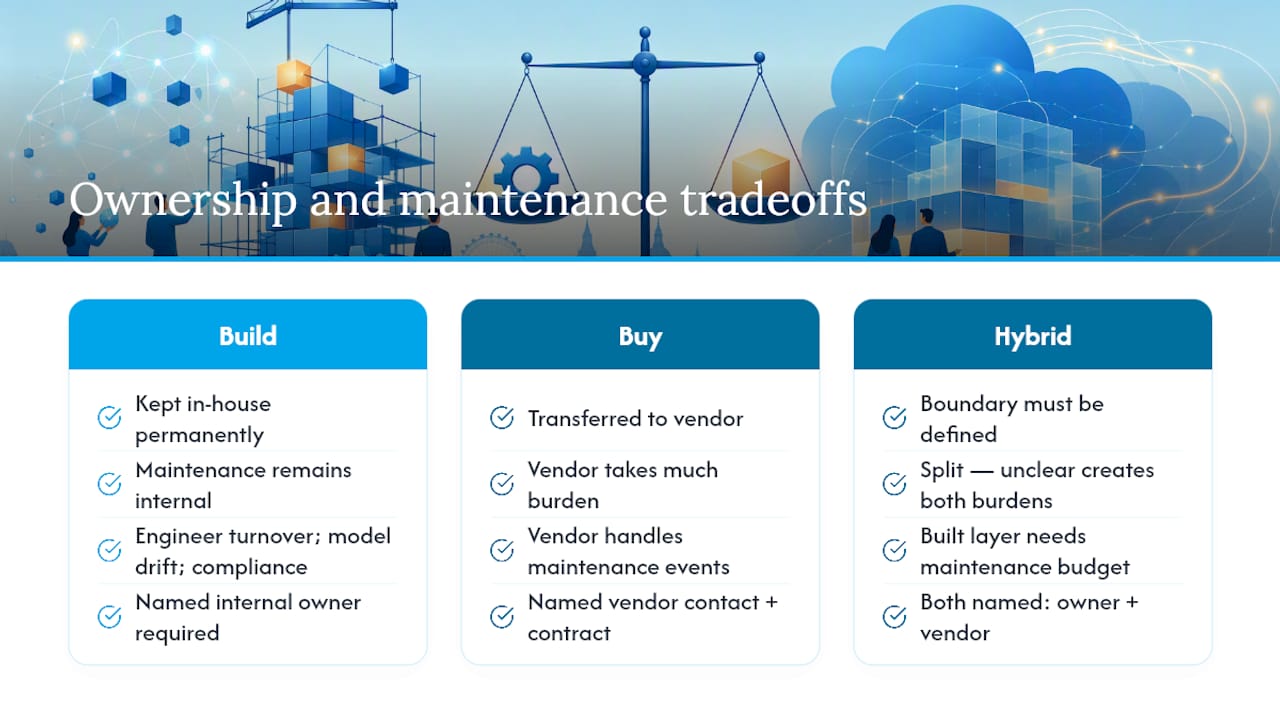
The 30% maintenance rule is not a heuristic teams invent. It reflects a consistent pattern: the initial build or integration is the easy part. The hard part is the engineer who leaves, the model that drifts, the compliance requirement that changes, and the business logic that needs updating every time a product or process changes. Bought solutions transfer much of that burden to the vendor. Built solutions keep it in-house permanently.
The other assumption worth challenging is that hybrid means "do both and hope they connect." The most effective hybrid architectures have a clear ownership boundary drawn before the first line of code. The bought layer has a named vendor contact and a contract. The built layer has a named internal owner and a maintenance budget. When those two things are not in place, the hybrid becomes the worst of both worlds: the cost of building plus the dependency of buying.
The practical rule of thumb: if you cannot name the person who will own this system in 18 months, you are not ready to build. That single question, asked honestly in the workshop, resolves more build vs buy debates than any scoring rubric.
Real-studios runs your build vs buy decision workshop
Deciding between a bespoke build, an off-the-shelf product, or a hybrid architecture is faster and less risky with a structured process than without one. Real-studios delivers a one-day decision workshop for UK businesses that produces a completed scorecard, a prioritised workflow map, a TCO comparison, and a 90-day pilot plan — the artefacts your leadership team needs to make a defensible decision and move forward.
For teams that have already decided on a hybrid path, Real-studios builds the differentiating layer: custom AI agents, RAG systems, voice and chat integrations, and workflow automations that connect your bought platforms to your proprietary business logic. Engagements start with a diagnostic call to scope the problem before any commitment.
Book a diagnostic call with Real-studios to get a clear recommendation within days, not months.
Useful sources and further reading
These sources support procurement, compliance, and strategy conversations for UK decision-makers.
- AI Adoption Research — GOV.UK
- Gartner: worldwide AI spending will total 2.5 trillion dollars in 2026
- Statista: Artificial intelligence market outlook
- MIT Sloan Management Review
- Build vs buy in the age of AI — SVPG
- Build vs Buy AI: A 2026 Decision Framework for UK Employers
- Build vs Buy for Enterprise AI: UK Framework