Azure OpenAI vs OpenAI: a guide for UK tech leaders
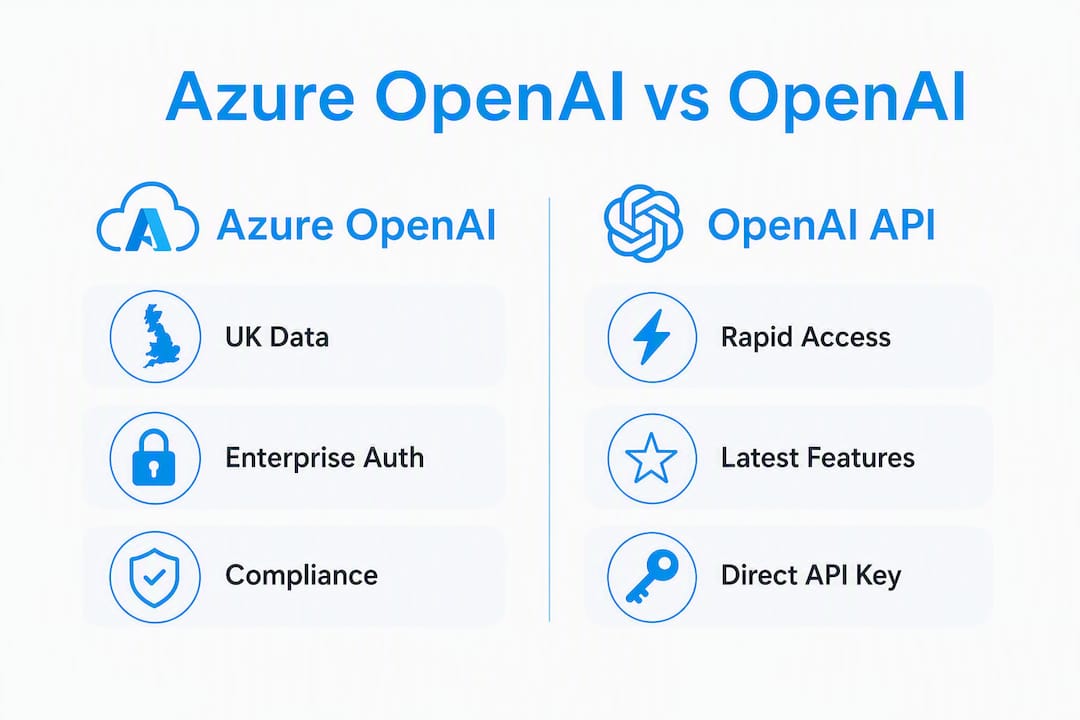
For UK enterprise production workloads, Azure OpenAI is the default choice: it runs on Microsoft-managed infrastructure with Entra ID authentication, UK-region data residency, and compliance certifications your procurement team already recognises. OpenAI direct is the faster route when you need day-zero model access, a quick prototype, or a consumer-facing product without regulated-data obligations.
Three reasons UK organisations default to Azure OpenAI:
- Data stays in UK South or UK West Azure regions, satisfying UK GDPR residency requirements without custom contractual negotiation.
- Entra ID and Managed Identities replace API key management, removing a significant operational security risk from production systems.
- Existing Microsoft Enterprise Agreements accelerate vendor approval, bypassing the security review bottleneck that typically stalls new vendor onboarding.
When OpenAI direct wins: you want GPT-4o or o1 on day zero, you are building a consumer product outside regulated sectors, or you need a working prototype in under an hour.
Table of Contents
- How do Azure OpenAI and OpenAI API actually relate to each other?
- What are the access and authentication differences you need to know?
- What enterprise integrations and compliance certifications does Azure OpenAI provide?
- How does each platform handle data residency and UK GDPR?
- What networking and deployment options does Azure OpenAI give you?
- How do pricing, billing, and SLAs compare in practice?
- What does the developer experience look like on each platform?
- Which platform should your UK organisation choose?
- How do you migrate from OpenAI direct to Azure OpenAI production?
- What risks and limitations should go into your project risk register?
- Key takeaways
- The case for choosing your platform before you build
- Real-studios helps UK teams deploy AI that meets enterprise standards
- Useful sources for procurement, legal, and engineering teams
How do Azure OpenAI and OpenAI API actually relate to each other?
Both services run the same family of foundation models: GPT-4o, GPT-4 Turbo, the o1 series, Whisper, and the text-embedding models. The weights are identical. What differs is the infrastructure layer, the governance boundary, and the contractual framework wrapped around them.
Microsoft licenses the models from OpenAI and hosts them inside Azure's own data centres. That means two separate control planes, two sets of terms, and two distinct release pipelines:
- Microsoft Online Services Terms — govern Azure OpenAI, integrating with your existing Microsoft Data Processing Agreement and enterprise compliance artefacts.
The release cadence is the most operationally significant difference. OpenAI direct typically ships new model features and versions earlier than Azure OpenAI, with lags running weeks to months. Azure validates each release against its enterprise compliance and safety standards before making it generally available. For teams building on the latest capabilities, that lag is a real constraint. For teams that need a stable, auditable model version, it is a feature.
Model freshness is a deliberate trade-off: teams that prioritise day-zero features accept migration overhead; teams that must demonstrate residency and governance accept a short feature lag.
What are the access and authentication differences you need to know?
Time to first API call
OpenAI direct takes minutes: create an account, generate an API key, and your first completion request is live. Azure OpenAI requires an Azure subscription, resource provisioning, and quota approval, which can take from a few hours to several business days depending on your tenant configuration and the model you are requesting.
Authentication patterns
| Dimension | OpenAI API | Azure OpenAI |
|---|---|---|
| Primary auth method | API key (bearer token) | Entra ID / Managed Identity or API key |
| Secret management | Developer stores and rotates keys | Managed Identity removes key storage entirely |
| RBAC granularity | Account-level roles | Resource-level RBAC via Azure IAM |
| Multi-tenant isolation | Shared account namespace | Dedicated Azure resource per deployment |
| SSO / conditional access | Not natively available | Entra ID Conditional Access policies apply |
Azure OpenAI allows UK businesses to use Microsoft Entra ID and Managed Identities, removing the need to store or rotate API keys in production systems. For any organisation running workloads on Azure, that is a material reduction in operational risk: secrets that do not exist cannot be leaked.
Onboarding friction for procurement and security teams
Azure OpenAI sits inside your existing Azure tenant, so your security team reviews one vendor (Microsoft) rather than two. Whitelisting, network egress controls, and support escalation all follow the same paths your team already uses for other Azure services. OpenAI direct requires a separate vendor assessment, a new DPA negotiation, and independent support channels.

Pro Tip: Use separate Azure OpenAI resource deployments for staging and production, each with its own Managed Identity and RBAC assignments. Never share a production resource key with a development environment, and never use API keys in production when Managed Identities are available.
What enterprise integrations and compliance certifications does Azure OpenAI provide?
This is where the Azure OpenAI vs OpenAI comparison becomes decisive for regulated UK sectors.
Azure OpenAI inherits the full Azure compliance portfolio automatically. That includes:
- Microsoft Entra ID — for identity and access management across all Azure resources.
Azure OpenAI inherits SOC 1/2/3, ISO 27001, HIPAA BAA eligibility, and FedRAMP-equivalent regional compliance certifications via Azure. For UK organisations already on Microsoft 365 or Azure, these certifications integrate with existing compliance artefacts rather than requiring fresh assessments.
OpenAI direct does offer enterprise contracts with SOC 2 Type II and HIPAA BAA options, but these require separate negotiation and do not inherit your existing Microsoft compliance posture. The security review bottleneck is a recognised procurement delay; Azure OpenAI reduces it by inheriting Microsoft compliance packs and vendor agreements that your legal team has likely already approved.
For UK organisations already invested in the Microsoft stack, Azure OpenAI also enables single-pane governance: Purview sensitivity propagation and Sentinel monitoring mean AI workload data flows into the same dashboards your security operations centre already monitor.
How does each platform handle data residency and UK GDPR?
Data residency is not a checkbox. It determines which legal framework governs your data, which regulators have jurisdiction, and whether your DPA with the vendor is sufficient for the categories of data you process.
| Dimension | Azure OpenAI | OpenAI API (standard) | OpenAI API (enterprise) |
|---|---|---|---|
| Region selection | UK South, UK West (and others) | US-based by default | Negotiable |
| Prompt/response storage | Configurable; abuse monitoring opt-out available | Stored for safety monitoring by default | Configurable under enterprise DPA |
| Data Processing Agreement | Microsoft DPA (existing enterprise agreement) | Separate OpenAI DPA required | Enterprise DPA with BAA option |
| UK GDPR controller/processor | Microsoft as processor; customer as controller | OpenAI as processor; customer as controller | OpenAI as processor; customer as controller |
| Model training on your data | Disabled by default on Azure | Disabled if opted out or on enterprise plan | Disabled under enterprise terms |
Azure OpenAI lets you select UK South or UK West as your deployment region, keeping prompt and response data within UK borders. Microsoft's Data Processing Agreement, which most enterprise Azure customers already have in place, covers Azure OpenAI under the same terms as other Azure services. That means no new DPA negotiation for most organisations.
OpenAI direct defaults to US-based infrastructure. Standard accounts have limited residency controls. Enterprise contracts unlock more flexibility, but require separate legal review and negotiation, adding weeks to procurement timelines.
Checklist for legal and compliance teams:
- Confirm the deployment region is UK South or UK West for Azure OpenAI deployments.
- Verify that abuse monitoring data retention settings match your data minimisation obligations.
- Check whether your data categories (special category data, financial records, patient data) require a HIPAA BAA or equivalent.
- Confirm model training on your prompts is disabled and document the setting.
- Review the vendor's sub-processor list and assess whether any sub-processors are outside the UK/EEA.
This article provides general technical and procurement guidance. For deployments involving special category personal data, regulated patient records, or financial services data, escalate to your legal and data protection teams before go-live.
What networking and deployment options does Azure OpenAI give you?
Azure OpenAI supports true network isolation via Azure Private Link, keeping traffic inside a VNet and off the public internet entirely. For financial services and health tech deployments, this is often a non-negotiable requirement: traffic that never leaves the Azure backbone cannot be intercepted in transit.
Azure networking options:
- Azure Private Link with private endpoints: — AI traffic stays within your VNet, with no public IP exposure.
OpenAI direct uses public HTTPS endpoints only. There is no private endpoint equivalent. Organisations that need network isolation must implement compensating controls: egress proxy servers, network-level allow-listing, or a gateway layer that terminates the public connection inside the perimeter. These mitigations add architectural complexity and do not provide the same assurance as Private Link.
Deployment patterns for UK firms:
For UK region performance, deploy to UK South (London) as your primary region. UK West (Cardiff) is a viable secondary for failover. Run latency tests from your application servers using Azure's network performance monitoring tools before committing to a region, particularly if your workload is latency-sensitive (real-time voice agents, for example).
How do pricing, billing, and SLAs compare in practice?
Per-token pricing for equivalent models is broadly similar between the two platforms. The decision is rarely made on base token rates alone.

Prices are indicative and subject to change. Verify current rates on the Azure pricing calculator and OpenAI pricing page before procurement.
The main cost differences come from Azure infrastructure overheads, which typically add approximately 5–10% to total cost of ownership, covering Private Link data processing charges, Azure Key Vault operations, Azure Monitor ingestion, and API Management units. For most regulated workloads, those controls are mandatory regardless of platform, so the overhead is not optional.
Azure OpenAI's Provisioned Throughput Units (PTU) offer 30–50% discounts for steady, predictable throughput compared with pay-as-you-go token billing. PTU is a reserved-capacity model: you commit to a throughput level and pay a fixed rate, regardless of actual token volume. For enterprise workloads with consistent demand (internal automation, contact centre AI, document processing pipelines), PTU materially reduces effective per-token cost.
SLA and support differences:
- Azure OpenAI carries Microsoft's enterprise SLA with financially backed uptime commitments, integrated into your existing Azure support plan.
- Microsoft support tiers range from Developer (business hours) through Professional Direct and Premier (24/7 with dedicated technical account management).
- OpenAI direct offers a standard support tier and an enterprise support option, but these are separate from any existing Microsoft support agreements and carry their own SLA terms.
For UK organisations with existing Microsoft Premier or Unified Support agreements, Azure OpenAI support is already covered. OpenAI direct requires a separate support contract negotiation.
What does the developer experience look like on each platform?
Both platforms support the OpenAI Python SDK and the REST API. Azure OpenAI requires an additional api_base and api_version parameter in SDK calls, plus an Entra ID token or resource key. The code change from OpenAI direct to Azure OpenAI is typically a configuration swap, not a rewrite, which is why application code often migrates with minimal changes when moving from prototype to production.
Feature cadence and roadmap impact
OpenAI direct ships new capabilities first. When GPT-4o with new modalities or o1 reasoning updates land, they are available on the direct API before Azure mirrors them. The lag is weeks to months depending on the feature. For teams building on the cutting edge, that gap affects roadmap planning. For teams running stable production workloads, it rarely matters.
Monitoring and observability
Azure OpenAI integrates natively with Azure Monitor for metrics (token usage, latency, error rates) and with Microsoft Sentinel for security event correlation. You can route logs to Log Analytics workspaces and build dashboards in Azure Monitor Workbooks without additional tooling.
OpenAI direct provides a usage dashboard in the platform console and a basic API for usage data. For production-grade observability, you will need third-party tools such as Langfuse, Helicone, or Datadog's LLM observability integration to achieve comparable visibility.
Recommended engineering practices:
- Pin model versions explicitly in deployment configuration; never rely on
latestaliases in production. - Use Azure OpenAI's deployment-level model versioning to control when you adopt new model releases.
- Implement canary deployments by routing a small percentage of traffic to a new model version before full rollout.
- Set up Azure Monitor alerts on token quota consumption and latency P95 thresholds before go-live.
- For API governance and deployment workflow automation, platforms such as Jundago provide structured tooling for managing API lifecycle across regulated environments.
Which platform should your UK organisation choose?
Use this matrix in stakeholder meetings. Each scenario maps to the dimensions that matter most for that use case.
| Dimension | Azure OpenAI | OpenAI API direct |
|---|---|---|
| Access & onboarding | Azure subscription + quota approval (days) | Account creation + API key (minutes) |
| Enterprise integration | Entra ID, Purview, Sentinel, CMK, Azure Monitor | API key auth; third-party tools for observability |
| Security & data residency | UK South/West regions; Private Link; Microsoft DPA | US-default; enterprise DPA negotiable |
| Networking | Private endpoints, VNet integration | Public HTTPS only |
| Model availability | Validated releases; weeks-to-months lag | Day-zero access to new models |
| Developer experience | Azure SDK config; Azure Portal; MLOps integration | Simpler onboarding; OpenAI Playground |
| Pricing & SLA | Token parity + 5–10% infra overhead; PTU discounts; enterprise SLA | Token parity; enterprise discounts available; separate SLA |
| Procurement | Covered by existing Microsoft agreements | New vendor onboarding required |
Scenario recommendations:
- Regulated healthcare (NHS trust, private clinic): — Azure OpenAI. HIPAA BAA eligibility, UK region residency, and Sentinel monitoring are required. OpenAI direct without an enterprise contract does not meet the bar.
After your platform decision, the immediate next steps are:
How do you migrate from OpenAI direct to Azure OpenAI production?
Many enterprises adopt a hybrid pattern: OpenAI direct for prototyping and day-zero experiments, Azure OpenAI for production workloads that require governance and residency. The migration path is well-trodden and the code changes are minimal if you keep your orchestration layer cloud-agnostic from the start.
Step-by-step migration checklist
- Provision an Azure OpenAI resource — in UK South or UK West within your existing Azure subscription.
Common blockers and mitigations
- Network design complexity: — engage your Azure network team early; Private Link configuration requires DNS changes that can delay go-live.
Pro Tip: Keep your prompt templates and orchestration logic in a cloud-agnostic layer (LangChain, Semantic Kernel, or a custom abstraction) from the start of development. This reduces migration cost to a configuration change rather than a code rewrite, and preserves the option to run parallel environments during cutover.
For mid-market firms evaluating vendor-assisted migration, AI automation consulting guidance for 2026 covers the procurement and integration patterns relevant to Azure OpenAI deployments.
What risks and limitations should go into your project risk register?
Operational risks
- Vendor dependency: — both platforms are subject to OpenAI's model deprecation schedule. Azure OpenAI publishes deprecation timelines with advance notice, but model retirement still requires engineering effort to migrate to successor versions.
Compliance limitations
- OpenAI direct without an enterprise contract does not provide a HIPAA BAA, making it unsuitable for processing protected health information.
- For UK-regulated sectors, Azure OpenAI is often the only viable option for strict region-bound compliance requirements; OpenAI direct requires separate enterprise contracting to match some controls.
- Azure OpenAI still requires explicit configuration to meet requirements: abuse monitoring must be reviewed, CMK must be enabled, and Private Link must be activated. Default settings are not automatically compliant.
Security risks
- Prompt injection: — both platforms are susceptible to prompt injection attacks. Content safety filters (Azure AI Content Safety, OpenAI's moderation endpoint) reduce but do not eliminate the risk. Include prompt injection in your threat model and test for it in staging.
Key takeaways
For UK enterprises, Azure OpenAI is the default production choice: data residency, Entra ID authentication, and Microsoft compliance certifications resolve the three most common procurement blockers before the first stakeholder meeting.
| Point | Details |
|---|---|
| Azure OpenAI for regulated production | UK South/West residency, Entra ID auth, and Microsoft compliance certifications satisfy most UK enterprise requirements out of the box. |
| OpenAI direct for speed and prototyping | Day-zero model access and minutes-to-first-call onboarding make it the right choice for prototypes and consumer products outside regulated sectors. |
| Infrastructure overhead is real but bounded | Azure adds approximately 5–10% to TCO via Private Link, Key Vault, and monitoring; PTU reserved capacity can offset this for steady workloads. |
| Hybrid pattern reduces risk | Prototype on OpenAI direct, migrate to Azure OpenAI for production; keep orchestration cloud-agnostic to make the move a configuration change. |
| Real-studios for guided deployment | Real-studios helps UK organisations select, configure, and migrate to the right platform, covering compliance packs, integrations, and ongoing governance. |
The case for choosing your platform before you build
The Azure OpenAI vs OpenAI debate is often framed as a technical question, but in practice it is a procurement and governance question with a technical implementation. Most UK engineering teams I work with have already made the right technical choice instinctively: they know they need Azure OpenAI for production. What slows them down is the procurement process, the network design, and the compliance documentation.
The advice I give consistently is this: do not wait until your prototype is ready to start the Azure OpenAI quota request and DPA review. Those processes run in parallel with development, not after it. Teams that start the Azure onboarding on day one of a project arrive at production-ready infrastructure at the same time their code is ready. Teams that start it after the prototype is built add four to eight weeks to their go-live date.
There is also a subtler point about model selection. The feature lag between OpenAI direct and Azure OpenAI is real, but it is rarely the constraint teams think it will be. In twelve months of production, most enterprise workloads use a stable model version and benefit from Azure's validation process rather than being held back by it. The teams that genuinely need day-zero access are the minority: they are building consumer products or research tools where the latest capability is the product. For everyone else, the governance controls are worth the wait.
The hybrid pattern (prototype on OpenAI direct, production on Azure OpenAI) is not a compromise. It is the correct architecture for most UK organisations. Build fast, validate the use case, then harden the deployment. Keep your orchestration layer cloud-agnostic and the migration is a configuration change, not a rewrite.
Real-studios helps UK teams deploy AI that meets enterprise standards
Choosing the right platform is step one. Deploying it correctly, integrating it with your existing systems, and keeping it compliant as models and regulations evolve is where most teams need support.
Real-studios is a Manchester-based AI consultancy that builds production-ready AI agents, automations, and enterprise integrations for UK businesses. For Azure OpenAI deployments, that means handling the quota requests, Private Link configuration, Entra ID setup, and compliance documentation alongside your team, not after them. For organisations moving from an OpenAI direct prototype to Azure production, Real-studios provides a structured migration service covering network design, RBAC mapping, monitoring setup, and DPA review coordination.
Services include RAG systems, voice and chat agents, Microsoft 365 integrations, and ongoing governance support post-launch. If you are evaluating Azure OpenAI for a regulated workload or need to move an existing prototype into production, speak to the Real-studios team to scope a pilot or a full deployment.
Useful sources for procurement, legal, and engineering teams
The sources below are grouped by audience. Vendor pages are useful for procurement; technical documentation is best for engineering; independent analyses are most useful for legal and risk teams.
For engineering teams (technical documentation):
- Azure OpenAI Service overview (Microsoft Learn) — the authoritative technical reference for Azure OpenAI capabilities, API versions, and deployment options.
- Azure OpenAI Service on the UK Digital Marketplace — the G-Cloud listing confirming Azure OpenAI's availability and compliance posture for UK public sector procurement.
- Difference between Azure OpenAI and OpenAI (Microsoft Q&A) — a concise Microsoft-authored explanation of the service boundary.
For legal and compliance teams (independent analysis):
For procurement and decision-makers: