Fix Citation Risk in 24 Hours: AI Overviews Optimization for SEO Teams
For the best chance of being cited in Google's AI Overviews, structure each target section as a self-contained answer, add original data, and make expertise machine-readable through named authors and schema. This matches Google's own guidance on generative search eligibility, and it lines up with real citation data. Start with the technical checklist and content structure sections below, then move to measurement once your pages are eligible.
TL;DR:
- Optimizing passages within pages for question-based headings increases the likelihood of your content being retrieved and cited in AI Overviews.
- Building authority signals through author bios, schema, and original data substantially improves citation rates and visibility in generative search results.
- Technical SEO fundamentals such as correct indexing, rendering, and crawlability are essential to ensure your pages are eligible for AI-driven snippets and citations.
- Content that directly answers questions, includes unique data, and features clear schema markup significantly boosts chances of being featured and cited.
- Focus on updating high-priority pages within 24 hours to add author information, last-updated dates, and rewrite intro sentences for direct answers to improve ranking and citation chances.
Table of Contents
- What are AI Overviews and how do they work?
- Why AI Overviews change the ROI of SEO work
- What makes content citation-ready
- How do you make sure Google can actually retrieve your pages?
- Which content structures do AI Overviews prefer to cite?
- Which schema markup actually improves citation odds?
- How do you measure AI Overview citations and their impact?
- How do you build the authority signals AI Overviews reward?
- What should you fix in the next 24 hours, 2 weeks, and 3 months?
- Why extractability will outlast every algorithm update
- Where Real-studios fits into your AI Overview strategy
- Sources
- FAQ
What are AI Overviews and how do they work?
AI Overviews run on a four-stage pipeline: trigger, retrieval, generation, and citation-safety. A query first has to trigger the feature at all, which Google decides based on intent signals and whether a synthesised answer would beat a standard results page. From there, the system often breaks a complex question into smaller sub-queries, a process usually called query fan-out. A search for "best CRM for a five-person agency" might fan out into separate lookups for pricing, integrations, and user reviews, before the answer gets assembled.
Retrieval works at passage level, not page level. This is the detail most SEO teams miss: your domain authority might rank a page on the first results page, but the AI Overview retrieval step ranks specific passages against the sub-query, not the whole document. A page can sit at position three on the fifth results page and still contribute a passage to the Overview if that passage answers the sub-query precisely and unambiguously.
Generation stitches the retrieved passages into a summary, then a citation-safety pass decides which sources get linked. Google confirms there are no extra technical requirements for AI Overviews beyond standard Search eligibility: a page must be indexed and eligible to show a snippet to be used as a supporting link. The mechanics of the pipeline itself come from independent analysis of how AI Overviews are actually built, which found retrieval and ranking are genuinely separate systems.
What this means for practitioners:
- Optimise sections, not just pages. Each H2 or H3 is a candidate passage for a different sub-query.
- Assume fan-out. Write for the specific question implied by a heading, not the broad topic.
- Snippet eligibility is the floor. If Google cannot generate a normal snippet for your page, it will not appear in an Overview either.
Why AI Overviews change the ROI of SEO work
The clearest signal comes from Pew Research: users are measurably less likely to click any link when an AI summary appears above the results. That is a structural drop in top-of-funnel traffic for informational queries, and no amount of on-page tinkering reverses it. The traffic that vanishes is largely the "what is X" and "how does Y work" volume that used to justify broad content calendars.
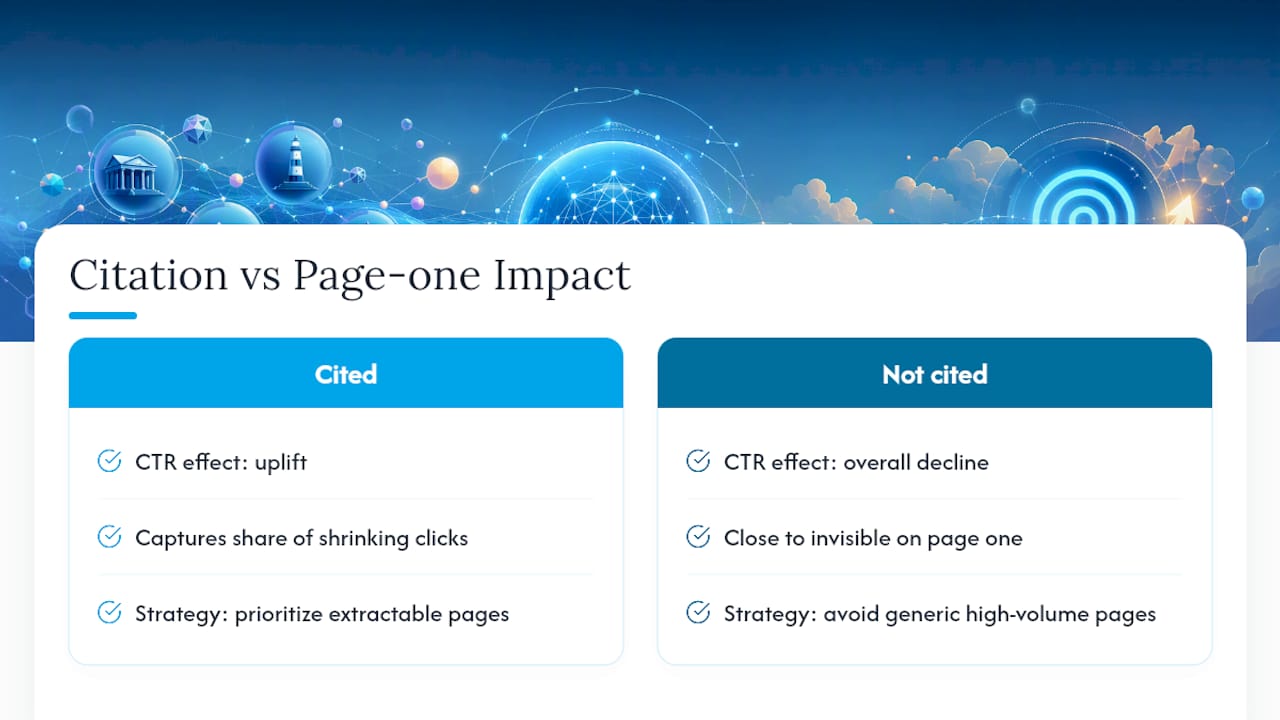
The trade-off in one line: pages that get cited inside an Overview see CTR uplifts even as overall organic CTR for top positions declines when an Overview appears, according to aggregated industry analysis.
That split matters more than the headline decline. If your content sits in the summary as a cited source, it captures a share of a shrinking click pool that competitors miss entirely. Being merely "on page one" without a citation is close to invisible for that query. This is why the sensible response is not to abandon informational content but to make far less of it, written to a far higher extractability standard.
Not every query type suffers equally. Transactional and comparison queries, where the searcher needs to evaluate specific options before committing money, still drive clicks through to the underlying pages because an Overview rarely resolves the decision on its own. Google's own framing of the feature backs this: AI Overviews are designed to help people find the gist quickly and then explore further, often via AI Mode, rather than fully replace the click. The strategic implication is straightforward: redirect effort from generic, high-volume top-of-funnel pages toward the smaller set of assets with genuine citation potential, be that a decision-stage comparison or a page with original data nobody else has published.
What makes content citation-ready
Four editorial rules separate pages that get cited from pages that get ignored, and none of them require guesswork.
Lead with the answer. The first one or two sentences under any heading should answer the implied question directly, in roughly 40 to 60 words, with no scene-setting. SerpNap's analysis links this direct-answer pattern, along with structured data and named authorship, to materially higher citation rates. A separate practical test found that reformatting sections to open with a direct answer doubled citation rates in the same source.
Add a signal nothing else has. Generic summaries of common knowledge are the easiest thing for a retrieval system to find a hundred times over, which makes them the hardest to get cited. A proprietary statistic, a client case study with real numbers, or a first-party survey gives the generation step a reason to pick your passage over a dozen near-identical ones.
Make expertise machine-readable. Named authors with visible credentials, external mentions, and author schema are not vanity additions. The same SerpNap data ties author schema and bios to materially higher citation rates, because the citation-safety pass appears to weight identifiable expertise over anonymous copy.
Show your working is current. A visible "last updated" date, backed by a real editorial refresh rather than a cosmetic timestamp change, tells both readers and retrieval systems the page reflects present conditions.
Bringing these together as a working checklist:
- Rewrite lead sentences under every H2/H3 to state the answer first, evidence after.
- Audit each priority page for at least one data point competitors cannot replicate.
- Add author bylines, short bios, and author schema to every page competing for citations.
- Set and display a genuine last-updated date, then commit to a refresh cadence.
Pro Tip: Run your top ten target pages through a simple test: cover the heading and read only the first sentence beneath it. If that sentence alone doesn't answer the question a searcher typed, an AI retrieval system will struggle just as much as your reader did.
How do you make sure Google can actually retrieve your pages?
Citation is impossible if the page never gets indexed properly, so technical hygiene comes before any content polish. Run through these checks in order:
- Confirm robots.txt and generative AI controls are configured deliberately. Google's support documentation explains that sites can be excluded from generative AI features using dedicated controls, separate from standard indexing directives. Check you haven't accidentally applied one of these to pages you want cited.
- Check server and CDN rules allow the right crawlers through. Firewalls and bot-management rules built to block scrapers sometimes catch Googlebot or AI-specific crawlers too. Review CDN logs for blocked requests from known crawler user agents.
- Verify JavaScript-rendered content is actually retrievable. If key passages load client-side without server-side rendering or prerendering, the retrieval step may never see them. Use Google Search Console's URL Inspection tool to check the rendered HTML.
- Track Core Web Vitals against citation likelihood. Faster, more stable pages correlate with better crawl efficiency and, indirectly, with retrieval odds. Treat performance regressions on priority pages as a citation risk, not just a UX one.
- Request recrawl after structural changes, then read the coverage report properly. After restructuring a page for direct answers, use Search Console's recrawl request and check the Page Indexing report for "Crawled, not indexed" or "Discovered, not indexed" states, both of which block citation eligibility entirely.
Google's own position bears repeating here: there is no separate technical bar for AI Overviews beyond normal Search eligibility. That is good news. It means the checklist above is really just rigorous, standard technical SEO, applied with more urgency.
Which content structures do AI Overviews prefer to cite?
Passage-level retrieval rewards writing that behaves like a reference document rather than a narrative. Structure headings as the literal questions a searcher would ask: "How do I choose between 4-corner and 5-corner e-invoicing?" retrieves more cleanly than a vague label like "E-invoicing models compared." Save descriptive H3s for supporting detail beneath a question-style H2.
Each passage needs to stand alone. Avoid opening a paragraph with "as mentioned above" or "this also applies here" because a retrieval system lifts the passage out of context, and a pronoun with no antecedent makes the extracted text meaningless. Repeat the subject by name where a reference would otherwise be ambiguous.
Format choice depends on the type of information:
- Use a short bullet list for sequential steps or a small set of discrete options.
- Use a comparison table when the reader is weighing named alternatives against shared criteria.
- Use a data table when you are presenting numbers that vary by category or condition.
Multi-modal pages, meaning pages that combine text with images or tables rather than pure prose, show notably higher selection rates in AI Overviews than text-only pages. A table forces you to structure data cleanly, which happens to be exactly what retrieval systems want.
| Content pattern | Best use case | Why retrieval favours it |
|---|---|---|
| Question-style H2 + direct-answer lead | Any discrete sub-query | Matches fan-out query phrasing directly |
| Short bullet list | Sequential steps, short option sets | Easy to lift as a self-contained unit |
| Comparison table | Weighing named alternatives | Presents criteria and values in fixed structure |
| Data table | Numeric values across categories | Removes ambiguity a prose paragraph would carry |
Prose without any structural markers is the format retrieval systems select least often. If a passage is important enough to want cited, it deserves a heading, a table, or a list of its own.
Which schema markup actually improves citation odds?
Three schema types cover most of the practical need. Article schema with author and date fields should sit on every page competing for citations, since it is the clearest machine-readable link between a passage and a named source. FAQPage schema should wrap genuine Q&A blocks, matching the direct-answer format Overviews already favour. HowTo schema earns its place only on genuine step-by-step processes, not retrofitted onto general advice.
Beyond that baseline, commercial queries benefit from Product, Review, or VideoObject schema where the underlying content genuinely supports it, such as an honest review with a real rating or a demonstration video.
The most common failure is mismatched schema: marking up a FAQ block that doesn't visibly exist on the page, or claiming a review score nowhere in the visible content. This isn't just risky, it actively undermines the trust signal schema is meant to build, since Google can detect the gap between structured data and rendered content.
- Add Article schema with author name, sameAs links, and datePublished/dateModified to every priority page.
- Wrap real FAQ content in FAQPage schema, matching visible questions exactly.
- Reserve HowTo schema for genuine sequential processes with named steps.
- Test every implementation with Google's Rich Results Test before publishing.
- Monitor Search Console's Enhancements reports for schema errors on a rolling basis.
How do you measure AI Overview citations and their impact?
Search Console's generative AI performance reporting is the starting point, letting you compare queries where your pages were cited against queries where they were merely indexed but ignored. Build the tracking discipline around four steps:
- Segment cited versus non-cited queries inside Search Console's generative AI reports, then compare impression and click patterns between the two groups.
- Track citation rate and citation CTR as standing metrics, alongside time on page and conversion rate for the specific pages being cited.
- Run a weekly watch and a monthly audit. Citations can disappear when Google refreshes an Overview's sources, so a weekly check catches drift early, while a monthly audit catches slower structural decay.
- Attribute conversions properly by tagging landing pages tied to cited queries and comparing their conversion rate against comparable non-cited pages, rather than assuming a citation alone drives revenue.
Google's own feedback mechanisms on AI Overviews, the thumbs up/down and reporting options, are worth monitoring too. They signal which summaries Google itself considers weak, which often precedes a citation reshuffle on that query.
How do you build the authority signals AI Overviews reward?
Authority has to be visible to a machine, not just implied by good writing. Start with named author pages carrying real credentials and sameAs links to verifiable profiles, then attach author schema to every article those authors write. This single change is one of the more reliably correlated factors with higher citation rates.
Original research is the second lever: a proprietary data set, a client case study with real figures, or a first-party survey gives retrieval systems something no competitor's page can replicate. Distributing that research through partner sites and industry outlets compounds the effect, since external mentions of your data reinforce the authority signal Google is already weighing.
- Publish named author bios with credentials and sameAs links on every content hub.
- Add author schema to all articles, not just flagship pieces.
- Produce at least one original data asset per quarter worth citing externally.
- Pitch that research to partner sites and trade outlets for genuine external mentions.
Pro Tip: A single well-distributed original data piece often earns more citations across a quarter than a dozen generic explainer pages, because it is the one thing on the internet that no one else can copy word for word.
What should you fix in the next 24 hours, 2 weeks, and 3 months?
- Next 24 hours: add a named author byline and a visible last-updated date to your top ten priority pages, and rewrite the opening one to two sentences of each key section to lead with the direct answer.
- Next 2 weeks: implement FAQPage schema on pages with genuine Q&A content, fix any crawl or rendering issues found in Search Console, and validate every schema change with the Rich Results Test.
- Next 3 months: publish one original data piece per priority topic cluster, build a distribution plan to earn external mentions, and schedule a quarterly refresh cycle for every page competing for citations.
Why extractability will outlast every algorithm update
Google will keep changing how AI Overviews trigger and rank, but the underlying advantage of a well-structured, evidenced, clearly authored page does not expire with the next update. Extractable writing and original data are durable because they solve the retrieval problem directly, rather than gaming a specific ranking signal that Google can quietly retire.
The discipline that matters most is measurement. Treat every restructured section as a hypothesis, then check Search Console's generative AI reports to see whether citation rate actually moved. Teams doing this well right now are the ones willing to test a pilot page, measure it honestly, and scale only what the data confirms.
— Oded
Where Real-studios fits into your AI Overview strategy
Implementing this playbook properly, across dozens of pages, author profiles, schema types, and a genuine refresh cadence, is a substantial workload on top of an existing content calendar. Real-studios's AI Engine Optimisation service is built specifically for this shift: engineering the extractable passages, structured data, and authority signals that get UK businesses recognised inside AI-driven search results, rather than left out as generative search takes share from traditional clicks.
Engagements typically start with a discovery review of your existing pages against the citation-readiness checklist above, followed by a focused pilot on a small set of priority pages to prove the approach before wider rollout, with measurement built in from day one so results are checked against Search Console data rather than assumed. This service is often paired with fixed pricing and full ownership of the finished work, so there's no ongoing dependency once the rollout is done.
If you want a working demo of what a GEO-optimised page looks like for your own site, get in touch through the services page and start with a pilot audit.
Sources
- Optimizing your website for generative AI features on Google Search
- Google AI Overviews: The Real SEO Impact in 2026 | SerpNap
- How Do AI Overviews Actually Work? · mentionLAB
- Get quick answers with AI Overviews — Google blog
FAQ
How do you optimise for Google AI Overviews?
Structure each section to lead with a direct one to two sentence answer, add original data competitors cannot replicate, and make authorship machine-readable with author schema and a visible last-updated date.
What is the 80/20 rule as applied to AI Overview optimisation?
There's no official 80/20 standard for this specific feature, but a practical version holds: roughly 20% of a site's pages, the ones with unique data or decision-stage intent, tend to earn most of the citation-worthy traffic, so audit and refresh those first rather than spreading effort evenly.
How can you improve AI search optimisation beyond basic SEO?
Beyond standard technical SEO, prioritise passage-level extractability, since AI Overviews retrieve specific passages rather than ranking whole pages, and layer in schema and named authorship, which correlate with materially higher citation rates according to SerpNap's analysis.
Can you stop your pages appearing in AI Overviews?
Yes. Google's generative AI inclusion controls let site owners exclude pages from these features without affecting standard indexing, though this also removes any chance of the citation traffic those pages might otherwise earn.
Does Real-studios offer AI Overview optimisation as a service?
Yes, through its AI Engine Optimisation (GEO) service, which focuses on structuring content and technical signals so UK businesses get recognised inside AI-generated search results; pricing is available on request.