AI governance framework for UK organisations: 2026 guide

An AI governance framework is a structured set of pillars, roles, and controls that lets a UK organisation deploy AI responsibly while meeting regulator expectations across the ICO, FCA, Ofcom, and sector-specific oversight bodies. Get this right and you gain risk control, regulatory alignment, and a defensible audit trail. Get it wrong and you face enforcement action, procurement disqualification, and reputational exposure.
Take these steps this week:
- Inventory every AI system in use — production, pilot, and third-party tools — and record purpose, data inputs, and decision outputs in a central AI register.
- Name a senior accountable executive with board-level visibility and documented authority over AI deployment decisions.
- Run a gap analysis against ISO/IEC 42001 to produce a prioritised action list and a realistic timeline to alignment or certification.
- Map your AI use cases to the relevant sector regulator (ICO for data processing, FCA for financial services, Ofcom for online platforms) because the UK operates a regulator-led model, not a single AI Act.
From 12 May 2026, the ICO holds a statutory duty under the Data Protection Act 2018 to produce a Code of Practice on AI and automated decision-making. That code will become the primary UK mechanism for aligning AI development with UK GDPR requirements. Organisations that have not yet documented their governance decisions are already behind.
Table of Contents
- What are the five core pillars of an AI governance framework?
- How do leading standards map to your governance pillars?
- How to implement AI governance: a phased playbook
- Is ISO/IEC 42001 certification right for your UK organisation?
- Common AI governance pitfalls and how to avoid them
- Key takeaways
- What practitioners get wrong about AI governance
- Real-studios helps UK organisations build governance into AI delivery
- Useful sources and further reading
What are the five core pillars of an AI governance framework?
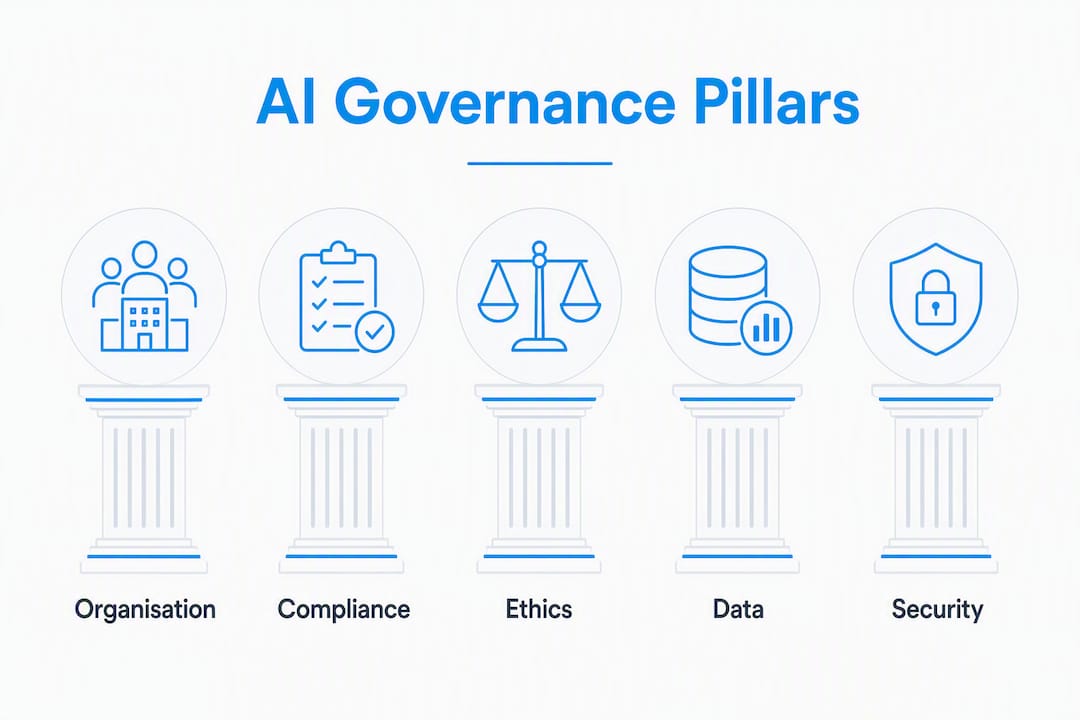
The UK's five cross-sectoral AI principles — safety and robustness, transparency and explainability, fairness, accountability and governance, and contestability and redress — map directly onto five operational pillars every governance programme must address. Each pillar has specific outputs, not just aspirations.

Pillar 1: Organisation and governance
This pillar defines who is accountable, how decisions escalate, and how the board stays informed. Without it, every other pillar drifts.
- Appoint a senior accountable executive (Chief AI Officer, CTO, or equivalent) with a documented mandate.
- Establish a cross-functional AI steering committee covering legal, data, security, product, and risk.
- Build a RACI for model lifecycle decisions: who approves deployment, who monitors performance, who can suspend a system.
- Produce a board-level AI risk report at least quarterly.
Key outputs: AI governance policy, steering committee terms of reference, RACI matrix, board reporting template.
Pillar 2: Legal and regulatory compliance
The UK does not have a single AI Act. Existing laws — UK GDPR, the Data Protection Act 2018, the Online Safety Act, and sector-specific regulation — apply to AI within their respective remits. Articles 22A–22D of the Data Protection Act (as amended) introduce new duties around automated decision-making that organisations must map to their systems now.
- Conduct a Data Protection Impact Assessment (DPIA) for every high-risk AI use case.
- Document legal bases for automated decisions and the human review architecture that supports them.
- Map each AI use case to its sector regulator and maintain a regulatory change log.
Key outputs: DPIA register, legal basis documentation, regulatory mapping matrix, procurement AI clauses.
Pillar 3: Ethics, transparency, and explainability
Fairness and explainability are not soft concepts — regulators treat absence of documentation as an accountability failure. Every design decision that affects a protected characteristic must be recorded, along with the mitigation chosen.
- Document model selection rationale, training data sources, and known limitations.
- Implement explainability tooling (SHAP, LIME, or equivalent) for high-stakes decisions.
- Establish a contestability process so affected individuals can challenge automated outcomes.
Key outputs: Model cards, bias assessment reports, contestability procedure, explainability methodology note.
Pillar 4: Data and MLOps
Governance without data provenance is unenforceable. This pillar covers the full model lifecycle from data ingestion to retraining.
- Maintain a versioned data inventory with provenance records for all training and inference data.
- Implement CI/CD pipelines with automated testing gates before any model update reaches production.
- Define retraining triggers based on performance drift thresholds, not calendar schedules.
- Monitor model outputs continuously and log anomalies with timestamps and reviewer actions.
Key outputs: Data inventory, model register, MLOps runbook, performance monitoring dashboard.
Pillar 5: Security and robustness
AI systems introduce attack surfaces that standard cyber controls do not fully address — adversarial inputs, model inversion, and supply-chain compromise among them.
- Assess adversarial risk for each deployed model and document mitigations.
- Apply vendor due diligence to every third-party model or API in the supply chain.
- Integrate AI incident response into the existing cyber incident playbook.
- Test for prompt injection and data poisoning in any generative or agentic AI deployment.
Key outputs: AI threat model, vendor risk assessments, incident response runbook, penetration test records.
Pro Tip: Document every governance decision at the time it is made, not retrospectively. Regulators treat a missing contemporaneous record as evidence that the decision was not made properly — not simply that it was not written down.

How do leading standards map to your governance pillars?
Four frameworks dominate the conversation for UK organisations: the NIST AI Risk Management Framework, ISO/IEC 42001, the OECD AI Principles, and the EU AI Act. None is a perfect fit for the UK context on its own, but each contributes distinct practical outputs.
| Standard | Pillars emphasised | UK applicability | Practical outputs | Maturity expectation |
|---|---|---|---|---|
| NIST AI RMF | All five (GOVERN, MAP, MEASURE, MANAGE) | Voluntary; widely adopted as a design reference | Risk register, governance policy, measurement plan | Flexible; scales from startup to enterprise |
| ISO/IEC 42001 | Organisation, data/MLOps, security | Voluntary; increasingly required in public sector procurement | Management system documentation, internal audit records, certification readiness | Formal management system; gap analysis first |
| OECD AI Principles | Ethics, transparency, accountability | Voluntary; underpins UK government white paper | Policy commitments, stakeholder communication | Principles-level; no audit artefact required |
| EU AI Act | Legal/compliance, ethics, security | Applies to UK organisations with EU market exposure | Conformity assessments, technical documentation, human oversight records | Risk-tiered; high-risk systems face strict obligations |
For most UK organisations, the practical path is to use the NIST AI RMF as a design scaffold, adopt ISO/IEC 42001 as the management system standard, and treat the OECD principles as the ethical baseline that underpins board-level commitments.
The EU AI Act matters even post-Brexit. Any UK organisation that sells AI-enabled products or services into the EU, or processes EU residents' data, faces direct obligations under the Act's risk-tiered regime. High-risk system categories — recruitment, credit scoring, critical infrastructure — carry the most demanding requirements, including mandatory conformity assessments and technical documentation.
- For legal/compliance outputs: prioritise DPIA discipline, ICO code alignment, and EU AI Act conformity documentation where EU exposure exists.
- For procurement readiness: ISO/IEC 42001 alignment produces the artefacts (model register, risk assessments, audit records) that public sector buyers increasingly request.
- For board-level communication: the OECD principles provide accessible language that translates technical governance into strategic commitments.
How to implement AI governance: a phased playbook
A governance programme that tries to do everything at once typically delivers nothing auditable within twelve months. A phased approach produces defensible artefacts at each stage and builds organisational capability progressively.
Phase 0: Scoping and inventory (weeks 1–4)
- Define the scope of the governance programme — which systems, which business units, which data flows.
- Build an AI register: list every AI system in use, its purpose, data inputs, decision outputs, and the business owner.
- Classify each system by risk level using a consistent rubric (high/medium/low based on impact on individuals, reversibility, and regulatory exposure).
- Run a gap analysis against ISO/IEC 42001 to produce a prioritised action list. A gap analysis for an SME can typically be completed in a single day and costs around £2,000.
Phase 1: Policy and control design (weeks 4–10)
- Draft an AI policy covering acceptable use, prohibited applications, human review requirements, and escalation paths.
- Design the human review architecture for each high-risk system. Reviewers must have sight of model inputs, outputs, and confidence scores, and must have the authority and training to override the model. Documented reviewer decisions — including the frequency with which they diverge from model outputs — are what regulators will examine.
- Introduce AI-specific clauses into supplier and procurement contracts.
- Complete DPIAs for all high-risk use cases.
Phase 2: Pilot controls and tooling (weeks 8–16)
- Deploy MLOps guardrails in a pilot environment: automated testing, drift detection, and access controls.
- Implement explainability tooling for the highest-risk model in scope.
- Test incident response procedures against a simulated AI failure scenario.
- Validate the model register and monitoring dashboard against real operational data.
Phase 3: Assurance and continuous monitoring (month 4 onwards)
- Define KPIs: model accuracy drift, DPIA completion rate, human override frequency, incident response time.
- Schedule internal audits against ISO/IEC 42001 controls at least annually.
- Establish a surveillance cadence for regulatory changes (ICO, DRCF, FCA, Ofcom).
- Produce a board-level AI risk report from monitoring data each quarter.
| Track | Timeline | Team size | Key milestone |
|---|---|---|---|
| Fast (alignment only) | 3–4 months | 2–3 people | AI register + policy + DPIA complete |
| Typical (alignment + monitoring) | — | — | Full management system operational |
| Thorough (certification-ready) | 10–12 months | — | ISO/IEC 42001 Stage 1 audit passed |
Is ISO/IEC 42001 certification right for your UK organisation?
For most UK SMEs, alignment with ISO/IEC 42001 is the pragmatic default. Building the management system yields governance benefits quickly — a documented AI register, risk assessments, and board reporting — without the cost and timeline of formal certification. Certification becomes necessary when a public sector contract requires it, when a large enterprise customer demands it as a procurement condition, or when the organisation wants a credible external signal of governance maturity.
The certification path
The standard route runs: gap analysis → remediation → Stage 1 documentation audit → Stage 2 on-site audit → certification → annual surveillance. BSI (British Standards Institution) is the first UKAS-accredited certification body for ISO/IEC 42001 in the UK market, and UKAS accreditation is increasingly becoming a procurement requirement in public sector supply chains.
| Cost item | SME estimate | Larger organisation estimate |
|---|---|---|
| Gap analysis | £2,000 | — |
| Preparation and remediation | (included in total) | — |
| Certification audit fees | £3,000–£8,000 | — |
| Annual surveillance | £1,500–£3,000 | — |
| Total initial cost | £15,000–£30,000 | — |
All figures are indicative and depend heavily on scope, existing documentation maturity, and the number of AI systems in scope. The initial cost for a UK SME to reach ISO/IEC 42001 certification typically sits between approximately £15,000 and £30,000 including preparatory work.
Regulatory watchlist for UK organisations
- ICO Code of Practice on AI and automated decision-making: — statutory duty effective 12 May 2026; this will be the primary compliance reference for any organisation processing personal data with AI.
- Crime and Policing Act 2026: grants the Secretary of State power to regulate AI services used for priority offences and mandates reporting timelines for draft regulations — directly relevant for organisations deploying agentic AI or content-generating systems.
Common AI governance pitfalls and how to avoid them
Most governance failures are not technical. They are organisational and documentary.
- Treating AI governance as a separate programme. Folding AI governance into existing risk, procurement, and compliance functions reduces duplication and increases enforceability. A parallel siloed programme typically lacks teeth and budget.
- Weak human review architecture. Claiming "human in the loop" without documenting what the reviewer actually sees, decides, and records is the single most common regulatory red flag. Reviewers must have access to model inputs, outputs, and confidence scores, and must have the authority to override. Documented override frequency is evidence of genuine involvement.
- Missing procurement clauses. Third-party AI tools used in production are in scope for governance. Contracts without AI-specific clauses on data handling, model changes, and incident notification create unmanageable supply-chain risk.
- Undocumented design decisions. Every decision to accept, mitigate, or transfer an AI risk must be recorded at the time it is made. Retrospective documentation is treated as reconstruction, not governance.
- Superficial DPIA discipline. A DPIA completed once at project inception and never revisited is not fit for purpose. DPIAs must be updated when the model, data, or use case changes materially.
Red flags regulators and auditors look for: no named board-level owner, an AI register that has not been updated in six months, human review processes with no override records, and DPIAs that are identical across different use cases.
Pro Tip: When documenting human review, capture the reviewer's name, the date, what they saw (inputs, output, confidence score), and whether their decision matched the model's recommendation. Four data points per review is the minimum defensible record under Articles 22A–22D.
Key takeaways
A well-implemented AI governance framework requires board-level accountability, a documented AI register, pillar-aligned controls, and continuous monitoring tied to the ICO's statutory code and sector regulator expectations.
| Point | Details |
|---|---|
| Start with an AI register | Inventory every AI system, classify by risk, and assign a named business owner before building any controls. |
| Name board-level accountability | A senior accountable executive with a documented mandate is the single most important governance control. |
| Alignment before certification | For most UK SMEs, ISO/IEC 42001 alignment costs significantly less than full certification and delivers governance benefits immediately. |
| Monitor the ICO code | The ICO's statutory Code of Practice on AI (effective 12 May 2026) is the primary UK compliance reference for any AI system processing personal data. |
| Real-studios for implementation | Real-studios delivers governance artefacts — model registers, DPIA templates, monitoring dashboards, and runbooks — as part of AI agent and automation engagements with UK organisations. |
What practitioners get wrong about AI governance
The most persistent misconception in UK boardrooms is that "pro-innovation" means the governance bar is lower than it would be under a prescriptive regime. It does not. UK legal practitioners are clear: pro-innovation is not deregulation. Organisations must document governance decisions and maintain an audit trail because regulators treat absence of documentation as an accountability failure, not a minor administrative gap.
The second misconception is that governance is a compliance project with a finish line. The ICO code, the DRCF thematic hubs, and sector regulator guidance are all active and evolving. A governance programme that passes an internal audit in January and is not reviewed until the following year will drift out of alignment with regulatory expectations within months.
The third, and perhaps most consequential, is the belief that a governance framework is separate from the technical work of building and deploying AI. The organisations that get this right treat governance as an engineering discipline — model cards, versioned data inventories, automated testing gates, and monitoring dashboards are not compliance documents bolted on after deployment. They are the artefacts of a well-run AI programme. The governance framework and the technical delivery are the same thing, viewed from different angles.
Real-studios helps UK organisations build governance into AI delivery
Governance documentation without working AI systems is overhead. Working AI systems without governance documentation is liability. Real-studios closes that gap for UK organisations by delivering governance artefacts — model registers, DPIA templates, board reporting packs, monitoring dashboards, and incident runbooks — as part of the same engagement that builds your AI agents, automations, and integrations.
A typical engagement runs from a one-day gap analysis against ISO/IEC 42001 through to a full governance sprint covering policy design, human review architecture, and a live monitoring setup. For organisations that need to move faster, a governance-ready automation pilot can validate controls in a contained environment before scaling across the business.
To scope a conversation about your governance programme, speak to the Real-studios team directly. The first step is a discovery call to map your AI systems, your regulatory exposure, and the fastest path to a defensible governance position.
Useful sources and further reading
The rule-making environment is active. Bookmark the ICO and sector regulator pages and check them quarterly.
-
The Data Protection Act 2018 (Code of Practice on AI and Automated Decision-Making) Regulations 2026: the statutory instrument that creates the ICO's duty to produce the AI Code of Practice. Read this first if your primary concern is UK GDPR compliance and automated decision-making.
-
UK Government AI Regulation White Paper — GOV.UK: the foundational policy document for the UK's pro-innovation, regulator-led approach. Sets out the five cross-sectoral principles and the rationale for sector-specific rather than technology-specific regulation.
-
Regulatory Outlook May 2026 — Osborne Clarke: covers the Crime and Policing Act 2026 and near-term compliance requirements for agentic and content AI. Essential reading for organisations deploying generative or autonomous systems.
-
Simmons & Simmons AI View May 2026: senior legal practitioners' perspective on the pro-innovation versus deregulation distinction and the documentation standard regulators will apply.