Fix AI Data Readiness in 90 Days With a Board Ready Scorecard
AI-ready data is representative, semantically labelled, owned, certified, and traceable back to a source. If your data cannot pass those five tests, pause before you build anything. Proceeding means shipping a model or agent that will fail quietly, in front of customers, on the questions that matter most. The checklist and scorecard below tell you exactly where to start.
TL;DR:
- Data must be representative, semantically labeled, owned, certified, and traceable to prevent AI models from failing silently on critical questions.
- Poor data quality, such as duplicates or missing metadata, leads to retrieval confusion, governance leaks, and repeated rework, increasing operational costs over time.
- Proper data preparation involves assessing use cases, assigning ownership, deduplicating, normalizing formats, enriching metadata, and ongoing monitoring before indexing.
- Governance measures like ownership, certification, lineage, and legal compliance are essential to reduce hallucinations and ensure auditable AI outputs.
- Focused 90-day data sprints on small domains, with proper metadata and certification, are more effective for establishing reliable AI readiness than attempting large-scale fixes later.
Table of Contents
- What does AI data readiness actually mean?
- Why unready data breaks AI projects (and what it costs)
- A practical roadmap to prepare data for AI
- Governance and compliance controls you need before launch
- Measuring AI data readiness: scorecards and the metrics that matter
- What practitioners learn in the first 90 days
- Your next 90 days: an executive checklist
- The uncomfortable truth about readiness programmes
- Sources
What does AI data readiness actually mean?
Clean data and AI-ready data are not the same thing. A spreadsheet with no blank cells can still be useless to a large language model if nobody has tagged what the numbers mean, who owns them, or whether they are current. AI data readiness is about semantics and structure, not just tidiness.
Five components separate data that AI systems can actually use from data that merely looks organised:
- Representativeness — the dataset reflects the real distribution of cases the model will face, not just the easy ones you happened to have on hand.
- Metadata and enrichment — every document carries owner, creation date, sensitivity level, and review status, so retrieval systems can filter before they ever hit the model.
- Lineage — you can trace any answer back to its source document and the transformation steps in between.
- Labels and annotations — structured tags that let a system distinguish a policy from a draft, or a current price list from last year's.
- Ownership and access model — a named person accountable for accuracy, and rules governing who can see or edit the record.
For retrieval-augmented generation (RAG) and other LLM knowledge bases, three more specifics matter. You need a single canonical version of every document, because near-duplicates confuse retrieval more than exact duplicates do. You need formats that chunk cleanly, so a paragraph split mid-sentence does not corrupt the context a model retrieves. And you need metadata rich enough that retrieval can prefer certified material automatically, without a human checking every result.
Why unready data breaks AI projects (and what it costs)
Source data quality, not model choice or retrieval architecture, is the leading cause of enterprise RAG failures, according to Atlan's analysis of RAG accuracy problems. Duplicate documents, noisy text, and missing metadata do more damage than a weaker embedding model or a smaller context window.
Three failure patterns show up repeatedly:
- Retrieval confusion from near-duplicates. A near-duplicate document appears to corroborate an answer while actually introducing a conflicting fact, which is more dangerous than an obvious exact copy because nobody flags it for review.
- Governance gaps that leak sensitive data. When sensitivity classification happens after indexing rather than before, restricted or personal data can surface in an answer to someone who should never have seen it.
- Compounding rework. Teams that skip upstream classification end up patching the same errors downstream, again and again, at the prompt and generation stages.
Data quality issues front-load at extraction and cascade downstream — research on step-aware data quality for RAG systems found that interventions applied early, during extraction and transformation, prevent far more damage than fixes attempted later at the prompt or generation stage.
The operational cost is rarely one dramatic failure. It is a slow accumulation: repeated remediation sprints, a chatbot that quietly drifts off-brand, and a board meeting where someone asks why the AI assistant just told a customer the wrong return policy.
A practical roadmap to prepare data for AI
Readiness work goes wrong when teams index everything first and sort out ownership later. Run the sequence in this order instead.
- Assess the use case and assign a risk tier. A customer-facing chatbot answering policy questions carries different evidence expectations than an internal sales-enablement tool. Gartner's AI-ready data framework makes this the first step precisely because different AI techniques (generative AI, predictive models, RAG) demand different data properties.
- Inventory every source and assign a named owner before a single document is ingested. No owner, no ingestion.
- Deduplicate and canonicalise. Consolidate near-duplicates into one authoritative version and mark anything superseded rather than leaving multiple near-copies indexed side by side.
- Normalise formats for chunking. Break documents into sections that retain meaning when split, so retrieval doesn't return half a sentence.
- Enrich metadata and set certification gates. Owner, certification status, expiry date, sensitivity level, and lineage should sit on every record before it is eligible for indexing.
- Establish ongoing monitoring. Recall tests, observability dashboards, drift detection, and a fixed refresh cadence keep the corpus from decaying after launch.
Pro Tip: Add a single "review status" field (approved, superseded, draft) to every document before it goes anywhere near an index. It's the cheapest metadata change you can make, and it lets retrieval systems favour certified content automatically, without a human checking every result.
Gartner's own roadmap for capturing AI value follows a similar arc: assess, secure board buy-in, evolve your data management practices, extend the ecosystem, then scale governance. Skipping steps to move faster almost always means repeating them later, at a higher cost.
Governance and compliance controls you need before launch
Defensible AI use rests on a small number of governance primitives, and none of them are optional once regulators or auditors start asking questions.
- Named ownership and a classification taxonomy. Every dataset needs a person accountable for it and a consistent scheme for tagging sensitivity, from public to restricted.
- Certification workflows. A document should not be searchable by an AI system until someone with authority has signed off on it.
- Lineage and evidence registers. Auditors and regulators will ask where an answer came from; you need a record that answers that question without a scramble.
- GDPR and EU AI Act considerations. Special-category data needs a clear lawful basis before it touches a model, and minimisation strategies (stripping unnecessary personal data before indexing) reduce exposure substantially. For UK organisations, practical guidance on GDPR and AI memory is worth reviewing before any personal data reaches an inference pipeline.
- Retention, expiry, and recertification cadence. Data that was accurate a year ago may not be accurate now; build expiry dates into the metadata itself, not into someone's calendar reminder.
A governed context layer, built from metadata, lineage, and certification, does more to reduce hallucination risk than raw vector search alone, according to Atlan's research on data quality in LLMs. Metadata is not bureaucratic overhead here; it is the mechanism that makes outputs auditable.
Measuring AI data readiness: scorecards and the metrics that matter
You cannot manage what you have not measured, and readiness is no exception. A scorecard approach, scored against dimensions tied to use-case risk, gives you a single number to track and a defensible artefact to show a board or regulator.
Four metrics do most of the work:
- Certification coverage — the percentage of your corpus that has passed a formal review, not just been uploaded.
- Freshness compliance — how much of your indexed content falls within its stated refresh window.
- Retrieval precision — how often a query returns the correct, current document rather than an outdated or conflicting one.
- Lineage completeness — the share of documents where you can trace the answer back to its source without manual digging.
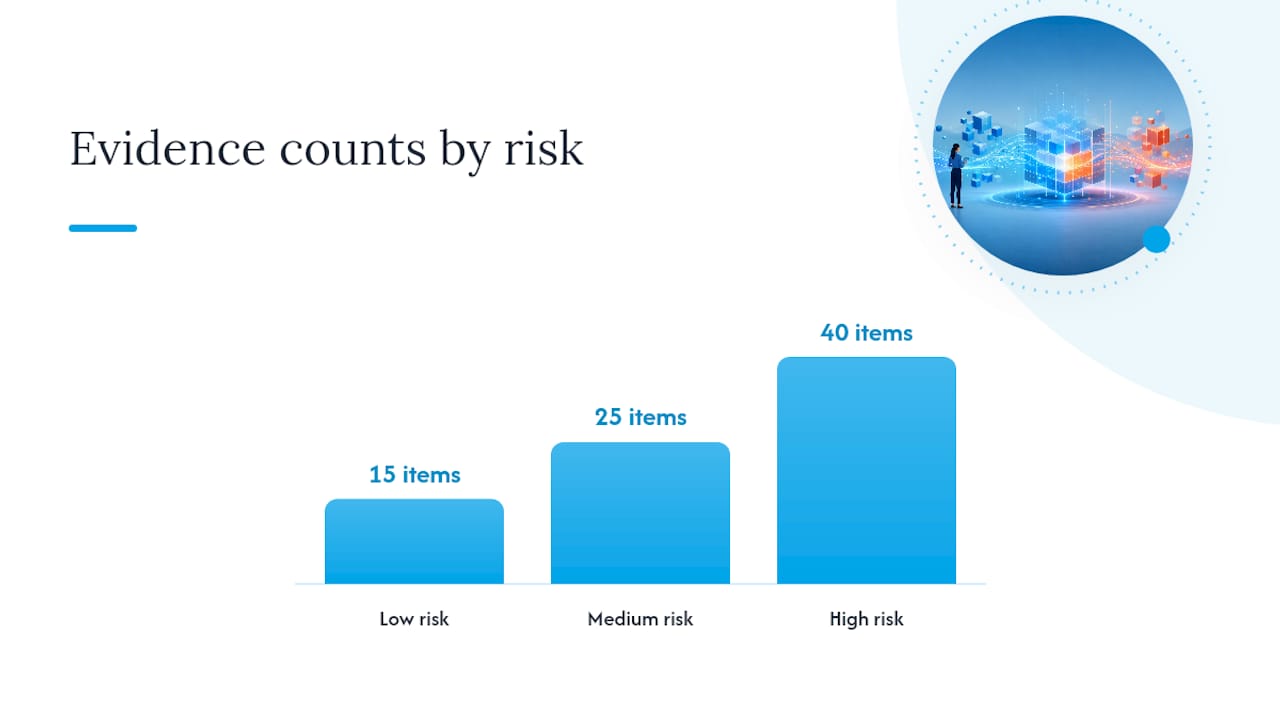
Minimum evidence counts scale with risk. The COMPEL AI Data Readiness Scorecard recommends at least 15 evidence items for low-risk use cases, 25 for medium-risk, and 40 for high-risk or EU AI Act "high-risk" classifications.
Organisations wanting a broader maturity benchmark, rather than a use-case-specific scorecard, can compare their data management practices against the Data Management Capability Assessment Model, an industry framework built for exactly that purpose.
What practitioners learn in the first 90 days
Teams that succeed rarely try to fix everything at once. A focused 90-day sprint on a single domain, naming owners, certifying a pilot corpus, and running weekly recall tests, tends to unblock a production pilot far faster than waiting for an enterprise-wide overhaul, a pattern documented in the CDO guide to AI data readiness.
Quick wins worth doing in week one: add a review-status field to every document, mark anything superseded, and classify sensitivity before indexing, not after.
Pro Tip: The most common trap isn't a technical one. It's sequencing. Teams index first and plan to "govern later." Later never comes, and near-duplicates that seemed harmless at launch are still quietly corrupting retrieval results a year on.
Your next 90 days: an executive checklist
Convene a working group of the data owner, the AI programme sponsor, and legal or compliance within the first 30 days. Ask for three deliverables from any readiness assessment: a scored scorecard, an evidence register, and a remediation plan with named owners and dates.
- Days 1 to 30: assess one use case, assign a risk tier, name domain owners.
- Days 30 to 60: deduplicate, classify, and certify a pilot corpus.
- Days 60 to 90: run recall tests weekly, present the scorecard to the board, fund the next domain.
Teams planning the integration work this involves, connecting cleaned, certified data to production AI agents, often need a structured build phase; Real-studios's automation and integration services are built around exactly that handoff, from data pipeline to deployed agent.
If you already know which domain to start with but need a partner to run the 90-day sprint alongside your team, Real-studios's service integrations work covers connecting certified data sources into the customer-facing agents, chat, voice, and email systems, that make readiness pay off in practice.
The uncomfortable truth about readiness programmes
Most advice on this topic treats readiness as a one-off audit: score the data, fix the gaps, ship the model. That framing undersells the problem. Readiness decays. A corpus that scores well in January can drift by June if nobody owns the refresh cadence, and the scorecard becomes theatre rather than a live instrument.
The research bears this out. Front-loading effort at extraction and classification, rather than patching problems downstream at the prompt stage, is what actually prevents cascading failures. That is a sequencing argument, not a tooling one, and it is the part most vendor pitches skip because it is unglamorous.
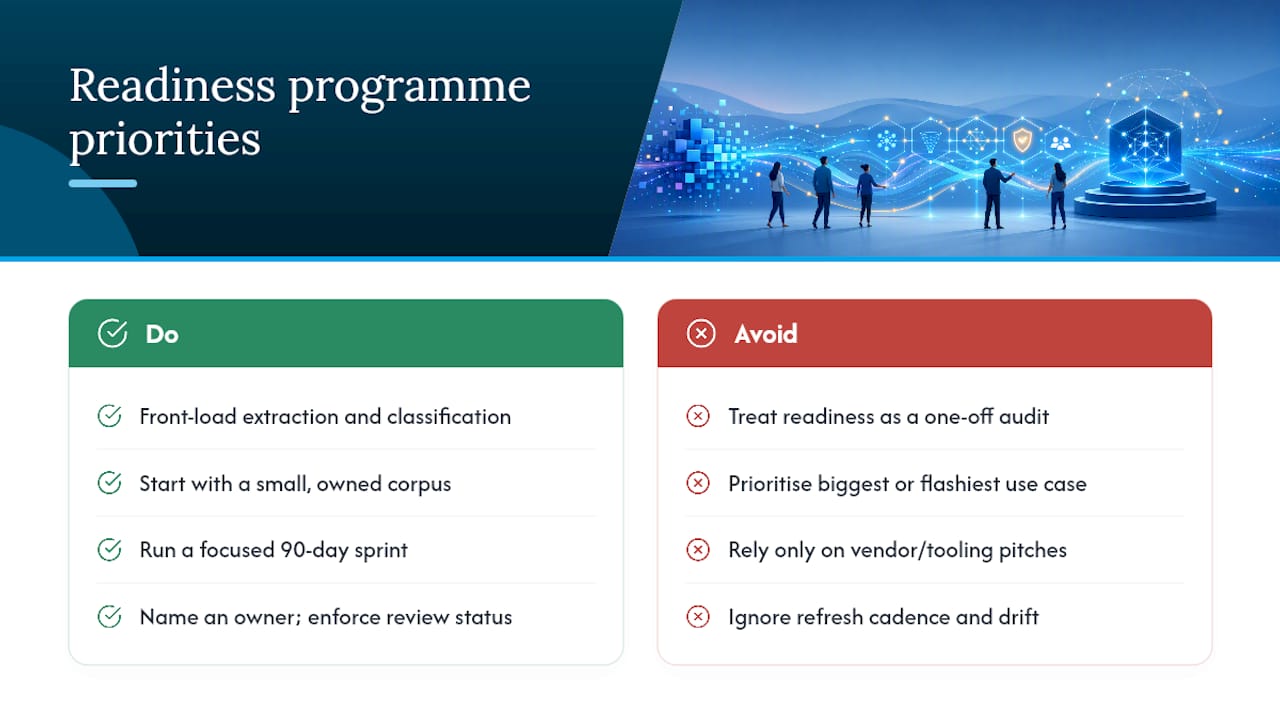
What should decision-makers prioritise first? Not the biggest domain, and not the flashiest use case. Start with the smallest corpus where you can name an owner, run a real 90-day sprint, and prove the scorecard moves. Boards fund what they can see working. A single certified, monitored domain is worth more evidence than a promise to fix everything by next quarter.
The uncomfortable part is that most of this is organisational discipline, not machine learning. Naming an owner and enforcing a review-status field will do more for reliability than switching embedding models ever will.
— Oded
Sources
- AI-ready data essentials to capture AI value | Gartner
- Template — AI Data Readiness Scorecard | COMPEL Framework
- Data Management Capability Assessment Model (DCAM) | EDM Council