AI change management for leaders: a practical guide
AI change management is the people-centred practice of planning, piloting and embedding artificial intelligence so organisations capture measurable value while managing risk. The technology is rarely the hard part. Getting people to trust it, use it consistently, and work differently because of it — that is where most programmes succeed or fail.
Before your next governance meeting, take three immediate actions:
- Confirm executive sponsorship. Name one senior leader who owns the outcome, not just the budget. Without a named sponsor, AI programmes drift into IT projects.
- Trigger a DPIA check. If the AI system processes personal data, Article 35 of the UK GDPR likely requires a Data Protection Impact Assessment. The ICO's guidance on AI and data protection makes clear that accountability sits with your organisation, not your vendor.
- Run a quick readiness probe. Survey three to five business unit leads this week: do they understand what the AI will do, who owns the data, and how staff will be trained?
Three authoritative bodies your governance discussion should reference: the ICO (data protection and DPIA obligations), DSIT (the UK government's five cross-sectoral AI principles), and the ONS (evidence on UK business AI adoption and capability gaps). Each one maps to a different risk your programme must address.
Pro Tip: Write the sponsor's name and their accountability statement into the programme charter on day one. A sponsor who cannot articulate the business outcome in one sentence is a governance risk, not an asset.
Key takeaways
Effective AI change management requires named sponsorship, a completed DPIA, structured capability building, and a phased pilot with defined success criteria before any scaling decision is made.
| Point | Details |
|---|---|
| People-first framing | Adoption, not deployment, determines ROI — treat the change programme as a parallel workstream to the technical build. |
| DPIA before vendor sign-off | UK GDPR accountability sits with your organisation; complete the DPIA and assess controller/processor roles before contracting. |
| Capability gaps are the top barrier | Gov shows 60% of organisations cite limited AI skills; budget for training as a programme deliverable, not an afterthought. |
| Pilot success criteria upfront | Define value, accuracy, operability, user acceptance and governance thresholds before the pilot starts, not after results arrive. |
| Real-studios for pilot delivery | Real-studios builds custom RAG agents, automations and integrations for UK businesses, with rapid MVP engagements scoped to a single use case. |
Table of Contents
- What does AI change management actually mean?
- Why structured change management raises AI ROI
- Common barriers to AI adoption you need to plan around
- What does an effective AI change programme look like?
- How to take an AI programme from readiness to scale
- UK governance and compliance checklist for AI programmes
- How to measure AI programme success
- Roles and tool categories to budget for
- An evidence-based implementation example
- Managing ethical implications and transparency in AI deployment
- How cross-functional teams stay aligned across IT, data science, and business units
- Managing continuous learning and improvement after deployment
- Risk mitigation plans for AI operational failures
- Which change management frameworks work best for AI projects?
- The part of AI change management most leaders get wrong
- Real-studios can scope and build your AI pilot
- Sources
What does AI change management actually mean?
The phrase gets used loosely, so the distinction matters. Implementation is the technical work: selecting a model, building integrations, configuring pipelines, deploying infrastructure. Adoption and change management is everything that determines whether people actually use the system, trust its outputs, and change how they work as a result. Most organisations over-invest in implementation and under-invest in adoption — which is why MIT Sloan research argues that aligning strategy, operating model and talent is what realises value from AI, not technology investment alone.
Adoption work starts before procurement. By the time a vendor is selected, the stakeholder map, the communications approach, and the training plan should already exist in draft form. It continues well after go-live: model performance drifts, user behaviour changes, and new regulatory guidance emerges.
Who must be engaged from the outset:
- Executive sponsor — owns the business outcome and removes blockers
- Business unit leads — define use cases and accept process changes
- Data Protection Officer (DPO) — leads DPIA and controller/processor assessments
- HR — manages role redesign, upskilling and workforce communications
- IT and data engineering — own infrastructure, security and data pipelines
- Product owner — translates business requirements into system specifications
- Communications lead — manages internal messaging and change narrative
The table below shows where implementation ends and change management begins:
| Dimension | Implementation | Change management |
|---|---|---|
| Focus | Technical build and integration | People, process, governance, measurement |
| Primary owner | IT / data engineering | Change lead, HR, sponsor |
| Key artefacts | Architecture docs, API specs, test results | Stakeholder map, training plan, DPIA, KPI dashboard |
| Timeline | Defined project end date | Ongoing post go-live |
| Success metric | System uptime, accuracy | Adoption rate, user satisfaction, business KPI shift |
Why structured change management raises AI ROI
Structured change work materially changes adoption outcomes. ONS analysis shows that firms with stronger management practices are more likely to adopt advanced technologies, and that around 62% of businesses citing a lack of AI expertise responded by investing in training or retraining existing staff. That is not a coincidence — it reflects a deliberate choice to treat capability as a programme deliverable, not an afterthought.
The business case for structured change management rests on four measurable outcomes:
- Faster time-to-value. A well-scoped pilot with clear success criteria reaches a go/no-go decision in weeks, not quarters.
- Higher adoption rates. Users who understand what the AI does, why it makes certain decisions, and how to escalate errors adopt at significantly higher rates than those who receive only a system demo.
- Safer deployments. Governance checkpoints — DPIA, bias review, human-in-loop design — catch risks before they reach production.
- Stronger trust. Transparent communications about model logic and limitations reduce resistance more durably than technical assurances alone.
For board reporting, track four metric categories from the start: adoption rate (percentage of target users active weekly), time-to-value (weeks from go-live to first measurable business KPI shift), model performance drift incidence (frequency of accuracy degradation events), and user satisfaction score (post-interaction or periodic survey).
Common barriers to AI adoption you need to plan around
Gov identifies the most commonly cited barriers as a lack of identified need (71% of respondents) and limited AI skills. Ethical concerns, high cost and regulatory uncertainty were flagged as particularly significant by those who cited them. These are not abstract risks — they are the specific failure modes your change programme must address before a pilot begins.
Red flags that signal a programme is likely to fail:
- No named executive sponsor with a defined accountability statement
- DPIA not triggered despite personal data processing
- Success metrics undefined or limited to technical uptime
- Data pipelines brittle or undocumented before model training begins
- No plan for what happens when the model is wrong
Practical mitigations:
- Run targeted upskilling before go-live, not after resistance emerges
- Scope pilots tightly: one use case, one team, defined success criteria
- Build human-in-loop checkpoints into the process design from day one
- Schedule governance reviews at fixed intervals, not only when problems arise
- Document ethical review decisions as programme artefacts, not meeting minutes
The most significant barriers to AI adoption are not technical. GOV.UK research shows that unclear need and limited skills outrank infrastructure and cost as reasons organisations fail to adopt AI. A change programme that addresses only the technical deployment is solving the wrong problem.
Pro Tip: Conduct a pre-mortem before the pilot launches. Ask the team: "It is six months from now and the programme has failed — what went wrong?" The answers become your risk register.
What does an effective AI change programme look like?
A well-structured programme has seven components. Each one has a clear owner and a set of artefacts the governance board can inspect.
1. Vision and sponsorship. The sponsor articulates a one-sentence business outcome, commits to a decision timeline, and attends governance reviews. Without this, every other component loses authority.
2. Stakeholder mapping. A living document that records each stakeholder's level of influence, current sentiment, and required engagement action. Update it at every phase gate.
3. Data and model governance. Covers data quality standards, bias review cadence, model versioning, and the DPIA. The DPO co-owns this component with the data engineering lead.
4. Capability building. Targeted upskilling for end users, managers and technical staff. Korn Ferry's analysis argues that diagnosing digital skill gaps and building structured upskilling programmes is central to transformation readiness — a point the ONS data on training investment reinforces.
5. Communications and training. A phased communications plan tied to programme milestones, not a single launch announcement. Training covers model logic, escalation paths, and user rights under UK GDPR.
6. Process and job redesign. Maps current-state workflows against AI-augmented future-state. Identifies roles that change, tasks that are automated, and new responsibilities that emerge.
7. Pilot governance and scale plan. Defines the pilot scope, success criteria, go/no-go decision gate, and the conditions under which the programme scales or stops.
| Role | Primary responsibilities |
|---|---|
| Executive sponsor | Owns business outcome; removes blockers; attends governance reviews |
| Change lead | Manages stakeholder map, comms plan, training and adoption metrics |
| DPO | Leads DPIA; assesses controller/processor roles; signs off data governance |
| Data engineer | Owns pipelines, data quality and model versioning |
| ML engineer | Builds, monitors and retrains models; manages drift alerts |
| Product owner | Translates business requirements; owns user acceptance criteria |
| HR / comms | Manages role redesign, upskilling programme and internal messaging |
Pro Tip: Sequence capability building before communications. Staff who understand what the AI does before they receive a launch announcement are far less likely to resist it.
How to take an AI programme from readiness to scale
A phased roadmap prevents the two most common failure modes: launching too fast without evidence, and stalling indefinitely in pilot mode.

Phase 1: Readiness assessment (weeks 1–4) Audit data quality, existing skills, current processes and regulatory obligations. Confirm sponsor, DPO and change lead are in post. Produce a readiness scorecard with go/no-go criteria for proceeding to discovery.
Phase 2: Discovery and use-case selection (weeks 3–8) Run structured workshops with business unit leads to identify and prioritise use cases. Score each against: data availability, business value, technical feasibility, regulatory complexity, and user readiness. Select one use case for the pilot.
Phase 3: Pilot / MVP (weeks 6–16) Build the minimum viable solution with a defined user group. A successful pilot must demonstrate five things:
- Value: a measurable improvement in the target business KPI
- Accuracy: model output meets the agreed quality threshold
- Operability: the system runs reliably within existing infrastructure
- User acceptance: target users adopt and rate the system positively
- Governance: DPIA is complete, audit trail is in place, escalation paths work
Phase 4: Iterative validation (weeks 14–20) Gather structured user feedback, monitor model performance, and run a bias review. Decide: stop, iterate, or scale.
Phase 5: Scale and embed (months 5–12+) Expand to additional teams or use cases. Integrate the AI system into standard operating procedures, onboarding materials and performance frameworks.
On cost: pilot engagements for a single use case typically involve discovery, build, integration and change management activities. Enterprise-scale rollouts add MLOps infrastructure, ongoing monitoring, and continuous training costs. Budget conversations should separate one-off build costs from recurring operational and governance costs — conflating them is a common source of mid-programme budget disputes.
Around 62% of UK businesses that identified capability gaps responded by investing in workforce training — which means the training budget is not optional; it is the adoption mechanism.
UK governance and compliance checklist for AI programmes
UK GDPR places accountability squarely on your organisation. The ICO's guidance on AI and data protection states that the accountability principle makes organisations responsible for complying with data protection law for AI systems, and that a DPIA is an ideal way to demonstrate that compliance.
When a DPIA is required:
- The AI system processes personal data at scale or uses systematic profiling
- Article 35(3)(a) of the UK GDPR is triggered where processing is likely to result in a high risk to individuals' rights and freedoms
- Processing involves sensitive categories of data (health, financial, biometric)
- The system makes or significantly influences automated decisions about individuals
What the DPIA must document:
- Description of the processing and its purposes
- Assessment of necessity and proportionality
- Risks to individuals and the measures taken to address them
- Controller/processor roles — particularly where AI components are outsourced
- Evidence of DPO consultation
Where AI processing is partly outsourced, the ICO states organisations should jointly assess responsibilities under Article 26 and collaborate on DPIAs where joint controllership applies. This has direct implications for vendor contracts: require DPA clauses, data minimisation commitments and audit rights before signing.
Accountability in AI is as much organisational as technical. The ICO treats the DPIA not only as a compliance document but as a programme roadmap instrument — it forces you to document risks, mitigations and responsibilities in one place before deployment, not after an incident.
The UK government's five cross-sectoral AI principles — safety; transparency and explainability; fairness; accountability and governance; contestability and redress — map directly to programme artefacts:
- Safety → risk register, human-in-loop design, incident response plan
- Transparency and explainability → user training on model logic, explainability documentation
- Fairness → bias review cadence, diverse test data, equality impact assessment
- Accountability and governance → DPIA, role matrix, audit trail
- Contestability and redress → escalation paths, user rights documentation, complaints process
Pro Tip: Attach the DSIT principles as a column in your risk register. Each risk entry should map to at least one principle — this makes regulatory conversations with the ICO or sector regulators significantly more straightforward.
How to measure AI programme success
Measurement without a defined cadence produces data nobody acts on. Structure your reporting in three tiers.
Primary KPIs to track from pilot day one:
- Adoption rate — percentage of target users active in the system weekly
- Task completion time — average time to complete the target task, pre- and post-AI
- Manual handover rate — percentage of AI-initiated tasks escalated to a human
- Model accuracy — output quality against the agreed threshold (e.g. precision/recall for classification tasks)
- Model drift incidence — frequency of accuracy degradation events per month
- User satisfaction score — periodic survey or post-interaction rating
- Business KPI shift — the specific business metric the use case was designed to improve
Reporting cadence:
| Phase | Frequency | Audience | Focus |
|---|---|---|---|
| Pilot | Weekly | Change lead, product owner, ML engineer | Adoption, accuracy, blockers |
| Scale | Monthly | Programme board | KPI trends, drift, training needs |
| Governance | Quarterly | Executive sponsor, DPO | Business impact, compliance, risk |
Assign a named owner to each KPI. A metric without an owner is not a metric — it is a number that appears in a report and changes nothing.
Roles and tool categories to budget for
HBR's analysis of agentic AI highlights that as AI agents take on more complex tasks, leaders must plan for human-agent teaming, accountability structures and skills reshaping — not only technical deployment. That means the role list and the tool budget are inseparable.
Roles and their core responsibilities:
- Change lead — stakeholder management, communications, adoption metrics, training coordination
- DPO — DPIA, data governance, regulatory liaison, vendor contract review
- Data engineer — pipeline integrity, data quality, model versioning, infrastructure
- ML engineer — model build, monitoring, retraining, drift management
- Product owner — requirements, user acceptance testing, roadmap prioritisation
- HR / comms — role redesign, upskilling programme design, internal messaging
Tool categories to include in procurement:
- RAG / agent platforms — for knowledge retrieval, customer interaction and workflow automation
- MLOps and model monitoring — for drift detection, retraining triggers and audit logging
- Learning management systems — for structured upskilling and compliance training delivery
- Communications and engagement platforms — for phased internal communications and feedback collection
- Workflow integration tools — for connecting AI outputs to existing business systems
Procurement requirements to specify in every RFP:
- Explainability: can the system produce a human-readable explanation of its outputs?
- Data minimisation: does the vendor process only the data necessary for the stated purpose?
- SLA for model updates and security patches
- Training and onboarding support included in the contract
- Audit trail and logging capabilities that satisfy ICO accountability requirements
An evidence-based implementation example
A UK professional services firm with around 400 staff deployed a RAG-based knowledge agent to handle internal policy and compliance queries — a task that previously consumed significant time from a small central team.
Scope and approach: The pilot covered one business unit (60 users) over 12 weeks. The agent was connected to a curated internal document store. Human-in-loop design meant every response flagged with low confidence was routed to a named subject-matter expert for review before delivery. The change programme ran in parallel: a stakeholder workshop in week one, a two-hour training session in week four, and a structured feedback survey at weeks six and twelve.
Outcomes: By week twelve, the target team was handling the majority of routine policy queries through the agent, with a measurable reduction in escalations to the central team. User satisfaction scores were positive, with staff citing speed and consistency of responses as the primary benefits.
The lesson from this pilot was not about the technology. The team that adopted fastest was the one whose manager had attended the stakeholder workshop and actively encouraged use. The team with the lowest adoption had received the same training but no visible manager endorsement. Sponsorship at the line-manager level proved as important as executive sponsorship.
Three lessons the organisation applied to its governance:
- Add line-manager accountability to the stakeholder map. Middle management is the adoption lever most programmes miss.
- Build the DPIA before vendor selection, not after. The firm had to renegotiate two contract clauses after the DPIA identified data minimisation gaps.
- Define "good enough" accuracy before go-live. Without a pre-agreed threshold, the team spent three weeks debating whether the model was ready — a decision that should have been made in the pilot scoping session.
Managing ethical implications and transparency in AI deployment
Ethical governance is not a separate workstream — it is embedded in every phase of the programme. The practical starting point is the DSIT transparency principle is that users must understand the logic, significance and consequences of AI-generated outputs, and they must know their rights. Abstract policy statements do not achieve this. Concrete training does.
Build explainability into user acceptance criteria from the start. Before go-live, every target user should be able to answer three questions: what does this AI do, what does it not do, and what do I do when I disagree with its output? If they cannot, the training has not worked.
Bias review should be a scheduled programme event, not a one-off pre-launch check. Test data must reflect the diversity of the real user population. Where the AI influences decisions about individuals (recruitment, credit, service access), an equality impact assessment is a programme requirement, not an optional extra.
Document every ethical review decision as a dated, named artefact. When a regulator or an internal audit team asks how a risk was assessed and by whom, "we discussed it in a meeting" is not an adequate answer.
How cross-functional teams stay aligned across IT, data science, and business units
Misalignment between IT, data science and business units is the most common source of mid-programme delay. The root cause is usually a shared assumption that someone else owns the integration between technical outputs and business outcomes.
The fix is structural, not cultural. Assign a product owner whose explicit role is to translate between the data science team's capabilities and the business unit's requirements. This person attends both the technical sprint reviews and the business stakeholder meetings. Without that bridge role, requirements drift and technical teams build to the wrong specification.
Establish a weekly cross-functional stand-up during the pilot phase. Keep it to 30 minutes: what was built, what was tested, what blocked progress, and what decision is needed from the business. This cadence surfaces misalignments before they become rework.
Shared documentation is non-negotiable. A single source of truth for requirements, decisions and open questions — whether that is Confluence, Notion, or a shared SharePoint — prevents the version-control failures that derail handovers between teams.
Managing continuous learning and improvement after deployment
Go-live is not the end of the change programme. It is the point at which the programme shifts from build mode to operate-and-improve mode. Most organisations underestimate how much governance this requires.
Model performance degrades over time as data distributions shift. Schedule a formal model review at 30, 90 and 180 days post go-live. Each review should assess accuracy against the agreed threshold, drift incidence, and whether the use case assumptions still hold.
User feedback is a data source, not a courtesy. Build a structured feedback loop: a short post-interaction rating, a monthly survey for active users, and a quarterly focus group with a sample of the target team. Feed findings directly into the product backlog.
Treat the change programme as a product, not a project. Projects end; products iterate. Assign a named product owner post go-live with a budget for incremental improvements. Without this, the system stagnates and adoption erodes within six to twelve months.
Risk mitigation plans for AI operational failures
Every AI programme needs a documented response plan for three categories of operational failure: model error, data failure, and system outage.
Model error (the AI produces an incorrect or harmful output): define the accuracy threshold below which the system is suspended, the escalation path to a human decision-maker, and the communication to affected users. This should be in the DPIA and the user-facing documentation.
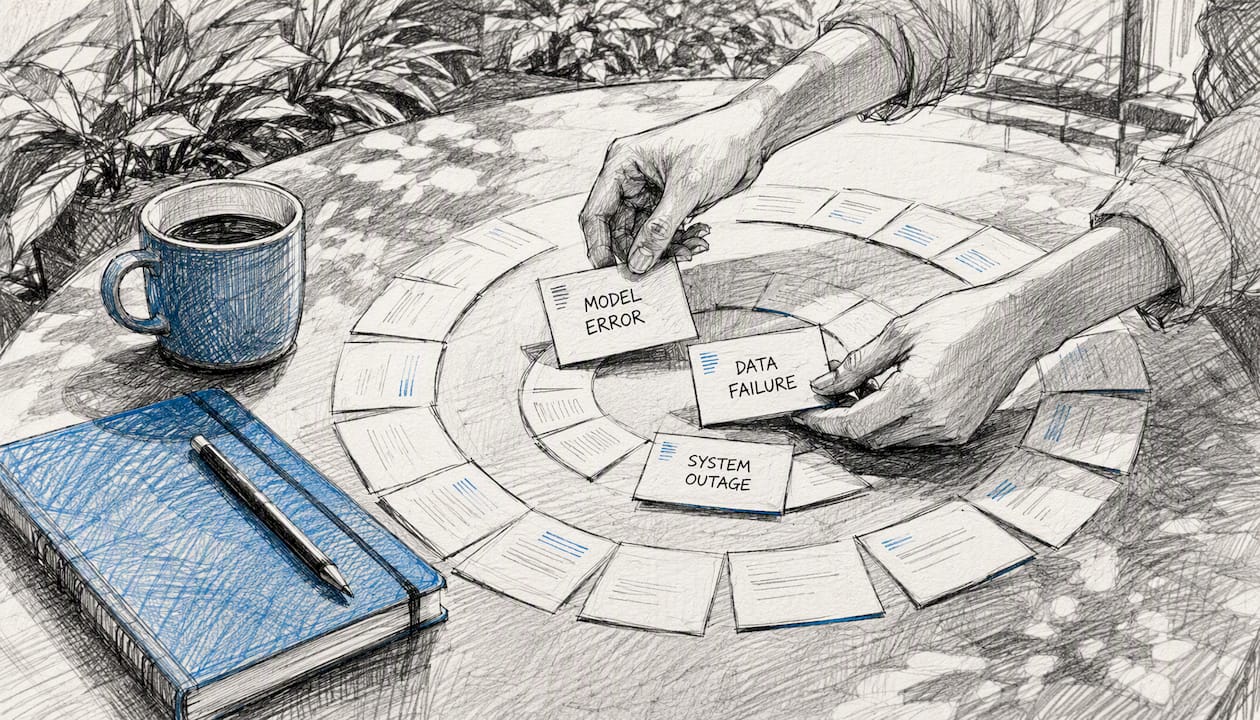
Data failure (pipeline corruption, data quality degradation, or a data breach): the DPO and data engineer co-own this response. The plan must cover containment, ICO notification obligations (72-hour window under UK GDPR), and the process for assessing whether affected outputs must be reviewed or reversed.
System outage (the AI system is unavailable): document the manual fallback process. Users must know exactly what to do when the system is down. An AI system with no fallback creates a single point of failure in a business process — which is a governance risk, not just an operational inconvenience.
Test the response plan before go-live. Run a tabletop exercise with the change lead, DPO, ML engineer and a business unit representative. The goal is to confirm that everyone knows their role before an incident, not during one.
Which change management frameworks work best for AI projects?
Standard frameworks — ADKAR, Kotter's 8-Step, Prosci — provide a solid structural foundation but need adaptation for AI-specific challenges. The key adaptations are around iterative delivery, ethical governance, and the ongoing nature of model management.
ADKAR (Awareness, Desire, Knowledge, Ability, Reinforcement) maps well to AI adoption when you add two AI-specific layers: an explainability step within Knowledge (users must understand model logic, not just system navigation) and a monitoring step within Reinforcement (adoption is not sustained without ongoing performance feedback to users).
Agile works well for the technical build but needs a change management overlay. Sprint reviews should include a business stakeholder who can assess whether the build is moving toward the agreed business outcome, not only whether it meets the technical specification. Without this overlay, Agile delivery can produce technically correct systems that nobody uses.
The most effective approach combines ADKAR's people-change structure with Agile's iterative delivery cadence. Run change activities (stakeholder engagement, training, communications) in parallel with technical sprints, not sequentially after them. The two tracks converge at user acceptance testing, where technical readiness and people readiness are assessed together.
The part of AI change management most leaders get wrong
Most governance frameworks for AI focus on what the system does. The harder question is what the organisation does differently because of it. That distinction is where most programmes lose value.
A RAG agent that answers policy queries accurately is a technical achievement. An organisation where staff trust the agent, use it consistently, and escalate edge cases appropriately is a change achievement. The first can be delivered in weeks. The second takes months of deliberate sponsorship, training and feedback loops.
The temptation is to declare success at go-live. Adoption metrics tell a different story: usage typically peaks in the first two weeks after launch, then drops as novelty fades and old habits reassert themselves. The programmes that sustain adoption are the ones that treat the post-go-live period as a distinct phase with its own budget, owner and KPIs.
One more thing leaders consistently underestimate: the line manager is the most powerful adoption lever in the organisation. Executive sponsorship sets the direction. Line manager behaviour determines whether staff actually change how they work. Building line-manager accountability into the stakeholder map and the communications plan is not a nice-to-have — it is the difference between a pilot that scales and one that quietly fades.
Real-studios can scope and build your AI pilot
UK organisations that have the governance framework in place but need a technical partner to build and integrate the AI system have a clear next step. Real-studios is a Manchester-based AI consultancy that builds custom RAG agents, automations and integrations for UK businesses — the exact technical components this article's roadmap calls for. The team handles model selection, pipeline build, system integration and post-launch monitoring, so your change lead can focus on adoption rather than infrastructure.
For leaders preparing a pilot budget, Real-studios offers rapid MVP and prototyping engagements scoped to a single use case with defined success criteria — the same pilot structure described in Phase 3 of this guide. Request a scoped discovery session at Real-studios to define your use case, data requirements and go-live timeline.
Sources
The following primary sources are referenced throughout this guide and are worth sharing with your governance team:
- Guidance on AI and data protection | ICO
- Artificial intelligence in UK businesses - Office for National Statistics
- A pro-innovation approach to AI regulation (government response)
- Reshaping business with artificial intelligence | MIT Sloan