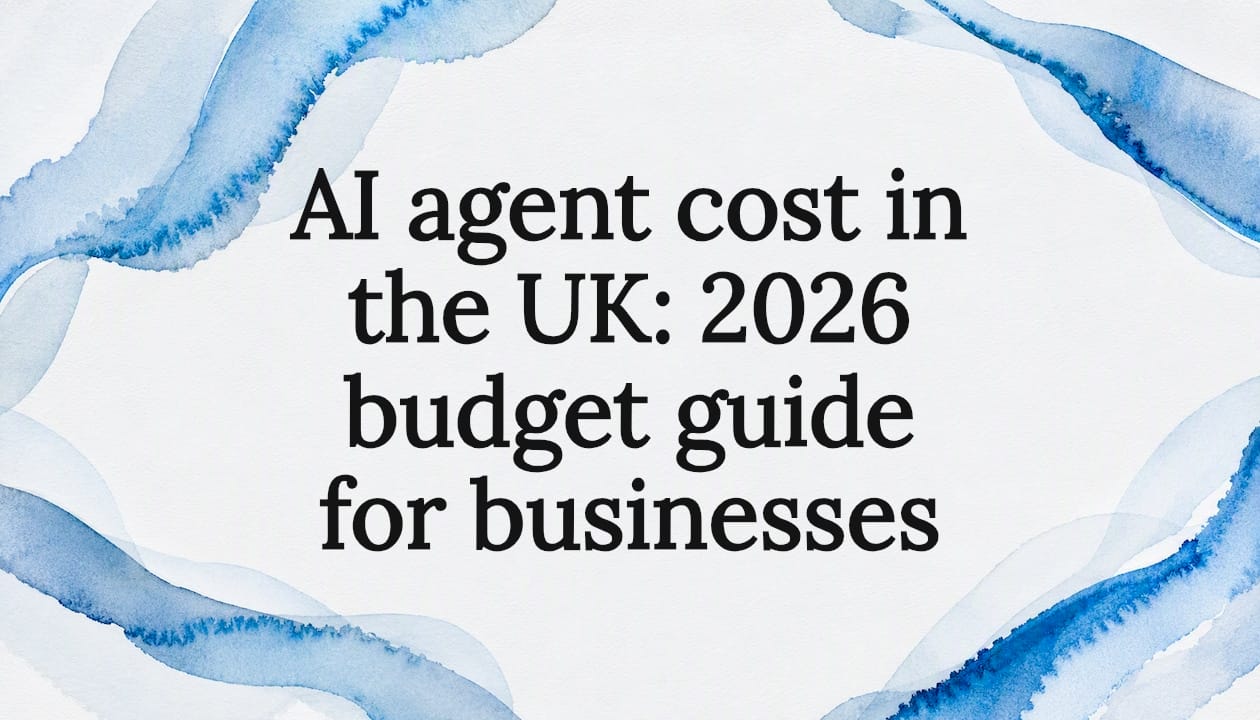
AI agent cost in the UK: 2026 budget guide for businesses
Building a functional AI agent in the UK can cost a wide range for initial development, depending on complexity. Simpler agents typically fall at the lower end of this range, with costs increasing for more integrated and advanced systems. These headline figures cover discovery, build, and basic testing. They exclude ongoing token usage, hosting, vector database fees, and maintenance, which add meaningful cost at scale.
Here is what each band typically buys:
- Simple (£3,000–£15,000): A single-purpose agent handling FAQ responses, email triage, or basic lead qualification using a hosted LLM API with minimal integration.
- Mid-range (£15,000–£50,000): A CRM-connected task agent that reads and writes records, handles multi-turn conversations, and includes a retrieval-augmented generation (RAG) knowledge layer.
- Advanced (£50,000–£150,000+): Multi-agent orchestration across several business systems, voice or real-time channels, custom guardrails, compliance controls, and a full evaluation harness.
Every project is different. For an accurate quote matched to your specific use case, speak to a specialist before committing a budget line.
Key takeaways
UK AI agent development costs range from £3,000 for a simple reactive agent to £150,000+ for enterprise multi-agent orchestration, with ongoing monthly running costs that must be modelled from day one.
| Point | Details |
|---|---|
| UK development cost bands | Simple agents cost £3,000–£15,000; mid-range £15,000–£50,000; enterprise £50,000–£150,000+. |
| Running costs compound | Monthly operational spend ranges from £200–£600 (simple) to £3,000–£10,000+ (enterprise); model these before approving a build budget. |
| Integration is the biggest cost driver | Every CRM, ERP, or bespoke system connection adds scoping, testing, and maintenance cost; scope integrations precisely in your RFP. |
| RAG beats fine-tuning on cost | RAG is cheaper and faster to update than fine-tuning an LLM; fine-tuning costs £5,000–£50,000+ and requires ongoing retraining as data changes. |
| Real-studios mid-range pricing | Real-studios delivers CRM-integrated agents for £20,000–£45,000, inclusive of discovery, build, testing, and three months of support. |
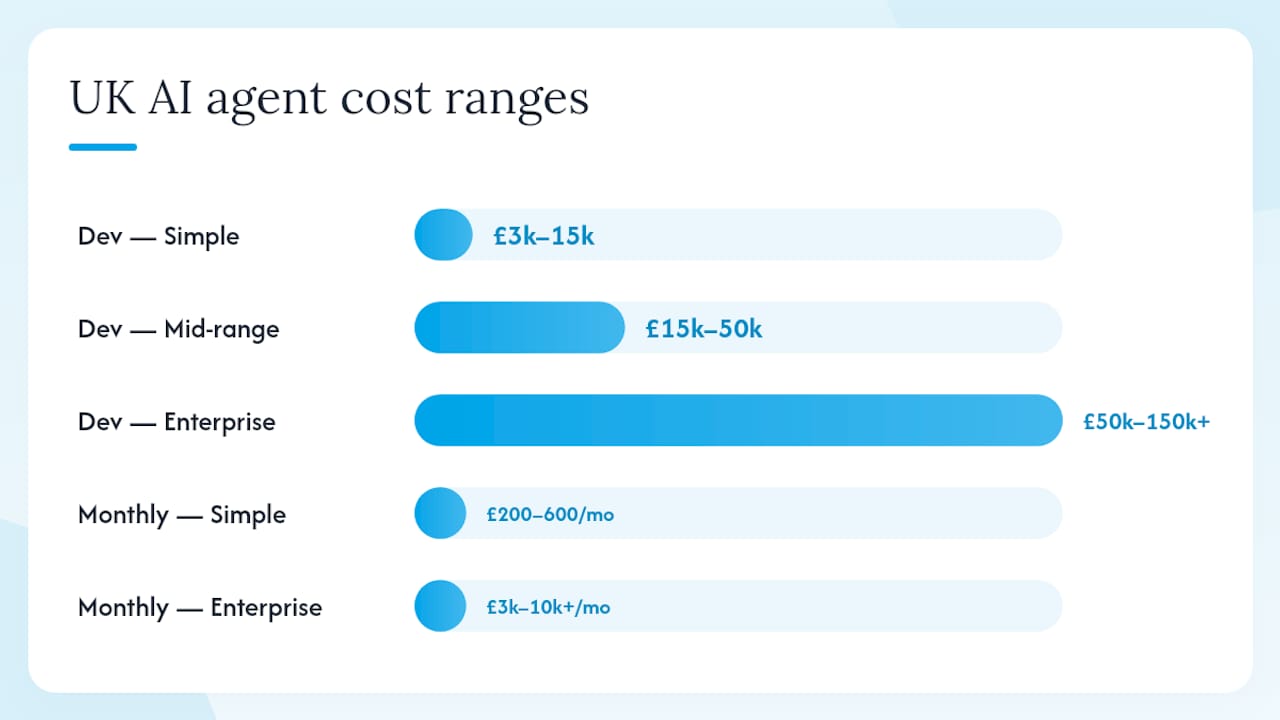
Table of Contents
- How is the AI agent cost broken down by development phase?
- What do ongoing operational costs look like each month?
- Which pricing models do agencies use for AI agent projects?
- What drives AI agent costs up, and how can you reduce them?
- Example UK budgets, timelines, and an RFP snippet
- How do you calculate ROI and compare agent costs to human labour?
- How Real-studios scopes, prices, and delivers AI agent projects
- What information do you need to get an accurate UK quote?
- The real cost of building AI agents in the UK right now
- What Real-studios delivers for UK businesses budgeting for AI agents
- Sources
How is the AI agent cost broken down by development phase?
Understanding where your budget goes is the fastest way to audit a vendor quote. Most UK AI agent projects follow a consistent phase structure, even when the total cost varies significantly.
Integration complexity is the line item that most frequently surprises buyers. Every CRM, ERP, or bespoke system the agent touches adds scoping, testing, and ongoing maintenance work. A project that looks like a £20,000 build can reach £40,000 once three legacy API connections are properly accounted for.
Testing and evaluation is the other area buyers routinely under-invest in. Guardrails, adversarial test suites, and evaluation harnesses feel like overhead until an agent produces a confidently wrong answer in front of a customer. Spending adequately here reduces downstream remediation costs considerably.
An evaluation harness built during development doubles as your acceptance test suite and your ongoing regression framework, saving significant cost post-launch.*
What do ongoing operational costs look like each month?
One-off development cost is only part of the picture. Monthly running costs depend on usage volume, model choice, and infrastructure decisions. Finance teams should model these before committing to a build.
Worked example — first-line support triage agent, medium usage: Assume 500 customer sessions per day, averaging 800 tokens per session (input plus output), five days per week. That produces roughly 80 million tokens per month. At OpenAI's published API rates, GPT-4o input tokens cost $2.50 per million and output tokens cost $10.00 per million. Add hosting, vector DB, and monitoring and the total operational spend sits around £1,500–£2,500 per month for this scenario.
Azure OpenAI Service pricing follows a similar per-token structure but adds separate charges for bandwidth and egress, which can materially affect bills for high-volume agents. Gemini API pricing from Google offers competitive rates for certain context lengths and is worth modelling as an alternative when token volumes are high.
Costs scale non-linearly when agents use multi-step reasoning, call external tools repeatedly, or handle concurrent sessions with long context windows. Model before you commit: estimate expected daily sessions, average tokens per session, and your caching hit rate.
Which pricing models do agencies use for AI agent projects?
Commercial structures vary across the UK consultancy market. Understanding each model helps procurement teams write contracts that protect their interests.
Fixed-price: A defined scope is agreed upfront and the vendor delivers for a set fee. Predictable for buyers, but requires a thorough discovery phase first. Any scope change triggers a change-request process.
- Pros: Budget certainty, clear deliverables, easier board approval.
- Cons: Vendors price in risk, so fixed quotes often run higher. Scope gaps become disputes.
Time and materials (T&M): The buyer pays for actual hours worked at agreed day rates. Common for exploratory or fast-moving projects where requirements evolve.
- Pros: Flexible, transparent, suited to iterative builds.
- Cons: Budget exposure if scope expands; requires active client oversight.
Managed subscription: A monthly fee covers hosting, monitoring, model costs, and a support allowance. Common for post-launch operations or for vendors who also manage the infrastructure.
- Pros: Predictable monthly spend, vendor accountability for uptime.
- Cons: Can obscure underlying cost components; check what the fee actually covers.
Outcome-based / per-resolution: The buyer pays per successful agent resolution (e.g. per ticket closed, per lead qualified). Aligns vendor incentives with business outcomes.
- Pros: Directly tied to value delivered.
- Cons: Defining "resolution" precisely is difficult; gaming risk if metrics are poorly specified.
Hybrid: A fixed-price build phase followed by a managed subscription for operations. The most common structure for mid-range and enterprise projects in the UK.
Contracting tips worth applying regardless of model: scope discovery as a paid, standalone phase before committing to a full build; include milestone-based safety gates that require sign-off before the next phase begins; specify SLAs for agent actions (response latency, escalation thresholds, uptime); and include explicit warranties covering data handling, residency, and model versioning.
What drives AI agent costs up, and how can you reduce them?
Some cost drivers are structural and unavoidable. Others are scope decisions you control. Knowing which is which lets you negotiate intelligently.
| Cost driver | Why it increases cost |
|---|---|
| Number of integrations | Each API connection requires scoping, authentication, error handling, and regression testing |
| Autonomy level | Agents that take actions (write records, send emails, trigger workflows) need more guardrails and testing than read-only agents |
| Model choice | Frontier models such as GPT-4o and Claude Sonnet cost significantly more per token than smaller or open-weight models |
| Data quality | Poorly structured or inconsistent data requires cleaning and transformation before it can feed a RAG pipeline reliably |
| Real-time or voice channels | Streaming, low-latency inference, and telephony integrations add infrastructure complexity and cost |
| Compliance & regulation | Financial services, healthcare, and legal environments require audit trails, data residency controls, and additional documentation |
| Concurrency & scale | High simultaneous user loads require load balancing, auto-scaling, and more expensive compute tiers |
Practical levers to reduce spend:
- Caching: Store responses to common queries. A well-tuned cache can reduce API token spend by 30–50% for FAQ-heavy agents.
- RAG instead of fine-tuning: Retrieval-augmented generation is almost always cheaper than fine-tuning a model for domain knowledge. The cost to fine-tune an LLM on a proprietary dataset can run from £5,000 to £50,000+ depending on data volume and the base model used, plus ongoing retraining costs as data changes. RAG updates are cheaper and faster.
- Batching and async workflows: Not every agent task needs a real-time response. Batch processing for document analysis or overnight report generation uses cheaper inference tiers.
- Limiting tool access: Every tool an agent can call adds testing surface. Start with the minimum viable tool set and expand after validation.
- Phased rollout: Launch with a pilot covering one use case or one team. Validate before scaling, which limits financial exposure if assumptions prove wrong.
Pro Tip: When evaluating model choice, compare Claude's model tiers alongside OpenAI and Google options for your specific task. Smaller, faster models often handle structured tasks (classification, extraction, routing) at a fraction of the cost of frontier models, with no meaningful quality loss for those workloads.
Example UK budgets, timelines, and an RFP snippet
Three ready-to-use budget templates for common UK project types. Copy these into internal budgeting documents or vendor RFPs.
Simple FAQ and reactive agent
One-off development cost: £5,000–£12,000 Monthly running cost: £200–£600 Delivery timeline: 4–8 weeks
- Discovery and use-case definition (1 week)
- Prompt engineering and knowledge base setup (1–2 weeks)
- Integration with website chat or email channel (1 week)
- Testing, guardrail validation, and UAT (1 week)
- Deployment and handover documentation (1 week)
Mid-range CRM-integrated task agent
One-off development cost: £20,000–£45,000 Monthly running cost: £1,000–£3,000 Delivery timeline: 8–16 weeks
- Discovery, data audit, and architecture sign-off (2 weeks)
- CRM and ticketing API integration build (3–4 weeks)
- RAG knowledge layer and prompt engineering (2–3 weeks)
- Evaluation harness, adversarial testing, and guardrails (2 weeks)
- Deployment, monitoring setup, and team training (1–2 weeks)
Advanced multi-agent orchestration
One-off development cost: £60,000–£150,000+ Monthly running cost: £3,000–£10,000+ Delivery timeline: 16–32 weeks
- Stakeholder workshops, system mapping, and compliance review (3–4 weeks)
- Agent architecture design and tool registry (2–3 weeks)
- Multi-system integrations (CRM, ERP, data warehouse, telephony) (6–10 weeks)
- Orchestration logic, inter-agent communication, and escalation routing (4–6 weeks)
- Full evaluation harness, red-teaming, and compliance documentation (3–4 weeks)
- Staged rollout, monitoring, and hypercare support (2–4 weeks)
Minimal RFP fields for apples-to-apples vendor quotes:
- Use case description and target business outcome
- Expected daily/monthly session volumes and peak concurrency
- Systems to integrate (list APIs, CRMs, databases, and whether APIs are documented)
- Data types handled (structured, unstructured, PII, regulated)
- Compliance or data residency requirements (UK GDPR, FCA, NHS, ISO 27001)
- Acceptance test criteria and definition of "done"
- SLA requirements (response latency, uptime, escalation time)
- Request a breakdown of ongoing running costs at low, medium, and high usage
How do you calculate ROI and compare agent costs to human labour?
The core ROI formula is straightforward:
ROI = (Annual savings − Annual operating cost) ÷ Total project cost
Payback period = Total project cost ÷ Annual net savings
A worked example makes this concrete. Consider a first-line support triage agent handling 200 tickets per day, five days per week.
These figures assume the agent handles the full triage and routing function, with human agents handling escalations. McKinsey's state-of-AI research consistently finds that automation of repetitive knowledge work delivers the fastest measurable ROI, particularly in customer operations and data processing.
Softer benefits matter too, though they are harder to quantify in a spreadsheet. A well-built agent operates 24 hours a day, seven days a week, with no variation in response quality between the first query of the morning and the last of the night. It scales to handle demand spikes without recruitment lag. The AI agents market is growing precisely because these operational advantages compound over time.
Risks that affect ROI calculations: error cost (a wrong agent action can be expensive to remediate), escalation overhead (poorly calibrated agents escalate too often, reducing savings), and retraining cost as business processes change. Build these into your model rather than assuming best-case performance from day one.
How Real-studios scopes, prices, and delivers AI agent projects
Real-studios operates as a Manchester-based AI consultancy building custom AI agents and automations for UK businesses. A typical engagement follows a structured scope of work:
Discovery outputs: A written use-case specification, data audit, system integration map, risk register, and recommended architecture. This is delivered as a standalone paid phase, giving buyers a vendor-neutral foundation before committing to a full build.
Build deliverables: Configured LLM pipeline, RAG knowledge layer (where applicable), API integrations, guardrail logic, evaluation harness, and a monitoring dashboard. Voice, chat, and email channels are built to the agreed specification.
Testing and acceptance: Automated test suite covering happy-path, edge-case, and adversarial scenarios. Guardrail logs are provided as part of handover. Acceptance tests are agreed before build begins, not after.
Post-launch support: Three months of included support covering monitoring, model version management, and minor prompt adjustments. This is built into the project fee, not charged separately.

A representative pricing band for a mid-range CRM-integrated agent with Real-studios runs £20,000–£45,000 for the full build, inclusive of discovery, integration, testing, and three months of post-launch support. Enterprise multi-agent projects are scoped individually.
Questions to ask any AI agent vendor:
- Can you provide sample acceptance tests from a comparable project?
- How are guardrail violations logged and reported?
- What does your monitoring dashboard show, and who has access?
- How do you handle model version changes that affect agent behaviour?
- What is the breakdown of ongoing running costs at our expected usage volume?
- Where is our data processed and stored? Is it within UK/EEA boundaries?
Pro Tip: Ask vendors to provide a guardrail log sample from a live project. A vendor who cannot show you how their agents fail safely is a vendor whose agents have not been tested rigorously enough.
What information do you need to get an accurate UK quote?
Vendors cannot price accurately without specific inputs. Sending a detailed brief upfront produces comparable, realistic quotes. Sending a vague brief produces wide ranges that are useless for budgeting.
- Use case description: What does the agent do, step by step? What is the business outcome it replaces or augments?
- Target volumes: Expected daily sessions, peak concurrency, and whether demand is seasonal or steady.
- Systems to integrate: List every CRM, ERP, database, or third-party API the agent must connect to. Note whether each has documented APIs or requires custom connectors.
- Data types: Structured data (records, forms), unstructured data (PDFs, emails, call transcripts), and whether any data is personally identifiable or regulated.
- Compliance requirements: UK GDPR obligations, sector-specific regulation (FCA, CQC, NHS Data Security), ISO 27001 or Cyber Essentials requirements, and data residency constraints.
- SLA requirements: Maximum acceptable response latency, uptime targets, and escalation time to a human.
- Acceptance criteria: How will you define and measure success? What test cases must the agent pass before go-live?
- Budget envelope: Sharing a realistic budget range helps vendors propose the right architecture rather than gold-plating or under-scoping.
A staged delivery approach reduces risk materially. A pilot covering one use case or one team, delivered in 4–8 weeks, validates assumptions before the full build budget is committed. Pilots typically cost £5,000–£15,000 and produce a working agent plus a realistic cost model for scale. Real-studios offers rapid MVP delivery as a structured entry point for buyers who want to validate before committing to a larger engagement.
This gives finance teams a cost envelope rather than a single point estimate, which is far more useful for budget approval.
The real cost of building AI agents in the UK right now
The procurement conversations I see most often go wrong in the same two places. Buyers either anchor on the development cost and treat running costs as an afterthought, or they scope the agent too ambitiously for a first build and then struggle to validate it before launch.
Development cost is a one-time line item. Running costs compound every month for the life of the product. A £30,000 build running at £3,000 per month costs £66,000 in year one and £96,000 by the end of year two. That trajectory needs to be in the business case from the start, not discovered six months post-launch.
The second pattern is scope creep driven by ambition rather than evidence. Multi-agent orchestration is genuinely powerful, but a business that has never run an AI agent before has no validated data on user behaviour, escalation rates, or edge-case frequency. Starting with a single-purpose agent, measuring it rigorously, and expanding based on evidence produces better outcomes than building a complex system against assumptions.
UK-specific compliance deserves its own budget line. Regulated sectors — financial services, healthcare, legal — face material additional cost for audit trails, data residency controls, and compliance documentation. Designing these controls in from the discovery phase is consistently cheaper than retrofitting them after a build is complete. The ICO's guidance on AI and data protection is the starting point for any UK deployment handling personal data, and it should be reviewed before architecture decisions are made, not after.
Pro Tip: Budget explicitly for continuous evaluation post-launch. Agent performance drifts as underlying data changes, model versions update, and user behaviour evolves. A quarterly evaluation cycle with a defined test suite is the governance mechanism most UK buyers omit and most often regret.
What Real-studios delivers for UK businesses budgeting for AI agents
Businesses that have worked through this guide know what they need: realistic cost estimates, a structured build process, and a vendor who can demonstrate how their agents fail safely as well as how they succeed.
Real-studios builds RAG systems, voice, chat, and email agents for UK businesses, with integrations across CRM, ERP, and bespoke systems. Projects start with a paid discovery phase that produces a vendor-neutral architecture and a realistic cost model before any build budget is committed. Mid-range projects typically run £20,000–£45,000 inclusive of discovery, build, testing, and three months of post-launch support. Enterprise scopes are priced individually.
For businesses that want to validate before committing, a structured pilot delivers a working agent and a validated cost model in 4–8 weeks. To discuss your use case and get a scoped quote, contact Real-studios directly.
Sources
- Azure OpenAI Service pricing — Microsoft Azure
- Developers
- Claude model overview — Anthropic platform