Agentic workflows for UK businesses: 2026 guide

Agentic workflows are the right move for mid-market UK organisations running fragmented SaaS stacks and losing hours to manual handoffs. Enterprise deployments report 20–50% reductions in coordination effort and 25–70% faster resolution times. The GOV.UK AI Insights publication defines them as autonomous AI agents that interpret goals, plan sub-tasks, act across systems, and iterate until success. If your organisation has defined processes, accessible APIs, and a clear outcome in mind, the case for moving forward is strong.
Three immediate next steps:
- Run a quick process audit: identify your top three workflows involving more than two systems and manual handoffs.
- Shortlist one pilot use case with a measurable success metric (e.g. invoice routing time, ticket resolution rate).
- Book a discovery session with a delivery partner to map your toolchain and receive a value estimate within two weeks.
Table of Contents
- What are agentic workflows, and how do they differ from classical automation?
- What business outcomes can agentic workflows realistically deliver?
- Are you ready to build? A readiness checklist
- What does a safe implementation roadmap look like?
- What technical architecture should you ask for?
- Governance, UK GDPR, and the controls you cannot skip
- What does a UK agentic workflow project cost?
- How do you choose the right delivery partner?
- How Real-studios delivers agentic workflows
- Key takeaways
- The gap most organisations miss
- What Real-studios can do for your organisation
- Useful sources
What are agentic workflows, and how do they differ from classical automation?
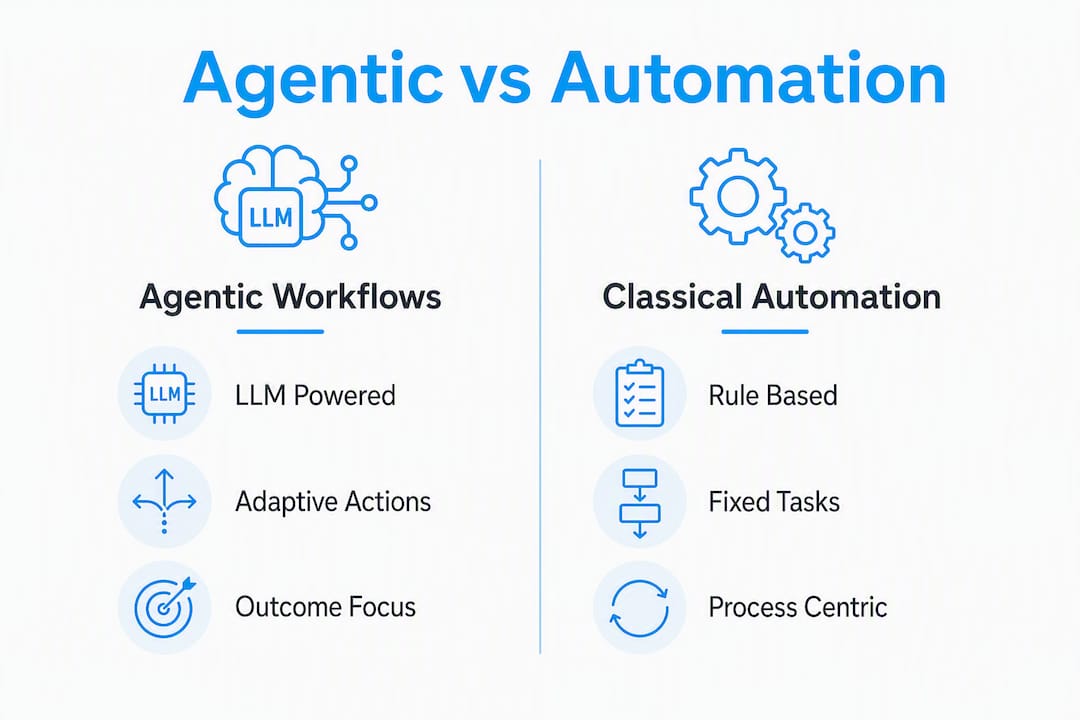
An agentic workflow is a business process in which one or more AI agents pursue a defined goal by reasoning, selecting tools, acting across systems, and adapting based on intermediate results. The agent does not follow a fixed script. It interprets the objective, decomposes it into sub-tasks, executes them, and refines its approach until the goal is met.
Three contrasts with classical automation make this concrete:
- Deterministic workflows follow hard-coded rules and break on exceptions. Agentic systems reason through exceptions.
- Scheduled scripts run on a timer against predictable inputs. Agents trigger on events and handle unstructured data.
- Single-system bots (RPA) operate within one application. Agents coordinate across your entire SaaS estate.
A simple mental model of the components: an agent (planning and decision layer, powered by an LLM) sits above a data layer (vector store, RAG retrieval, memory) and communicates with your systems through a connector layer (APIs, message queues, webhooks).
Most UK deployments in 2026 sit in the supervised-to-semi-autonomous range. Fully autonomous agents handling irreversible actions remain rare outside tightly scoped, low-risk processes. The typical UK mid-market firm runs 8–15 SaaS tools; agentic AI is most often deployed to bridge that integration gap rather than replace existing software.
Pro Tip: Start by mapping which of your SaaS tools have documented REST APIs. That list is your agent's action space before a single line of code is written.

What business outcomes can agentic workflows realistically deliver?
PwC recommends designing agentic workflows around the desired business outcome first, bypassing legacy process steps where they add no value. That framing matters: the gains come from reinvention, not digitisation.
Realistic outcomes for UK organisations include reduced manual handoffs between teams, faster customer resolution, and end-to-end automation of multi-system processes that previously required human coordination at every step.
High-value UK use cases:
- Lead routing and enrichment: agent queries CRM, scores lead, routes to correct rep, and logs activity automatically.
- Invoice processing: agent extracts data, matches purchase orders, flags discrepancies, and triggers payment approval.
- IT incident triage: agent diagnoses issue, checks knowledge base via RAG, attempts resolution, and escalates with a full diagnostic report.
- Meeting preparation: agent pulls CRM history, recent emails, and news, then produces a pre-meeting brief.
- Client portal updates: agent monitors upstream systems and pushes status updates without human intervention.
TechUK practitioner findings put efficiency gains at 20–50% reduction in coordination effort, 25–70% faster resolution times, and 15–40% improvement in decision speed across enterprise deployments.
Are you ready to build? A readiness checklist
The single biggest predictor of a failed agentic deployment is poor data readiness, not poor technology. Before commissioning a build, score your organisation against these dimensions:
| Dimension | Green | Amber | Red |
|---|---|---|---|
| Data quality | Clean, structured, accessible | Partially structured, some gaps | Siloed, inconsistent, no ownership |
| API availability | All target systems have documented APIs | Most do, some require custom connectors | Legacy systems with no API layer |
| Process ownership | Named owner, documented process | Owner identified, process informal | No clear owner or documented steps |
| Governance & GDPR | DPO engaged, data flows mapped | Partial mapping, DPO not yet involved | No data governance in place |
| Sponsorship | Executive sponsor confirmed | Interest at manager level only | No internal champion |
| Change readiness | Team briefed, training planned | Team aware, no plan yet | No change management resource |
Green on data, APIs, and process ownership is the minimum for a safe supervised pilot. Amber on governance is acceptable if you commit to resolving it before production deployment. Red on any dimension means focus there first.
For a supervised pilot, the minimum prerequisites are: a scoped allowlist of permitted actions, a defined action budget (maximum API calls and spend per run), and a named human reviewer for each agent decision above a set confidence threshold.
What does a safe implementation roadmap look like?
The shortest safe route to value is a strictly scoped supervised MVP with human-in-the-loop validation before any autonomous action touches production data. Phasing the work into a strict scoping stage followed by a supervised prototype, validated against 50–100 test missions before pilot, is standard practice among UK practitioners.
| Phase | Duration | Key activities | Success checkpoint |
|---|---|---|---|
| Discovery | 2–4 weeks | Process mapping, API audit, data assessment, outcome definition | Agreed pilot scope and success metrics |
| Supervised prototype | 4–8 weeks | Build agent, connect 2–3 systems, shadow mode testing | Accuracy validated against test missions |
| Supervised MVP | 2–4 weeks | Human-in-the-loop live deployment, action logging | KPIs trending toward target; zero uncontrolled actions |
| Pilot | 4–6 weeks | Expand user base, monitor telemetry, refine prompts | Measurable outcome improvement confirmed |
| Scale | Ongoing | Add connectors, increase autonomy, governance review | Cost-per-transaction and error rate within agreed ceiling |
Decision gates before moving between phases: completion criteria met, security checks passed, cost ceiling confirmed, and kill-switch tested under load.
Pro Tip: Run your kill-switch test during the prototype phase, not after go-live. Simulate a runaway loop and confirm the switch halts execution within your agreed response window.
What technical architecture should you ask for?
The architecture pattern that reliably supports multi-step agents combines an LLM reasoning layer, a RAG retrieval system, a vector database, an orchestration framework, a connector layer, and an observability stack. Each component has a specific role:
- LLM (reasoning layer): interprets goals, selects tools, and plans sub-tasks. Model selection affects both capability and inference cost.
- RAG and vector store: retrieves relevant business context at query time, reducing hallucination and keeping responses grounded in your data.
- Orchestration framework: manages agent state, tool calls, and multi-agent coordination. Low-code tools such as n8n allow rapid prototyping; production builds typically use LangGraph or CrewAI.
- Connector layer: API integrations to your CRM, ERP, ticketing system, and communication platforms. Real-studios's integration services cover this layer end-to-end.
- Observability stack: telemetry, logging, and alerting so every agent decision is auditable and anomalies surface immediately.
For common enterprise systems, the integration pattern is: CRM via REST API (read/write on contact and deal records), ERP via webhook or batch connector (inventory, finance), and ticketing via API (create, update, escalate).
Pro Tip: Demand a data residency confirmation before any connector is built. UK GDPR requires personal data processed by your agent to remain within agreed geographic boundaries.
Governance, UK GDPR, and the controls you cannot skip
Governance is non-negotiable. The controls that must be in place before production deployment are: an action budget (maximum permitted API calls and spend per run), an allowlist of approved actions, human-in-the-loop gates for irreversible decisions, full action logging, and a tested kill switch. Overruns on action budgets can burn hundreds of pounds in minutes if left unchecked.
UK GDPR and ICO considerations:
- A Data Protection Impact Assessment (DPIA) is triggered when your agent processes personal data at scale, makes automated decisions with legal or significant effects, or accesses special-category data.
- All agent actions involving personal data must be logged with timestamps and decision rationale for ICO audit readiness.
- Data minimisation applies: the agent should access only the fields it needs for the task, not full records.
Operational risk controls: deploy in shadow mode first, where the agent runs in parallel with your existing process and its outputs are reviewed but not acted upon. Test the kill switch under simulated load before go-live. Define rollback procedures and assign a named incident owner before the pilot begins.
This article is general information, not legal or compliance advice. Confirm your specific obligations with your DPO or a qualified data protection professional.
What does a UK agentic workflow project cost?
A focused agent connecting a few tools typically takes several weeks and costs tens of thousands of pounds. More complex multi-system builds take longer and cost more, especially with deep ERP integrations or multi-agent orchestration layers.
Primary cost drivers:
- Integration complexity: custom connectors for legacy or undocumented systems add significant development time.
- Model inference costs: repeated LLM calls in long-running agents accumulate; caching and retrieval strategies reduce this.
- Security and compliance: DPIA preparation, data residency controls, and audit logging add scope.
- Orchestration complexity: multi-agent coordination requires more engineering than a single-agent build.
Pricing models to expect from consultancies: fixed-scope prototype (clearest for procurement), time-and-materials for complex integrations where scope evolves, and a managed service arrangement for ongoing SLA and post-launch support.
How do you choose the right delivery partner?
The single most important criterion is proven delivery of scoped, governed agentic workflows in UK contexts, with references and documented outcomes. Technical capability alone is insufficient without governance experience and post-launch support.
Procurement checklist:
- Demonstrated integration experience with your specific systems (CRM, ERP, ticketing)
- Governance credentials: GDPR/ICO alignment, DPIA experience, data residency controls
- Post-launch SLA with defined response times and escalation paths
- UK-based references or case summaries with measurable outcomes
- Transparent pricing with cost ceilings and change-control process
Ten questions to ask any supplier:
- Can you show a case summary with measurable outcomes from a comparable UK deployment?
- How do you design and test the kill switch?
- What shadow-mode duration do you recommend before go-live?
- How do you define and enforce the action budget?
- What telemetry and observability do you provide post-launch?
- Where does our data reside during processing?
- How do you handle a DPIA requirement?
- What is your change-control process when scope evolves?
- What does your post-launch SLA cover, and what are the response times?
- How do you manage model drift and prompt degradation over time?
How Real-studios delivers agentic workflows
Real-studios (AIthatworks) applies an outcome-first method: every engagement begins by defining the measurable business outcome, then designing the agent architecture to reach it. Governance controls, including action budgets, allowlists, and kill-switch testing, are built into every delivery, not added afterwards. Post-launch SLAs cover monitoring, prompt refinement, and connector maintenance.
Two anonymised outcomes from recent UK engagements:
- A professional services firm reduced manual invoice-handling steps by over 60% within six weeks of supervised MVP deployment. The agent connected their ERP, email inbox, and approval workflow, eliminating three handoff points.
- A B2B technology business cut first-response time on support tickets by more than half after deploying a triage agent that queried a RAG knowledge base, classified issues, and routed to the correct team with a pre-populated diagnostic summary.
Real-studios services relevant to the full project lifecycle:
- Discovery and process mapping
- Automation design and build
- RAG systems and vector store integration
- Voice, chat, and email agents
- MVP prototyping and phased delivery
- Connector development for CRM, ERP, and ticketing systems
- Generative Engine Optimisation (GEO) for AI search visibility
- Ongoing managed support and SLA
Key takeaways
Agentic workflows deliver measurable efficiency gains for UK mid-market firms when scoped around a clear outcome, built with governance controls from day one, and validated in shadow mode before production deployment.
| Point | Details |
|---|---|
| Outcome-first scoping | Define the measurable business outcome before selecting technology or architecture. |
| Readiness threshold | Green on data quality, API availability, and process ownership is the minimum for a safe pilot. |
| Cost and timeline | A focused two-to-three-system agent typically costs £15,000–£35,000 and takes 4–6 weeks; more complex multi-system builds may take 8–12+ weeks and require higher budgets. |
| Governance non-negotiables | Action budget, allowlist, human-in-the-loop gates, full logging, and a tested kill switch must be in place before go-live. |
| Real-studios | Real-studios delivers outcome-first agentic workflow builds for UK businesses, with post-launch SLAs and governance built into every engagement. |
The gap most organisations miss
The conversation around autonomous workflows tends to focus on capability: what can the agent do? The more useful question is what the agent is permitted to do, and how you will know when it goes wrong.
Organisations that rush to production without shadow-mode validation or a tested kill switch are not being bold; they are creating an incident waiting to happen. The governance layer is not a constraint on ambition. It is what makes ambition sustainable. Two tips that consistently separate smooth deployments from costly ones: first, run shadow mode for a minimum of 50 real missions before granting the agent any write access to production systems. Second, test your kill switch under simulated peak load, not just in a quiet development environment. An agent that halts cleanly in testing but fails to stop under load is not a governed agent.
What Real-studios can do for your organisation
Real-studios gives UK businesses a faster path from process audit to working agent, without the overhead of building an in-house AI team. A discovery session delivers a mapped toolchain, a prioritised pilot recommendation, and a value estimate, typically within two weeks of engagement. From there, the team moves to a fixed-scope prototype, with governance controls and post-launch support included as standard.
If your organisation is ready to move from manual handoffs to a governed, outcome-first automation, request an automation assessment to get started. For businesses assessing integration complexity first, the integrations service page outlines connector options across CRM, ERP, and ticketing systems.
Useful sources
- GOV.UK AI Insights: Agentic Workflow — the UK government's formal definition and lifecycle description; best starting point for governance and technical framing.
- PwC UK: Real Change Agents — strategic framing for outcome-first reinvention; useful for board-level business cases.
- ICO: Automated Decision-Making and Profiling — primary source for UK GDPR obligations when agents make automated decisions; essential before any DPIA.
- TechUK: Enterprise AI Agents in Practice — UK practitioner findings on efficiency gains and deployment patterns; useful for KPI benchmarking.
- DPLIANCE: Business AI Agents 2026 Practical Guide — detailed governance controls, shadow-mode guidance, and kill-switch design for UK companies.