Stop Trusting Single Runs: Agent Evaluation for Practitioners With ICC
Agent evaluation measures three things at once: the trace, the components, and the final outcome. It has to be multi-run, not single-shot, because AI agents behave stochastically even at temperature zero. The minimum viable evaluation trio is end-to-end testing, trajectory analysis, and component-level checks, each run enough times to report a confidence interval or a pass@k score rather than a single pass/fail number.
TL;DR:
- Multi-run testing is essential because agent performance can vary by 2.2 to 6.0 percentage points between identical runs, making single-shot results unreliable.
- Combining end-to-end, trajectory, and component-level evaluation scopes reveals failures that only a comprehensive, multi-step analysis can detect.
- Accurate assessment requires variance reporting, at least 8 to 16 trials for simple tasks and over 32 for complex reasoning, to ensure stability and confidence.
- Use a mix of code-based, model-based, and human graders to handle different output types and reduce systematic biases in evaluation.
- An effective evaluation pipeline should be built into the agent from the start, with versioned datasets, instrumentation, and adaptive CI testing to prevent silent failures and production issues.
Table of Contents
- What is agent evaluation and why single-run testing fails
- Evaluation scopes and what each reveals
- Types of graders and how to combine them
- Core metrics that actually belong in a report
- Handling stochasticity and making evaluation stable
- Designing evaluation datasets, tasks, and harnesses
- Regression testing and CI/CD for agents
- Operational monitoring and production sampling
- How a consultancy operationalises this in practice
- Balancing capability gains with evaluation stability
- Get your evaluation pipeline built properly, not bolted on
- Sources
- FAQ
What is agent evaluation and why single-run testing fails
Agent evaluation is the discipline of measuring whether an AI agent completes tasks correctly, efficiently, and safely, across repeated runs rather than one lucky pass. That last clause matters more than most teams assume. Research into stochastic variance in agentic systems found that single-run pass@1 estimates vary by 2.2 to 6.0 percentage points between identical test runs, with standard deviations exceeding one percentage point even when temperature is set to zero.
That means a team that ships an "improvement" based on one test run could be measuring noise, not progress. A model that scores 78% on Monday and 82% on Tuesday hasn't necessarily improved. It might just have been lucky on Tuesday.
This is why the field has moved towards a structured, multi-pillar approach. Industry guidance from Google Cloud recommends combining agent success scoring, trajectory analysis, and trust and safety assessment into a single evaluation framework, precisely because checking only the final answer misses silent failures: an agent that reaches the right answer via a policy violation, a wasted tool call, or an unsafe intermediate step looks identical to a clean success if you only check the output.
Standard terminology in the research community sometimes differs from what practitioners search for. "Agent benchmarks" and "agent evaluation metrics" both describe the same underlying practice: systematically scoring how an agent performs against defined tasks, using repeatable, quantifiable criteria. Some literature also references measurement-science concepts like Evaluation Cards, a structured documentation format borrowed from the ICC (intraclass correlation coefficient) tradition in psychometrics, used to specify exactly what a benchmark measures, under what conditions, and with what known limitations. Treat that framing as complementary to the operational approach this guide takes: measure the trace, the components, and the outcome, and always report variance alongside the score.
Evaluation scopes and what each reveals
Three scopes cover a stochastic agent from different angles, and each one catches failures the others miss.
End-to-end evaluation checks only the final output against an expected result. It's the fastest scope to set up, because it needs nothing more than an input, an output, and a comparison function. It's also the weakest scope on its own. An agent can retrieve the wrong document, call the wrong tool, or take five times longer than necessary, and still produce a correct final answer. End-to-end testing is blind to all of that. It's the right first check during early prototyping, and the wrong sole check once an agent is customer-facing.
Trajectory-based evaluation looks inside the run. It captures the sequence of decisions, tool calls, and intermediate state the agent produces on its way to an answer. This is where root-cause debugging actually happens. If a customer support agent gives a wrong refund amount, end-to-end evaluation tells you it failed. Trajectory evaluation tells you it called the pricing tool with the wrong currency parameter three steps earlier. That distinction is the difference between a one-line fix and a week of guessing.
Component-level evaluation treats individual pieces of the agent, a parser, a tool-call generator, a retrieval step, as independently testable units, in the same spirit as unit tests in conventional software. You feed a component a known input and check its output against a known-good result, isolated from the rest of the pipeline. This is the only scope that reliably separates "the model made a bad decision" from "the harness gave the model bad information to decide with", a conflation the Survey on Evaluation of LLM-based Agents flags as one of the most common evaluation mistakes teams make.
Where each scope earns its place in a development cycle:
- Use end-to-end checks during early prototyping, when you just need a directional signal fast.
- Add trajectory analysis the moment an agent has more than two or three sequential decision points, because that's when silent internal failures start hiding behind correct-looking outputs.
- Run component-level tests continuously on any piece of the pipeline you change independently, particularly tool schemas and retrieval logic, since these break quietly and often.
- Combine all three before a production release. None of them substitutes for the others.
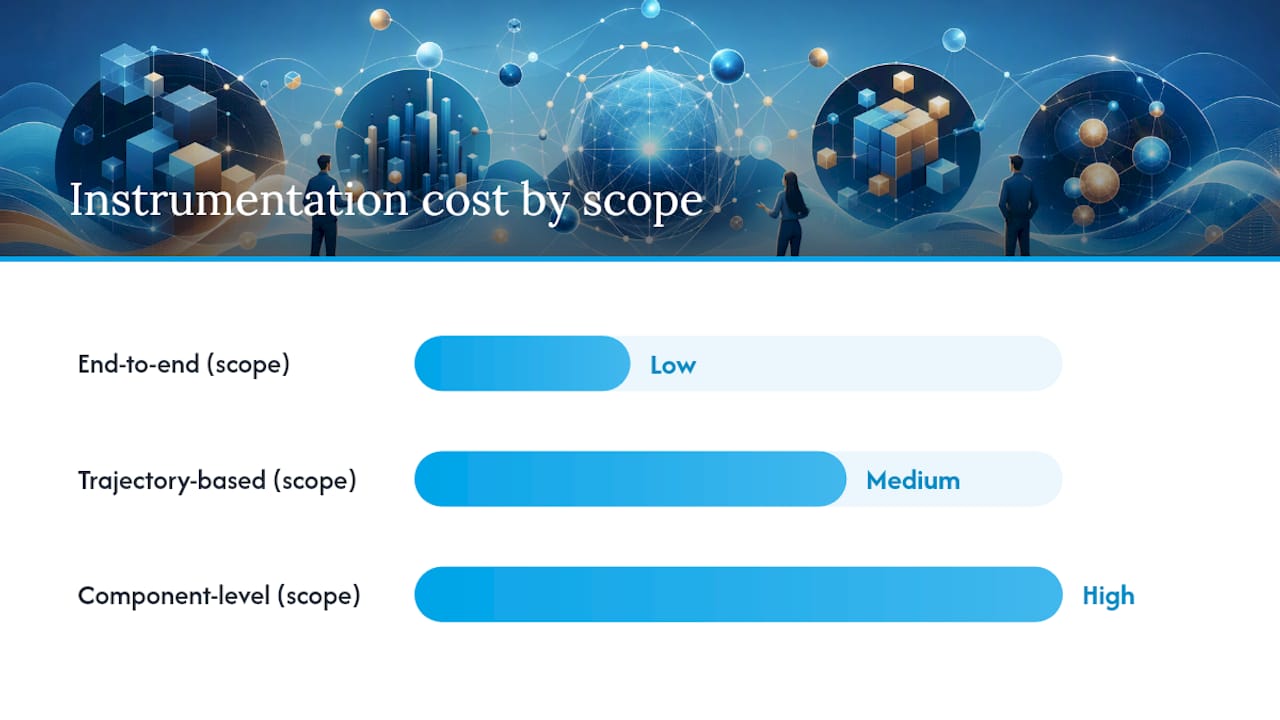
Instrumentation cost rises in that order too. End-to-end is nearly free to instrument. Trajectory evaluation needs structured logging of every intermediate step, which means your agent architecture has to expose that state in the first place. Component-level testing needs isolated harnesses for every piece you want to test independently, which is real engineering overhead. Budget for it accordingly: teams that skip trajectory logging early usually end up retrofitting it under pressure, at a worse time, with a production incident as the motivation.
Types of graders and how to combine them
Grading an agent's output is its own discipline, and the biggest mistake teams make is picking one grading method and using it for everything. Code-based, model-based, and human graders each solve a different problem, and the strongest evaluation pipelines route work between all three based on how ambiguous the judgment call is.
- Code-based graders check things with a definite right answer: does the JSON parse against a schema, did the tool call use valid arguments, does a numeric output fall within a tolerance band. They're cheap to run at scale, deterministic, and produce zero grading noise. Use them for anything with an objectively correct answer, which in most agent pipelines is a larger share of checks than teams initially assume.
- Model-based graders, typically an LLM acting as judge, handle output that requires interpretation: is this response helpful, does it match the tone of the brand, did the agent correctly synthesise conflicting retrieved documents. They scale far better than human review, but they introduce their own variance and need calibration against human-labelled examples before you trust them. An uncalibrated LLM judge can systematically favour longer answers, more confident-sounding phrasing, or a particular writing style, regardless of actual correctness.
- Human review stays the gold standard for genuinely ambiguous cases, but it's the most expensive resource in the pipeline by a wide margin. The fix isn't to review everything by hand. It's to sample deliberately, apply a structured rubric so two reviewers reach the same verdict on the same trace, and reserve human time for the band of cases automated grading can't confidently resolve.
The workflow that ties these together, and one that Label Studio's guidance on non-determinism in agent evaluation recommends explicitly, runs automated scoring first across every trace, routes anything the code-based checks can't resolve to an LLM judge, and sends only the genuinely ambiguous remainder to a human reviewer working from a structured rubric. If your human review queue is much larger than that, your code-based or model-based graders are under-calibrated, not your agent.
Pro Tip: *Track disagreement rate between your LLM judge and human reviewers as its own metric.
Core metrics that actually belong in a report
Task completion rate is the metric everyone measures. It's also the one most likely to mislead you if you report it alone, without the metrics that explain how the agent got there and what it cost to get there.
Task completion and pass@k. Reporting a single pass rate hides the difference between an agent that succeeds reliably and one that succeeds occasionally by chance. Pass@k measures the probability the agent succeeds at least once in k attempts, while the related pass^k measures the probability it succeeds in all k attempts, a much stricter and more production-relevant bar for anything running unattended. Report both together: pass@k tells you what's achievable with retries, pass^k tells you what you can actually rely on without them.
Tool-call accuracy and argument correctness. Did the agent select the right tool, and did it populate that tool's arguments correctly? These two numbers frequently diverge. An agent can pick the correct tool and still fail because it passed a malformed date or the wrong customer ID, a distinction end-to-end scoring will never surface.
Trajectory efficiency. Measured as steps or tokens consumed per successful task, this catches an agent that technically works but burns three times the compute a leaner path would need. Two agents at the same task-completion rate can have wildly different production costs, and trajectory efficiency is the number that exposes that gap.
Cost-normalised and safety-constrained success. This is where most current benchmarking falls short. A comprehensive review of agentic AI evaluation found that zero of fifteen major benchmarks reviewed integrate safety or security scoring, and none include cost-efficiency metrics in primary evaluation. The same review recommends two formulas worth adopting directly:
- Cost-normalised success:
Success_Rate / log(1 + Cost_Ratio), which penalises agents that succeed only by burning disproportionate compute. - Safety-constrained performance:
Success × (1 − Violation_Rate)^λ, where λ tunes how harshly policy violations get penalised. The same review suggests λ = 2 for high-risk domains, effectively squaring the penalty so violation rate erodes the score far faster than it would linearly.
Reporting convention. Every metric above should ship with a confidence interval, a sample count, and a variance figure, never a bare percentage. A comprehensive review of agentic evaluation practice notes that reporting uncertainty by default is what makes small improvements interpretable rather than cosmetic. A 3-point lift with a 5-point confidence interval isn't a lift.
Handling stochasticity and making evaluation stable
An agent tested once and an agent tested sixteen times can produce entirely different verdicts about the same underlying system, and this is the single most under-addressed problem in production agent evaluation.
Single-run pass@1 is unreliable precisely because of the variance already covered: 2.2 to 6.0 percentage points of swing between runs of the identical agent on the identical task. That variance can hide a genuine regression behind a lucky run, or manufacture a fake improvement out of nothing but noise. Either way, a team acting on single-run numbers is making decisions on a coin flip dressed up as data.
The intraclass correlation coefficient (ICC) is the metric that fixes this. ICC measures how consistent an agent's performance is across repeated runs of the same task, distinct from accuracy, which measures whether the agent is right. An agent can have high accuracy and low ICC, meaning it's often correct but wildly inconsistent about how it gets there, which is a genuine production risk even when the top-line pass rate looks fine.
Research quantifying inconsistency with intraclass correlation found ICC converges at different trial counts depending on task structure:
| Task type | Recommended trial count (n) | Convergence behaviour |
|---|---|---|
| Structured, low-ambiguity tasks | 8 to 16 | ICC stabilises quickly; diminishing returns past n=16 |
| Complex reasoning tasks | 32 or more | ICC requires substantially more trials to converge reliably |
| High-risk or safety-critical tasks | 32+, with power analysis | Under-sampling risks a false sense of stability |
Treat those numbers as a resampling budget, not a fixed rule. Run a quick power analysis before committing a permanent trial count: if the variance in your early runs is unusually high, the task probably sits closer to the complex-reasoning end of that table regardless of how simple it looks on paper.
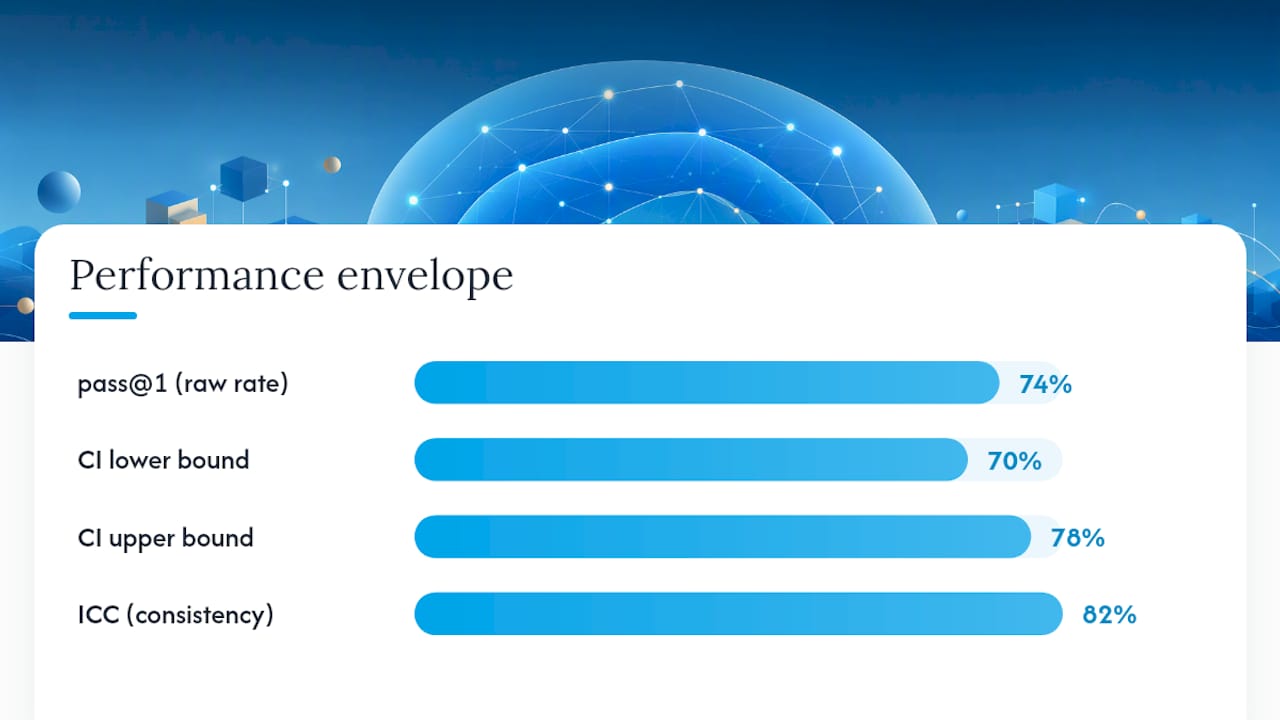
When you report results, present the full performance envelope rather than a single figure: pass@1 for the raw single-attempt rate, pass@k for best-of-k reliability, pass^k for guaranteed-every-time reliability, and the ICC alongside all three. A report that shows "pass@1: 74% (CI: 70 to 78%), ICC: 0.82" tells a technical manager something a bare "74%" never could: that the number is both meaningfully measured and reasonably stable run to run.
Designing evaluation datasets, tasks, and harnesses
An evaluation suite is only as trustworthy as the tasks and harness underneath it, and this is where quiet overfitting does the most damage.
Task selection has to represent the actual distribution of production traffic, edge cases included, not the tasks that were easiest to write test cases for. A common failure mode: teams build a golden dataset from the first fifty examples someone thought of, tune the agent until it aces that set, and then watch performance collapse in production against traffic the dataset never anticipated. Golden datasets need deliberate coverage of the awkward 10% of real usage, not just the clean majority.
- Build a golden dataset from curated, hand-verified examples that cover both common paths and known edge cases.
- Augment it with synthetic data generation for scenario classes that are rare in production but still need coverage, particularly failure modes and adversarial inputs.
- Grow the dataset continuously from real production traces, since the traffic your agent actually sees is the most honest signal of what to test next.
- Version every dataset change so a score improvement can always be traced to a genuine agent change rather than a quietly modified test set.
The harder problem sits underneath the dataset: the harness itself. Research on standardising non-LLM evaluation components makes the case plainly, that comparing two models across different execution environments, tool implementations, or retry logic confounds the comparison before it starts. A unified evaluation substrate fixes the harness and environment so that a score difference reflects the model or agent logic under test, not incidental variation in how the test itself was run.
This is what the Survey on Evaluation of LLM-based Agents calls the identification problem: without a controlled substrate, you cannot cleanly separate "the model got worse" from "the harness changed underneath it." Practically, that means versioning your harness and environment with the same discipline you'd apply to the agent's own code, and never comparing scores across harness versions without flagging the change. A benchmark result from six months ago, run on a different harness version, is not directly comparable to today's number, no matter how tempting that comparison is.
Regression testing and CI/CD for agents
Deterministic CI rules break the moment you point them at a stochastic agent.
The fix is stochastic test semantics: a three-valued verdict instead of a binary one. Pass means the metric held within expected variance. Fail means it dropped meaningfully beyond that variance. Inconclusive means there isn't yet enough evidence to say either way, and the pipeline should run more trials before deciding, rather than forcing a premature call.
- Set an expected variance band for each metric from historical multi-run data, not from a single baseline run.
- Run trials incrementally, checking after each batch whether the result has crossed clearly into pass, fail, or needs more evidence.
- Apply a Sequential Probability Ratio Test (SPRT) to decide, at each checkpoint, whether enough evidence exists to stop early, which is the mechanism that keeps this affordable rather than requiring a fixed, expensive trial count on every single CI run.
- Use behavioural fingerprinting, mapping full execution traces to compact vectors, to catch regressions that a single pass-rate number would miss entirely, such as a subtle shift in tool-call ordering that doesn't change the final outcome but does change reliability.
This is the core idea behind AgentAssay's approach to token-efficient regression testing: adaptive trial budgets driven by SPRT reduce the number of expensive live trials needed to reach a confident verdict, while behavioural fingerprinting adds multivariate detection power that a simple pass/fail comparison structurally cannot match, since it's checking the shape of the whole trace rather than one summary number.
Pro Tip: Run fingerprint comparisons offline against cached traces before spending live trial budget. Trace-first offline analysis catches the obvious regressions cheaply, leaving your SPRT-driven live budget for the genuinely ambiguous cases.
Operational monitoring and production sampling
Evaluation doesn't stop at the release gate. Production is where an agent meets traffic no test suite predicted, and the telemetry you capture there decides whether you catch problems in hours or in customer complaints.
Capture, at minimum: tool-call error rates and types, end-to-end and per-step latency, token consumption and the resulting cost per interaction, and any explicit or implicit user feedback signal you can instrument, thumbs up/down, escalation to a human agent, session abandonment.
- Log every tool call with its arguments and result, not just a success/failure flag, because the argument detail is what makes root-cause analysis possible later.
- Set automated triage thresholds so traces scoring in a clear "good" or clear "bad" band get auto-classified, and only the ambiguous middle routes to human review.
- Define drift-detection rules that watch for a shift in score distribution, latency profile, or cost per task over time, not just a drop in the headline pass rate.
- Treat a sustained drift signal, or a spike in violation rate on the safety-constrained metric, as a trigger to refresh the evaluation suite itself, not just the agent.
The most valuable long-term habit is closing the loop between production and your test assets. Curate a sample of real production traces regularly, anonymise anything containing customer data, apply the same structured rubric your human reviewers use elsewhere, and add the resulting labelled examples into the golden dataset. This is how an evaluation suite stays representative of what the agent actually faces, rather than freezing in place around whatever traffic existed at launch. An agent evaluation programme that never ingests new production traces is testing against a world that stopped existing months ago.
How a consultancy operationalises this in practice
Turning this framework into a working pipeline is where most in-house teams stall, not because the metrics are unclear, but because building trajectory logging, multi-run harnesses, and CI gating on top of a live customer-facing agent is a substantial engineering lift on top of the agent build itself.
Real-studios approaches this as a Manchester-based AI consultancy building tailored AI agents and automations for UK businesses, which means the evaluation layer gets designed alongside the agent, not bolted on afterwards once something has already gone wrong in production. That sequencing matters: a RAG or voice agent instrumented for trajectory logging from day one is far cheaper to evaluate properly than one retrofitted for it six months post-launch.
For customer-facing deployments specifically, RAG systems, voice, chat, and email agents built to handle enquiries naturally need the full evaluation trio this guide describes, end-to-end checks for the customer experience, trajectory analysis for the retrieval and tool-call logic underneath it, and component-level tests on the retrieval pipeline itself, since a RAG system that retrieves the wrong document but phrases the wrong answer fluently is a silent failure end-to-end testing alone will never catch.
Real-studios also applies a related discipline to a less obvious surface: how a business gets recognised inside AI-generated search answers. Its Generative Engine Optimisation work applies comparable evaluation thinking, tracking how consistently and accurately a brand appears in AI engine responses, rather than assuming visibility once and never checking again.
The throughline across modernising customer interactions and automating workflows is the same one this guide argues for: an agent that hasn't been measured with statistical rigour hasn't really been evaluated, it's just been demonstrated once, under favourable conditions.
Balancing capability gains with evaluation stability
The instinct in most engineering teams is to chase capability first and worry about measurement later. That ordering is backwards, and the variance data in this guide explains why: if you can't tell a genuine 4-point improvement from noise, every capability decision downstream of that number is a guess wearing a lab coat.
Instrument early, even before the agent feels finished, and insist on variance reporting from the first evaluation run, not as an afterthought once someone questions a suspicious result. Start resampling budgets small, n=8 to 16 for anything structured and low-risk, and only escalate to the heavier n=32-plus regime for tasks where a wrong or inconsistent answer actually costs something, financially, reputationally, or legally.
The cultural piece is the one teams skip most often: evaluation assets, golden datasets, rubrics, harness configs, shouldn't belong to one engineer or one team. They need shared ownership across whoever builds the agent and whoever's job depends on it working. An evaluation suite nobody but its original author understands is a liability with a delay timer on it.
— Oded
Get your evaluation pipeline built properly, not bolted on
Building the evaluation trio described here, end-to-end, trajectory, and component-level, with multi-run statistical reporting, is a genuine engineering project on top of the agent itself. Most in-house teams building their first production agent don't have spare capacity to also build a stochastic CI gate and a golden dataset pipeline from scratch, which is usually where evaluation gets skipped or done superficially.
Building that instrumentation into the agent from the start rather than retrofitting it after a production incident forces the question means incorporating trajectory logging, tool-call validation, and CI gating designed alongside your RAG, voice, chat, or email agent, not added as an afterthought once something has already broken.
If you're deploying or scaling an AI agent and want an evaluation-ready build from day one, start with a discovery audit through Real-studios' automations service, where the first step is mapping your current agent (or planned agent) against the evaluation scopes and metrics this guide sets out, and identifying exactly what instrumentation is missing before it costs you a production incident.
Sources
The strongest single source in this guide is the comprehensive review of agentic AI evaluation published in Artificial Intelligence Review, which supplies the cost-normalised and safety-constrained scoring formulas and the finding that no major benchmark currently integrates both cost and safety scoring.
For the statistics behind multi-run testing, the ICC-based stochasticity research sets the trial-count thresholds used throughout the stochasticity section, and the multi-run variance study supplies the pass@1 variance figures.
For CI/CD implementation, AgentAssay's regression-testing framework covers SPRT and behavioural fingerprinting in full technical detail, while Google Cloud's methodical evaluation guide offers the clearest practitioner-level walkthrough of the three-pillar framework.
- From benchmarks to deployment: a comprehensive review of agentic AI evaluation | Artificial Intelligence Review | Springer Nature Link
- A methodical approach to agent evaluation: Building a robust quality gate (Google Cloud Blog)
- On stochastic variance in agentic evaluations and the need for multi-run reporting
FAQ
What is agent evaluation?
Agent evaluation is the systematic process of measuring how well an AI agent completes tasks, using repeated multi-run testing across end-to-end, trajectory, and component-level scopes rather than a single pass/fail check.
What are the main types of evaluation used for AI agents?
The core categories are end-to-end evaluation (final output only), trajectory-based evaluation (decisions and tool calls along the way), and component-level evaluation (testing individual pieces like parsers or retrieval steps in isolation), graded using code-based, model-based, or human review.
How do I evaluate my agent's skill at a specific task?
Run the task multiple times, typically 8 to 16 trials for structured tasks and 32 or more for complex reasoning, and report task completion alongside pass@k, pass^k, and an ICC stability score, rather than a single accuracy number.
What are the basic steps in an agent evaluation process?
A practical sequence is: define the task and success criteria with AI for agencies, select or build a representative dataset, choose the grading method (code-based, model-based, or human), run multi-run trials with statistical reporting, and gate deployment decisions on confidence intervals rather than a single score.
Why does a single test run give an unreliable result?
Because agent outputs vary run to run even at temperature zero. Research on stochastic variance found pass@1 estimates swing by 2.2 to 6.0 percentage points between identical runs, which means a one-off score can look like an improvement or a regression when it's actually just noise.